Executive Summary
- High-energy lasers serve as critical diagnostic tools for stellar physics and inertial confinement fusion.
- The operational complexity of shot days highlights the immense infrastructure requirements for fusion research.
- Advancements in laser precision are accelerating the timeline for viable net-energy fusion gain.
Strategic Deep-Dive
The Operational Reality of High-Energy Lasers
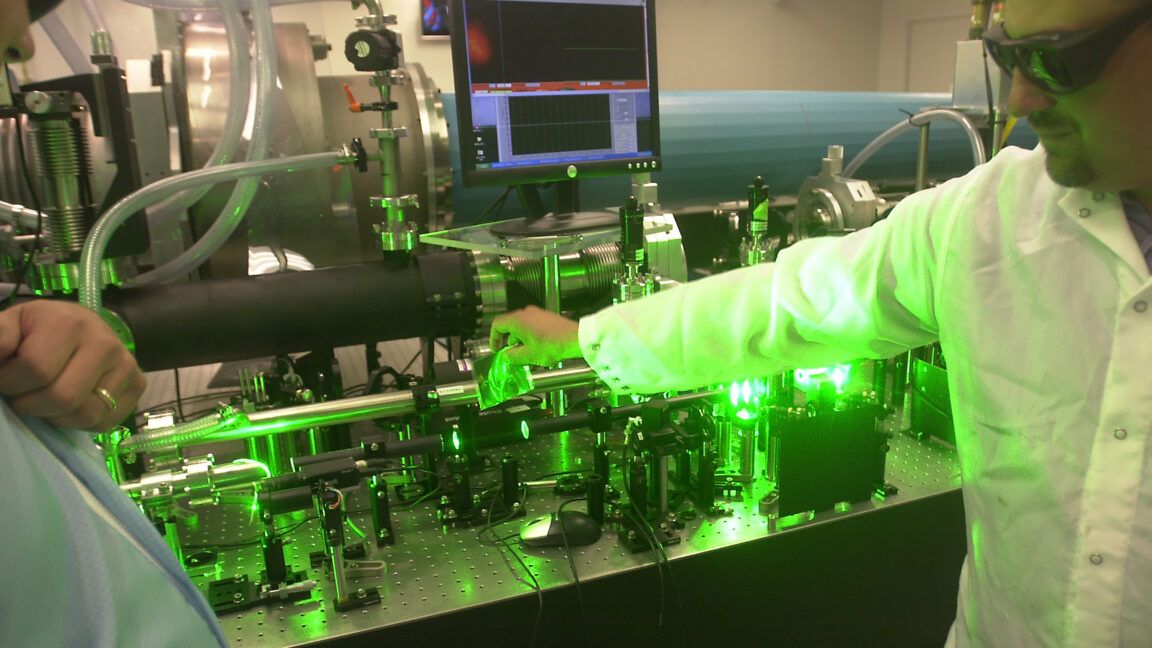
Recent operational insights from high-energy laser facilities reveal the grueling industrial cadence required to simulate stellar interiors. These systems, utilizing massive laser arrays to compress fuel pellets, represent the frontier of inertial confinement fusion (ICF). Unlike traditional power generation, the ‘shot day’ is a logistical exercise in extreme precision, involving nanosecond-scale synchronization and high-vacuum engineering.
Technical Specifications and Constraints
These facilities operate on the edge of material science. The lasers utilize glass-based amplification chains, requiring massive capacitor banks and complex beam-steering optics to ensure uniform compression. Technical hurdles remain centered on ’target gain’—the ratio of fusion energy produced to laser energy delivered—and the repetition rate of the systems, which currently lag behind the requirements for a continuous commercial power plant.
Business Risks and Strategic Outlook
- Capital Intensity: The cost of maintaining and upgrading these facilities is prohibitive, relying heavily on government-backed research grants.
- Scalability: The transition from experimental physics to commercial energy production faces a significant ‘valley of death’ in engineering, specifically regarding heat extraction and target mass production.
- Geopolitical Utility: Beyond energy, the data derived from these shots is dual-use, offering insights into nuclear weapon physics without the need for underground testing, making these facilities strategic assets for nuclear-armed states.
Strategic Insights
While the scientific community focuses on the breakthrough physics of fusion, the real ‘Tech Intelligence’ lies in the facility’s scalability. The transition from a single, manual ‘shot day’ to an automated, high-frequency industrial cycle is the primary barrier to commercialization. Investors should view these laser arrays not just as energy projects, but as high-fidelity simulation engines for materials science and national defense.