Executive Summary
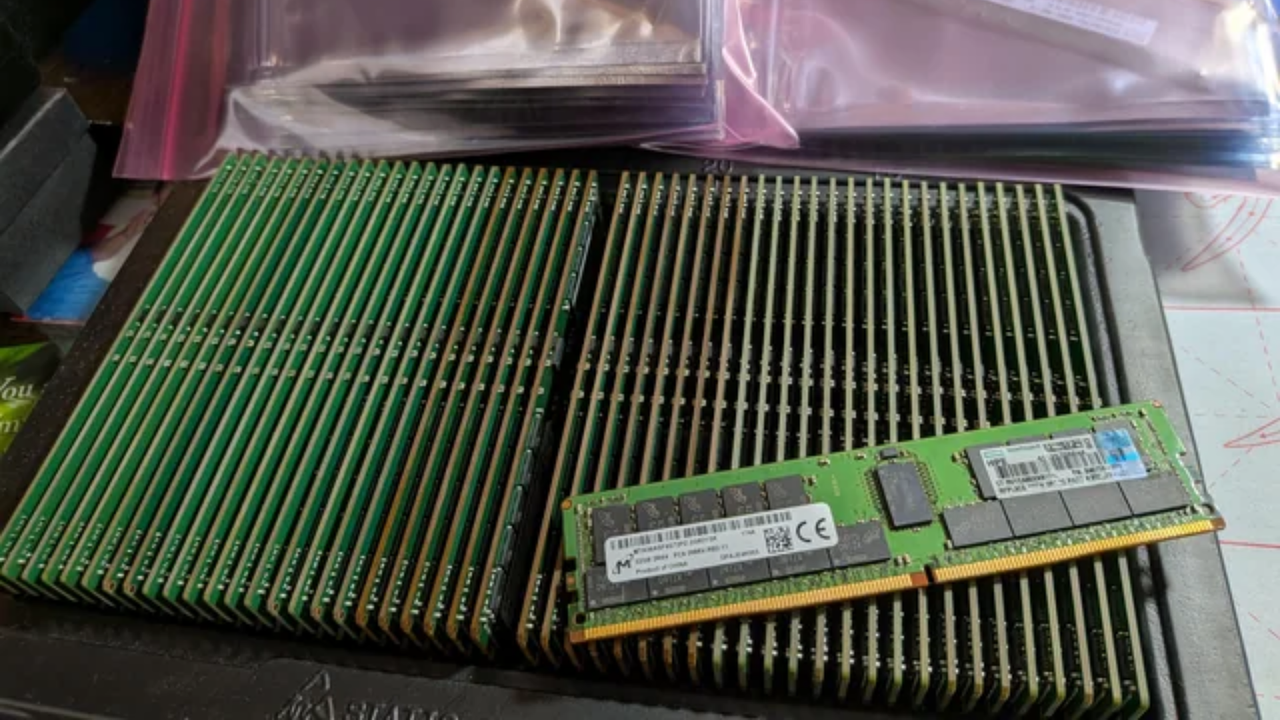
- 72 high-capacity enterprise-grade DDR4-2666 ECC RDIMMs were recovered from corporate disposal.
- The hardware, originally valued at approximately $20,000, highlights inefficiencies in enterprise IT asset disposition (ITAD).
- The incident underscores the persistent market value of legacy server-grade memory despite the shift toward DDR5.
Strategic Deep-Dive
The Incident Overview
A recent discovery involving 72 HPE 32GB DDR4-2666 ECC Registered DIMMs (RDIMMs) highlights a significant lapse in corporate IT asset management. The modules, destined for the dumpster following a server infrastructure refresh, represent a recovered value of approximately $20,000.
Technical Specifications
The recovered hardware consists of server-grade ECC (Error Correction Code) memory. Key specs include:
- Capacity: 32GB per module (Total: 2.3TB of RAM).
- Type: DDR4-2666 RDIMM.
- Application: Enterprise-grade server environments requiring high reliability and data integrity.
Business Risks and ITAD Failures
The disposal of high-value, functional hardware points to systemic failures in IT Asset Disposition (ITAD) protocols. From a business risk perspective, this event raises two critical concerns:
- Financial Leakage: Failure to audit decommissioned hardware results in direct capital loss and missed opportunities for internal redeployment or secondary market recovery.
- Data Security Vulnerabilities: While RAM is volatile, the lack of oversight in the disposal chain often correlates with lax procedures for storage media (SSDs/HDDs), potentially leading to significant data breaches.
Future Outlook
As the industry transitions to DDR5, the secondary market for DDR4 will remain robust for small-to-medium enterprise (SME) environments and home-lab enthusiasts who prioritize cost-efficiency over peak performance. Organizations must move toward automated asset tracking and formalized liquidation channels to capture residual value and ensure environmental compliance.
Strategic Insights
This salvage operation serves as a cautionary tale for enterprise IT departments. The ‘dumpster-bound’ status of $20,000 in functional memory suggests that many firms treat high-value assets as disposable waste due to the administrative burden of liquidation. Companies should implement mandatory ‘Asset Recovery Audits’ before any decommissioning phase to prevent similar capital hemorrhaging.