Executive Summary
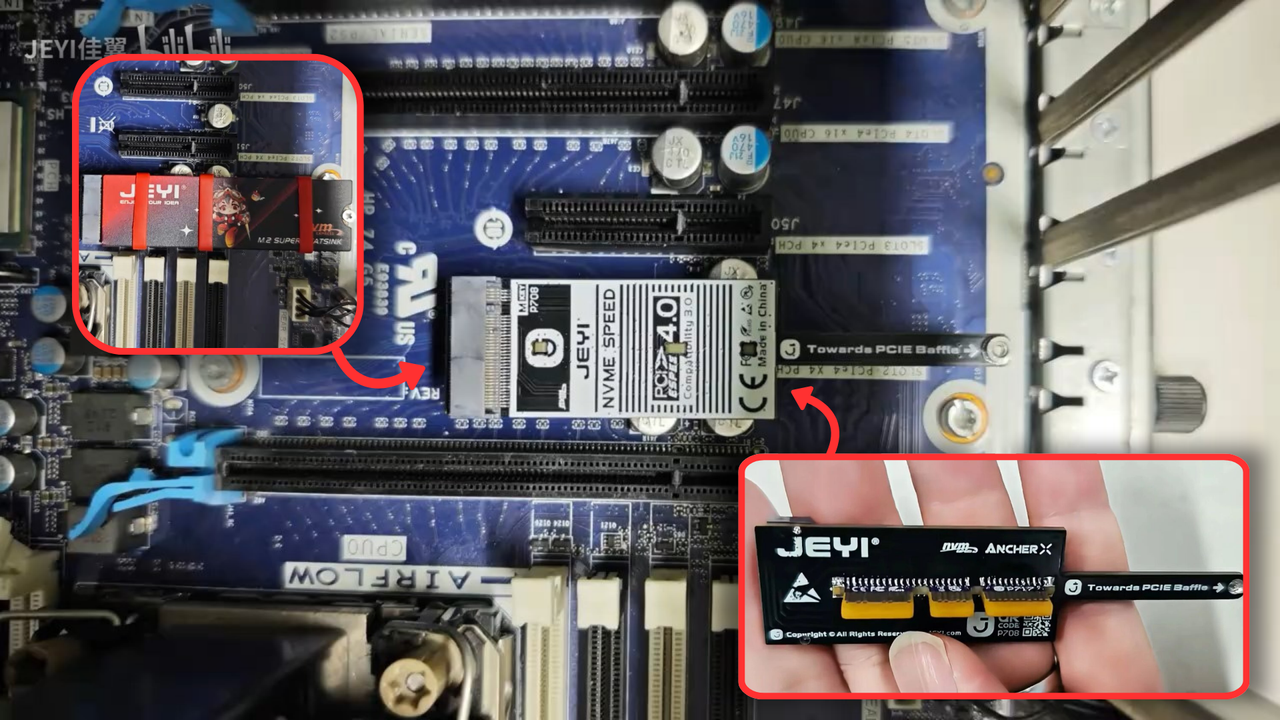
- JEYI launches ‘ArcherX’, a flush-mount PCIe to M.2 adapter designed to circumvent physical obstruction by high-TDP GPUs.
- The adapter maintains PCIe 4.0 data throughput, ensuring high-speed storage access in constrained motherboard layouts.
- The design effectively repurposes blocked PCIe slots, increasing functional storage density for enthusiast and workstation builds.
Strategic Deep-Dive
Technical Overview
The JEYI ArcherX represents a mechanical optimization in motherboard component management. By reorienting the M.2 interface to sit flush with the PCB, the adapter negates the vertical clearance issues typically caused by oversized triple-slot GPU heatsinks.
Key Specifications:
- Interface: PCIe to M.2 NVMe
- Throughput: PCIe 4.0 (backward compatible with PCIe 3.0)
- Form Factor: Low-profile, flush-mount
- Target Use: Slot reclamation for secondary storage in high-density builds
The ‘Why’ and ‘So What’
As modern GPUs continue to expand in physical volume, the ‘dead zone’ created beneath the primary PCIe x16 slot has rendered adjacent slots unusable. The ArcherX addresses this structural bottleneck. The ‘So What’ is a significant increase in storage utility for users operating within ITX or micro-ATX constraints, or those utilizing high-end air-cooled GPUs that would otherwise obstruct standard adapter cards.
Business Risks
- Thermal Management: Placing an M.2 drive directly beneath a heat-dissipating GPU poses potential thermal throttling risks. Without active cooling or sufficient airflow, sustained high-speed operations may degrade drive performance.
- Signal Integrity: The non-standard routing required for a flush-mount design introduces potential electrical noise risks compared to traditional vertical riser cards.
- Market Niche: While functional, the addressable market is limited to power users who have exhausted onboard M.2 slots, potentially limiting mass-market scalability.
Strategic Insights
The ArcherX is a quintessential example of ‘physical layer’ innovation. As motherboard manufacturers struggle to balance increasing GPU thickness with I/O requirements, third-party component designers like JEYI are filling the gap through mechanical ingenuity. Future iterations will likely need to integrate passive heatsink solutions to mitigate the thermal proximity to modern, high-TDP GPUs.