Executive Summary
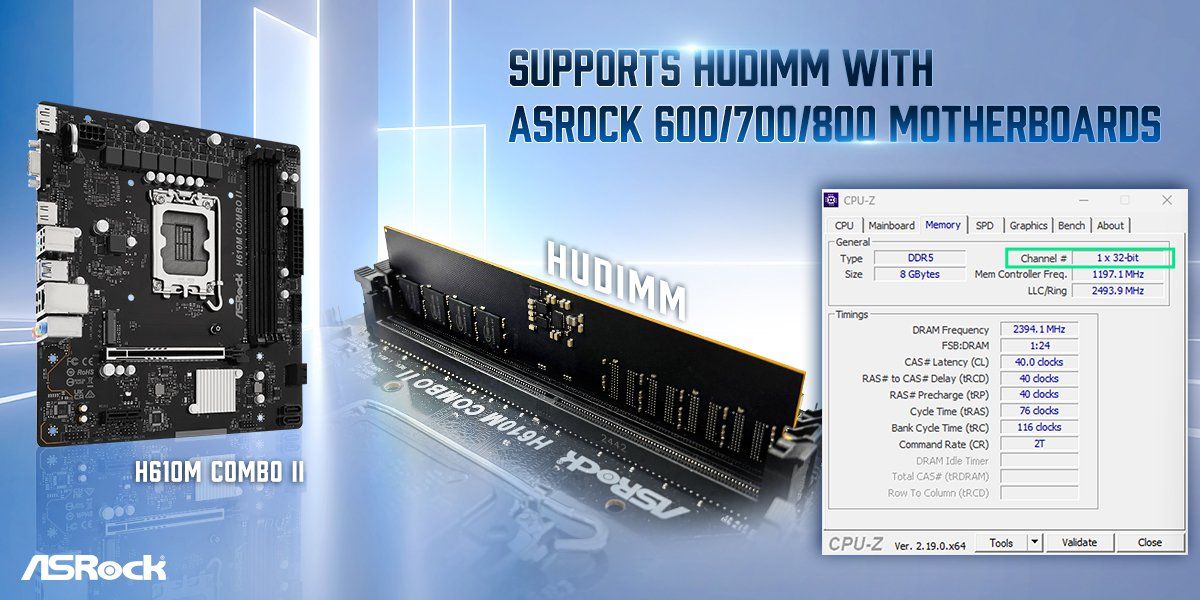
- ASRock launches HUDIMM, a cost-optimized memory standard utilizing a 32-bit channel architecture.
- The design reduces IC count by halving capacity and bandwidth requirements, targeting lower-cost segments.
- Initial deployment involves TeamGroup modules with compatibility across select LGA 1700 ASRock motherboards.
Strategic Deep-Dive
Technical Specification Overview
The HUDIMM (Half-Unbuffered Dual In-line Memory Module) standard marks a departure from the traditional JEDEC-compliant DDR5 architecture. Standard DDR5 utilizes a dual 32-bit subchannel configuration to achieve a 64-bit wide bus. In contrast, HUDIMM utilizes a single 32-bit channel.
By reducing the width of the data bus, manufacturers can populate modules with fewer integrated circuits (ICs), effectively halving both the total memory capacity and the theoretical bandwidth per stick.
The ‘Why’: Cost Optimization Amid Supply Constraints
The primary driver for HUDIMM is the high bill-of-materials (BOM) cost associated with standard DDR5 modules. During periods of semiconductor scarcity or elevated memory pricing, the cost of populating a full 64-bit bus with numerous ICs creates a barrier to entry for budget-conscious consumers. HUDIMM serves as a ’lite’ version, allowing system builders to populate memory slots without the premium cost of high-density, high-bandwidth modules.
Compatibility and Market Integration
ASRock has engineered its LGA 1700 motherboard lineup to support HUDIMM, ensuring that these modules can function alongside standard DDR5 sticks in mixed-configuration setups. This flexibility is critical for adoption, as it allows users to integrate HUDIMM into existing ecosystems without requiring a total system overhaul.
Business Risks and Future Outlook
While HUDIMM addresses immediate pricing pressures, it introduces significant fragmentation into the consumer memory market.
- Performance Degradation: Users sacrificing bandwidth may face bottlenecks in memory-intensive professional workloads.
- Inventory Complexity: Retailers and OEMs now face the challenge of managing dual-tier memory standards, which may complicate SKU management.
- Long-term Viability: The success of HUDIMM hinges on whether the price delta between HUDIMM and entry-level standard DDR5 is substantial enough to justify the performance trade-off.
Strategic Insights
HUDIMM represents a tactical defensive maneuver by motherboard OEMs to maintain volume in the budget segment despite the inherent cost floor of DDR5. By commoditizing ‘good enough’ memory, ASRock is effectively offloading the burden of rising DRAM costs onto the user’s performance headroom. If adopted widely, this could signal a shift toward bifurcated memory standards where performance and cost-per-gigabyte are increasingly decoupled in the consumer channel.