Executive Summary
- Linux maintainers propose the removal of obsolete ISA and PCMCIA Ethernet drivers to mitigate the “maintenance burden” caused by automated AI fuzzing and low-quality bug reports targeting unused legacy code.
Strategic Deep-Dive
The Linux kernel, the backbone of modern computing infrastructure, is currently grappling with an unforeseen consequence of the AI revolution: a paralyzing influx of automated, AI-generated bug reports. As AI-driven “fuzzing”—the process of flooding software with random data to trigger crashes—becomes more accessible, maintainers of the mainline kernel are seeing a surge in theoretical vulnerability reports. The problem?
A vast majority of these reports target ancient hardware drivers that have not seen active use in decades, creating a massive triage bottleneck for human developers.
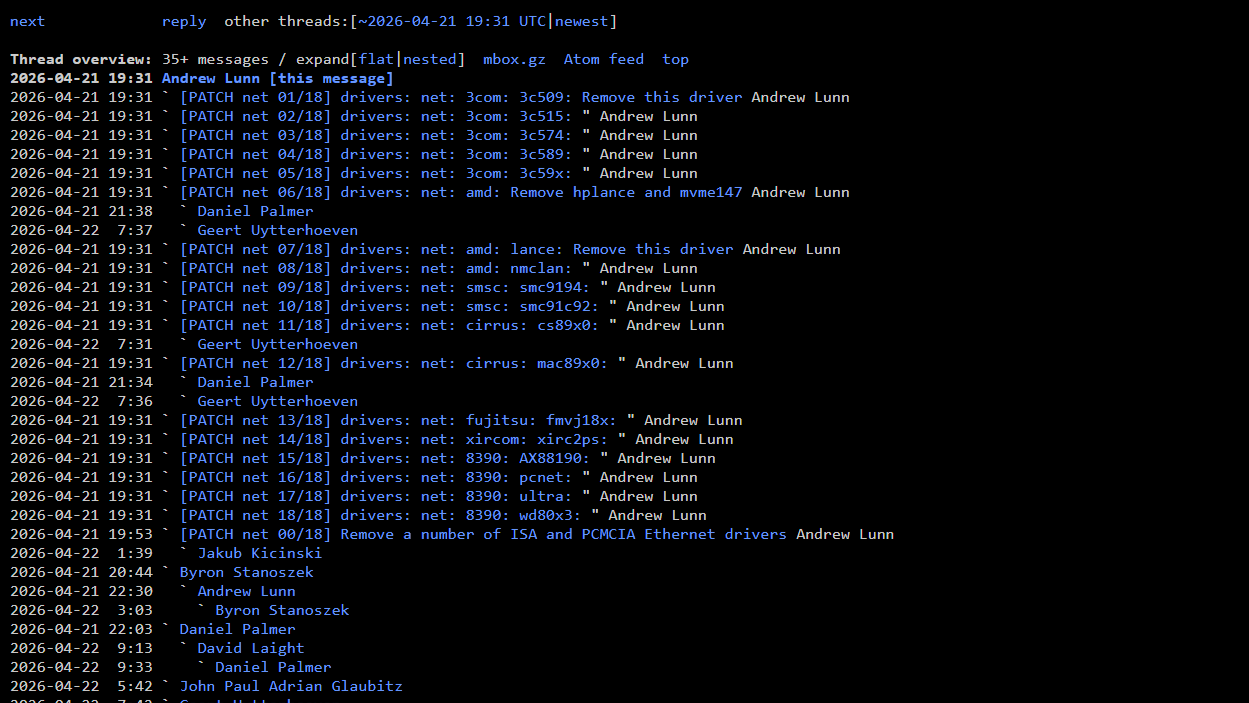
At the center of this storm is a proposal to remove approximately 27,000 lines of legacy code associated with Industry Standard Architecture (ISA) and PCMCIA-era Ethernet drivers. These standards, dominant in the 1980s and early 1990s, present significant technical debt in a 2026 kernel environment. From a technical standpoint, ISA drivers are notoriously difficult to maintain due to their reliance on manual I/O port mapping and lack of modern Plug-and-Play capabilities.
In a modern 64-bit kernel with advanced memory management and strict security protocols, these 16-bit era constraints require constant, complex refactoring just to keep the kernel bootable.
The rise of AI-generated noise has turned this technical debt into a strategic liability. When an AI tool like Syzkaller flags a potential memory corruption in a 30-year-old NE2000 Ethernet driver, a maintainer must spend valuable hours investigating it. However, because the hardware is obsolete, most developers lack the physical boards to verify if the bug is even reproducible in the real world.
This results in “maintainer-hours” being wasted on code that serves zero percent of the current user base.
The decision to cut these 27,000 lines signals a fundamental shift in the Linux philosophy. For years, the kernel community took pride in its “support everything” mantra. However, we are entering an era of “maintenance pragmatism.” The community is realizing that maintaining “bit-rotted” code is no longer sustainable when AI can generate a million theoretical edge cases in seconds.
By retiring these drivers, the Linux community is prioritizing the stability and security of modern systems over the nostalgia of legacy compatibility. This move is a necessary evolution to ensure that human expertise remains focused on the critical path of kernel development rather than being drowned out by machine-generated noise.