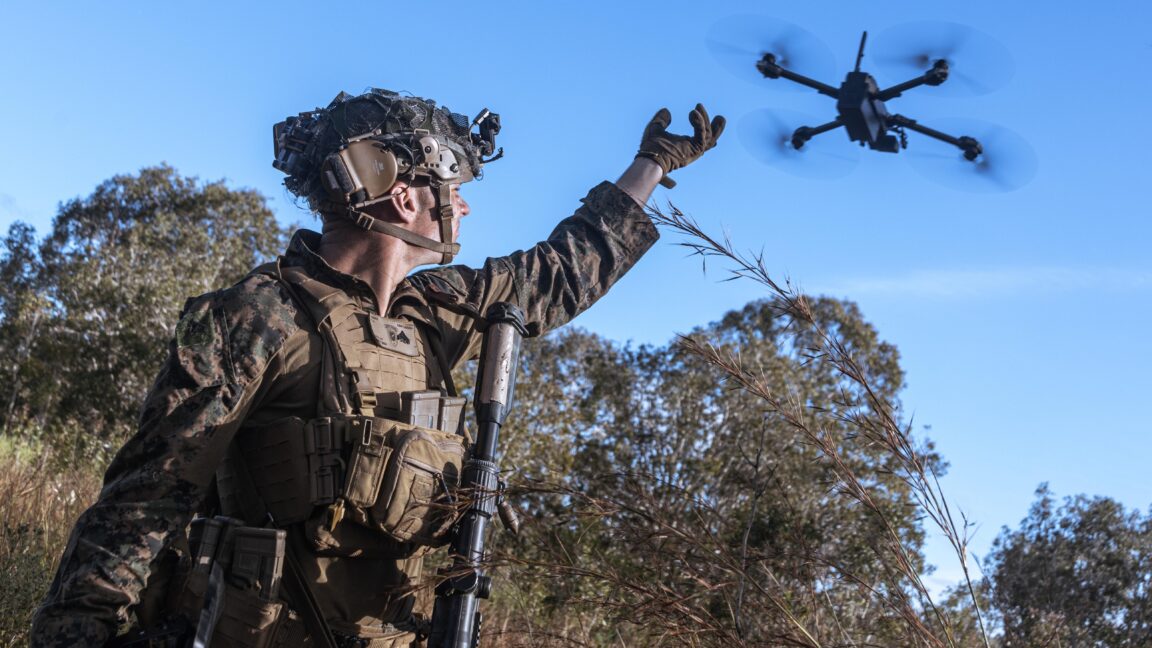
Executive Summary
- The U.S. Pentagon has requested a staggering $54 billion for the procurement and development of autonomous drone systems, a figure that rivals the entire annual military expenditure of Ukraine. This strategic pivot highlights a fundamental shift in American defense doctrine toward mass-produced, low-cost autonomous platforms intended to overwhelm adversaries through sheer volume. By prioritizing “attrittable” technology over traditional, multi-billion-dollar manned platforms, the military seeks to maintain technological hegemony in an era of increasingly sophisticated electronic and autonomous warfare.
Strategic Deep-Dive
The United States Department of Defense (DoD) has signaled a tectonic shift in its long-term strategic planning with a massive $54 billion budget request dedicated exclusively to drone technology and autonomous systems. To contextualize the scale of this investment, the figure is not only comparable to the total military budget of Ukraine amidst its ongoing conflict but also exceeds the combined defense spending of mid-power nations like Israel, Canada, and Australia. This is not merely an incremental budgetary adjustment; it is a formal declaration that the era of “exquisite” warfare—characterized by a small number of extremely expensive, manned assets—is being superseded by an era of “intelligent mass.”
The heart of this investment lies in the “Replicator” initiative, a program designed to field thousands of autonomous systems across multiple domains within a truncated timeframe. The Pentagon’s leadership has recognized that traditional procurement cycles, which often span decades for a single fighter jet or aircraft carrier, are insufficient for the pace of modern technological evolution. By leaning into AI-driven, attrittable systems—drones that are cheap enough to be lost in combat without catastrophic financial or strategic consequences—the U.S.
aims to create a “dilemma of mass” for potential adversaries. These drones are intended to operate in swarms, utilizing decentralized AI “brains” to coordinate attacks, conduct surveillance, and provide logistical support even in GPS-denied environments.
Technical development within this $54 billion framework will focus on a “software-defined” defense architecture. Significant funding is earmarked for the integration of Large Language Models (LLMs) and computer vision into edge computing modules, allowing drones to identify and prioritize targets with minimal human latency. This move towards autonomous lethality, however, brings profound ethical and geopolitical implications.
Critics argue that such vast spending on autonomous systems could trigger a global “algorithms race,” where the speed of AI decision-making outpaces human oversight, potentially lowering the threshold for armed conflict.
Furthermore, this investment serves as a catalyst for the domestic industrial base. The Pentagon is moving away from its reliance on the “Big Five” defense contractors, instead opening the floodgates for Silicon Valley startups and specialized software firms. This diversification aims to foster a more agile innovation ecosystem, where code updates can be deployed to the front lines as quickly as hardware.
As the world watches this $54 billion deployment, it is clear that the U.S. is betting its future military supremacy on the synergy of mass production and machine intelligence.