Executive Summary
- The Snapdragon X2 Elite signifies Qualcomm’s definitive pivot toward fully custom silicon, leveraging the second iteration of its Oryon CPU architecture. Targeted for 2026 flagship laptops, the SoC aims to dominate the Windows on ARM ecosystem by prioritizing massive IPC (Instructions Per Clock) improvements and leveraging TSMC’s advanced 3nm node. This analysis explores how the X2 Elite addresses historical bottlenecks in branch prediction and thermal management to compete with x86 and Apple silicon.
Strategic Deep-Dive
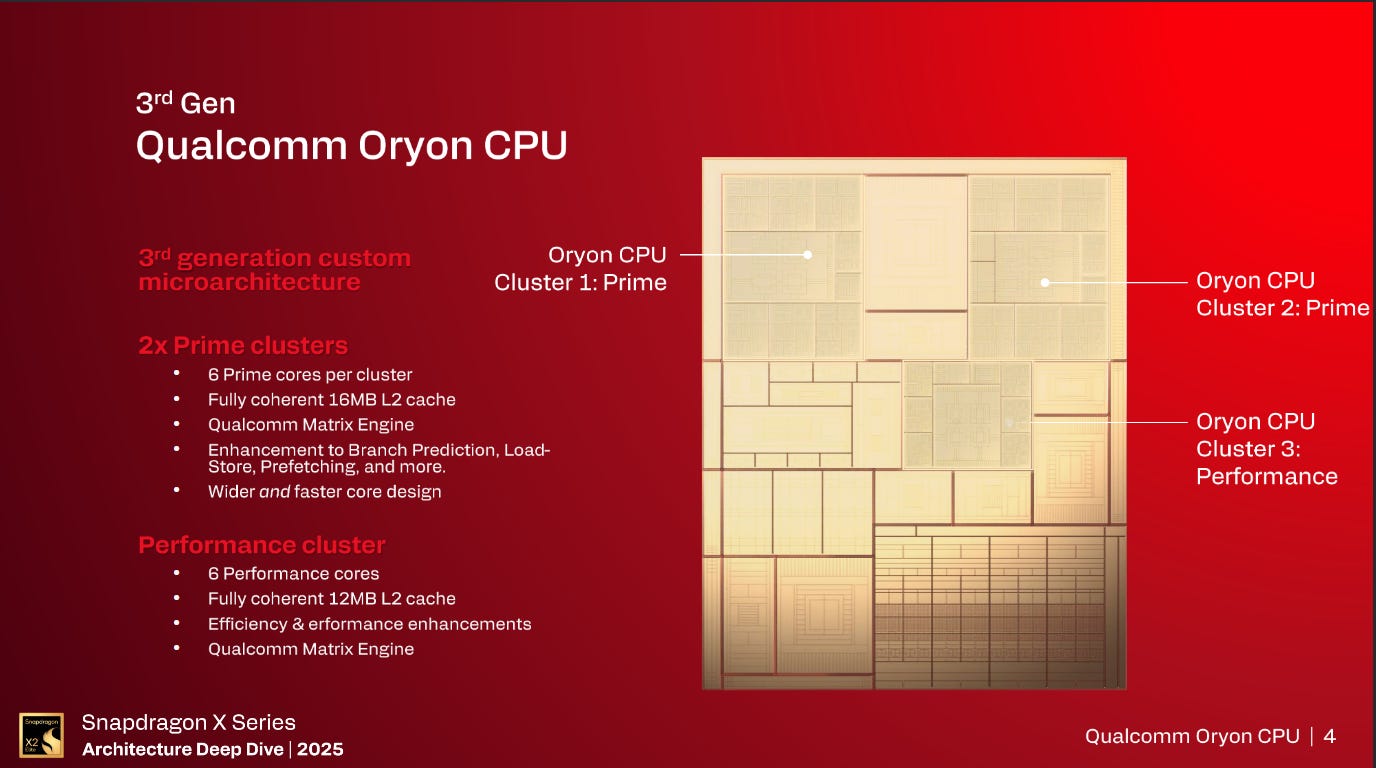
The Snapdragon X2 Elite is the cornerstone of Qualcomm’s strategy to achieve performance parity with Apple’s M-series and Intel’s top-tier mobile offerings. At its core, the second-generation Oryon CPU represents a significant departure from standard ARM Neoverse or Cortex blueprints. As a systems analyst, it is critical to look at the architectural widening of the execution pipeline.
Qualcomm has expanded the decode width and re-engineered the out-of-order (OoO) execution window, allowing the X2 Elite to handle more instructions in flight than the original X Elite. This expansion is supported by a sophisticated branch prediction unit that utilizes advanced machine learning algorithms to minimize pipeline stalls, a necessity for the complex branch-heavy workloads typical of modern Windows applications.
A primary technical challenge for high-end ARM laptops has always been maintaining peak performance under sustained thermal load. The X2 Elite utilizes TSMC’s 3nm lithography, likely the N3E or N3P variant, which offers a 15-20% reduction in power consumption at the same performance levels compared to 5nm-class nodes. This transition is not merely about density; it is about managing the thermal design power (TDP).
By refining the voltage regulation modules (VRMs) on-die, Qualcomm has mitigated the “hot spot” issues that plague monolithic mobile chips. Furthermore, the 3nm transition allows for a larger L3 and system-level cache (SLC), which is crucial for reducing the latency penalties associated with the Windows scheduler’s memory-intensive nature.
The integration of the Adreno GPU and Hexagon NPU into a unified silicon fabric has also been optimized. For 2026, the NPU is expected to deliver a massive leap in INT8 and FP16 operations per second, targeting the 70+ TOPS range. This is achieved by increasing the vector unit count and enhancing the local SRAM within the NPU to ensure high data reuse, which is vital for Large Language Models (LLMs) running locally.
The memory controller has also seen an upgrade to support LPDDR5X-9600, providing the high-bandwidth backbone required by both the heavy GPU rendering and the NPU’s weight-streaming demands. By addressing the branch prediction accuracy and the memory latency floor, Qualcomm is positioning the X2 Elite as a platform where the distinction between native and emulated code becomes nearly invisible to the end user, marking the maturity of Windows on ARM.