Executive Summary
- The release of the AMD Ryzen 9 9950X3D2 “Dual Edition” at $899 is a bold declaration of intent in the ultra-high-end silicon market, positioning AMD not just as an alternative to Intel, but as the definitive architect of enthusiast performance. This chip represents the pinnacle of “X3D” technology, utilizing 3D V-Cache to vertically stack L3 memory directly onto the core complex dies (CCDs). By doing so, AMD effectively bypasses the agonizing latency penalties inherent in fetching data from traditional system RAM. For specialized workloads—namely high-refresh-rate gaming and complex logistical…
Strategic Deep-Dive
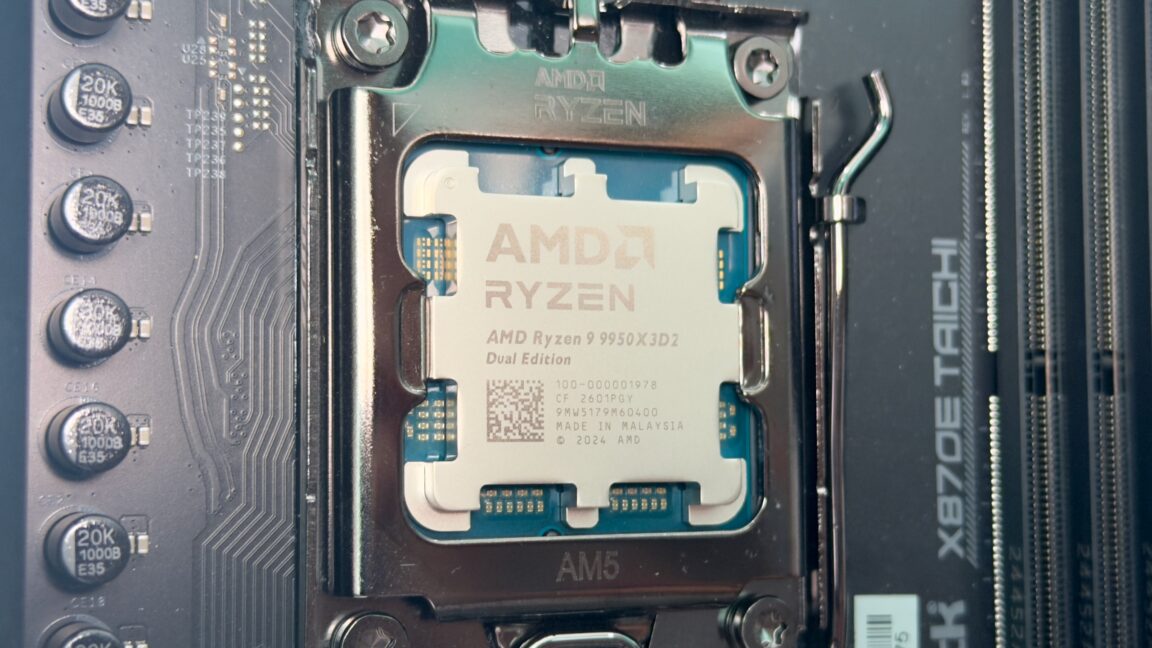
The release of the AMD Ryzen 9 9950X3D2 “Dual Edition” at $899 is a bold declaration of intent in the ultra-high-end silicon market, positioning AMD not just as an alternative to Intel, but as the definitive architect of enthusiast performance. This chip represents the pinnacle of “X3D” technology, utilizing 3D V-Cache to vertically stack L3 memory directly onto the core complex dies (CCDs). By doing so, AMD effectively bypasses the agonizing latency penalties inherent in fetching data from traditional system RAM.
For specialized workloads—namely high-refresh-rate gaming and complex logistical simulations—this massive cache reservoir acts as a “speed-of-light” buffer, ensuring that the CPU’s processing cores are never starved for instructions.
However, the “Dual Edition” moniker and the staggering $899 price tag warrant a critical investigation into the law of diminishing returns. The architecture is a masterclass in compromise; stacking silicon creates a thermal insulator, essentially trapping heat within the high-performance cores. To manage this, AMD has likely implemented a split-topology design where one CCD is laden with the 3D V-Cache for latency-sensitive tasks, while the other is optimized for raw frequency and throughput.
This creates a scheduling nightmare for the operating system. If the OS scheduler incorrectly assigns a thread—placing a gaming process on the high-frequency/low-cache core or a rendering task on the high-cache/low-frequency core—the performance “premium” for which the user paid $899 evaporates instantly.
When compared to Intel’s current strategy, which focuses on heterogeneous “Performance” and “Efficiency” cores, AMD’s approach is far more niche. While Intel seeks to optimize for the background tasks of a modern PC user, AMD is chasing a “halo” effect for the top 1% of users. The source context notes that while there are practical benefits, they are limited for the average professional.
For video editing or compile-heavy tasks, raw clock speed and instruction-per-clock (IPC) gains often outweigh the benefits of an oversized L3 cache. We are witnessing a phase where adding more of a single component—in this case, cache—is yielding smaller and smaller gains in overall system utility. For the average enthusiast, this chip might be more of a status symbol than a logical upgrade, as the performance delta over a standard 9950X often fails to justify the 40% price premium.
AMD is testing the limits of how much users will pay for specific, rather than general, performance dominance.