Executive Summary
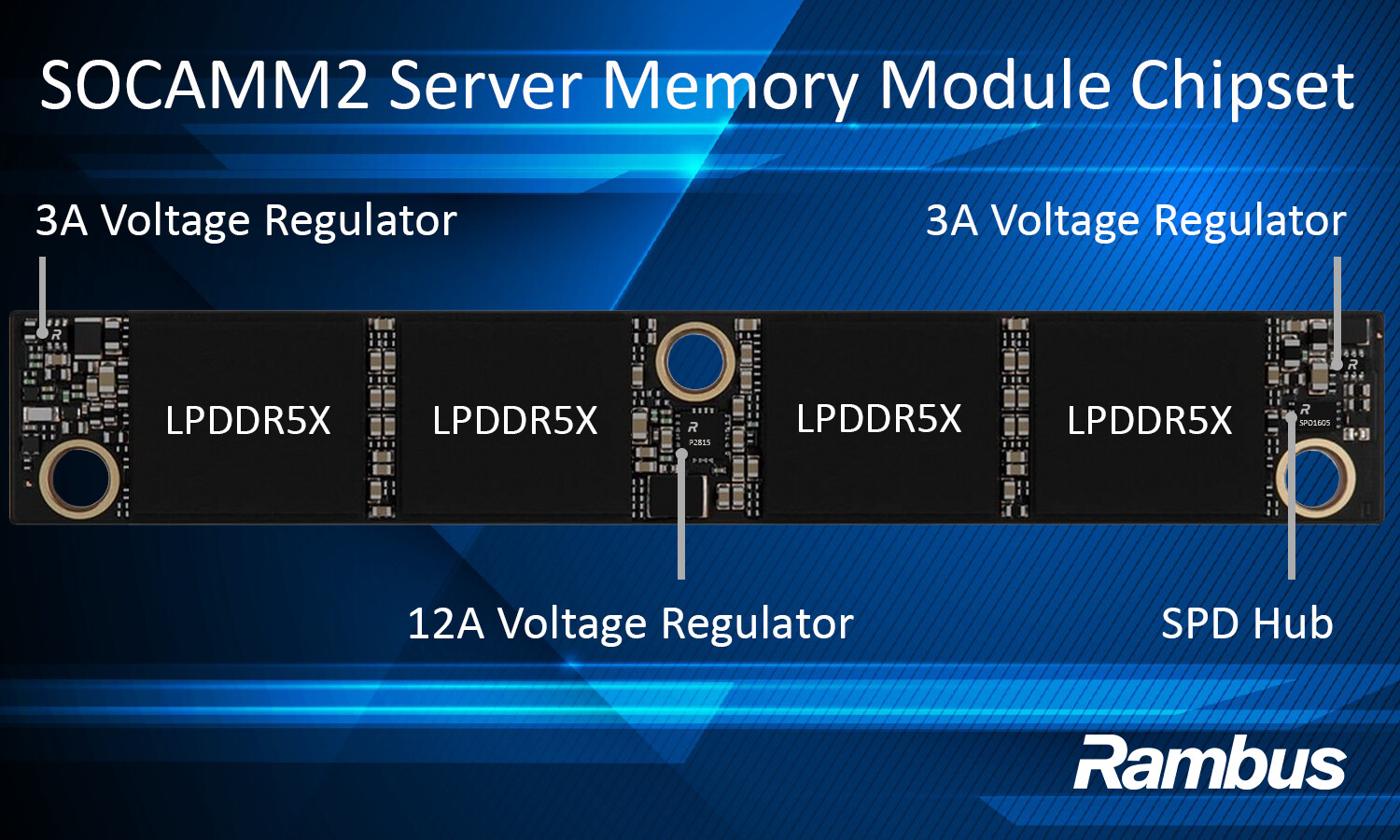
- Rambus has introduced the SOCAMM2 chipset, a dedicated interface designed to integrate LPDDR5X memory into high-performance AI server environments.
- Utilizing “Compression Attached” technology, the chipset overcomes the limitations of traditional SODIMMs, offering superior bandwidth and signal integrity.
- The launch is aimed at reducing Total Cost of Ownership (TCO) for data centers by significantly lowering power-per-bit consumption in AI workloads.
Strategic Deep-Dive
Rambus Inc. (NASDAQ: RMBS), a pioneer in high-speed silicon IP, has taken a significant step toward redefining data center architecture with the announcement of its SOCAMM2 (Small Outline Compression Attached Memory Module) chipset. This specialized chipset is engineered to facilitate the transition of LPDDR5X memory into the enterprise server market, specifically targeting the soaring demands of AI inference and training platforms.
By bridging the gap between low-power mobile memory standards and high-performance server requirements, Rambus is addressing one of the most persistent challenges in modern hardware: the energy-bandwidth bottleneck.
The core innovation of the SOCAMM2 lies in its adoption of the “Compression Attached” standard. Unlike traditional DIMM (Dual In-line Memory Module) or SODIMM slots that rely on long connector pins, CAMM modules use a pressure-based contact system that significantly reduces the physical distance signals must travel. This mechanical improvement leads to superior signal integrity and lower parasitic capacitance, allowing LPDDR5X memory to hit its peak theoretical speeds without the thermal and electrical penalties associated with older form factors.
For AI server manufacturers, this means they can now deploy LPDDR5X—which was once restricted to soldered-down smartphone boards—in a modular, upgradable format that provides much-needed flexibility in high-density rack environments.
From a Senior Analyst’s perspective, the primary driver for SOCAMM2 is the Total Cost of Ownership (TCO). Modern AI data centers are grappling with immense cooling costs and power constraints. Traditional DDR5 memory modules, while capable, often consume a disproportionate amount of power at the edge of the memory bus.
LPDDR5X offers a massive reduction in power-per-bit, which, when scaled across thousands of servers, results in multi-million dollar savings in energy bills. Rambus’s SOCAMM2 provides the silicon foundation necessary to manage the complex signaling of LPDDR5X, ensuring that server-grade reliability is maintained even as power consumption is slashed.
This launch is just the first entry in a broader Rambus roadmap. The company intends to lead the industry away from the limitations of the decades-old DIMM standard toward more compact, thermally efficient memory subsystems. As AI models continue to grow in size, the ability to pack more high-bandwidth memory into smaller footprints will become a key competitive advantage.
By enabling LPDDR5X for the server room, Rambus is not just launching a chip; it is establishing a new paradigm for how AI hardware is built, serviced, and scaled. This chipset represents a “green” revolution for the high-performance computing (HPC) sector, promising to make data movement faster, safer, and significantly more efficient.