Executive Summary
- Framework is integrating the royalty-free Oculink port into its Framework Laptop 16, offering a 64Gbps high-bandwidth alternative to proprietary standards for connecting eGPUs and high-speed NVMe drives.
Strategic Deep-Dive
Framework has once again disrupted the hardware landscape by announcing the integration of the Oculink port into its Framework Laptop 16 ecosystem. Oculink (Optical-Copper Link) is a royalty-free high-speed interface that represents a significant departure from the consumer electronics industry’s heavy reliance on proprietary or licensing-heavy standards like Intel’s Thunderbolt. By supporting staggering data transfer speeds of up to 64Gbps, Oculink provides a direct, low-latency connection to the system’s PCIe lanes, making it an ideal solution for enthusiasts who demand desktop-class performance from a modular, portable chassis.
This move reinforces Framework’s status as a leader in the “Right to Repair” movement and hardware transparency.
Technically, Oculink’s primary advantage over Thunderbolt 4/5 lies in its protocol efficiency. While Thunderbolt encapsulates PCIe and DisplayPort data within a single protocol layer—introducing unavoidable overhead and latency—Oculink offers a more direct mapping to the PCIe bus. This results in significantly improved performance for external GPUs (eGPUs), where bandwidth bottlenecks are the traditional enemy of performance.
For the Framework Laptop 16, this means users can connect high-end desktop graphics cards, massive NVMe storage arrays, or specialized high-speed network cards (10GbE or higher) via an expansion card without the 15-20% performance penalty often associated with Thunderbolt-based eGPU enclosures.
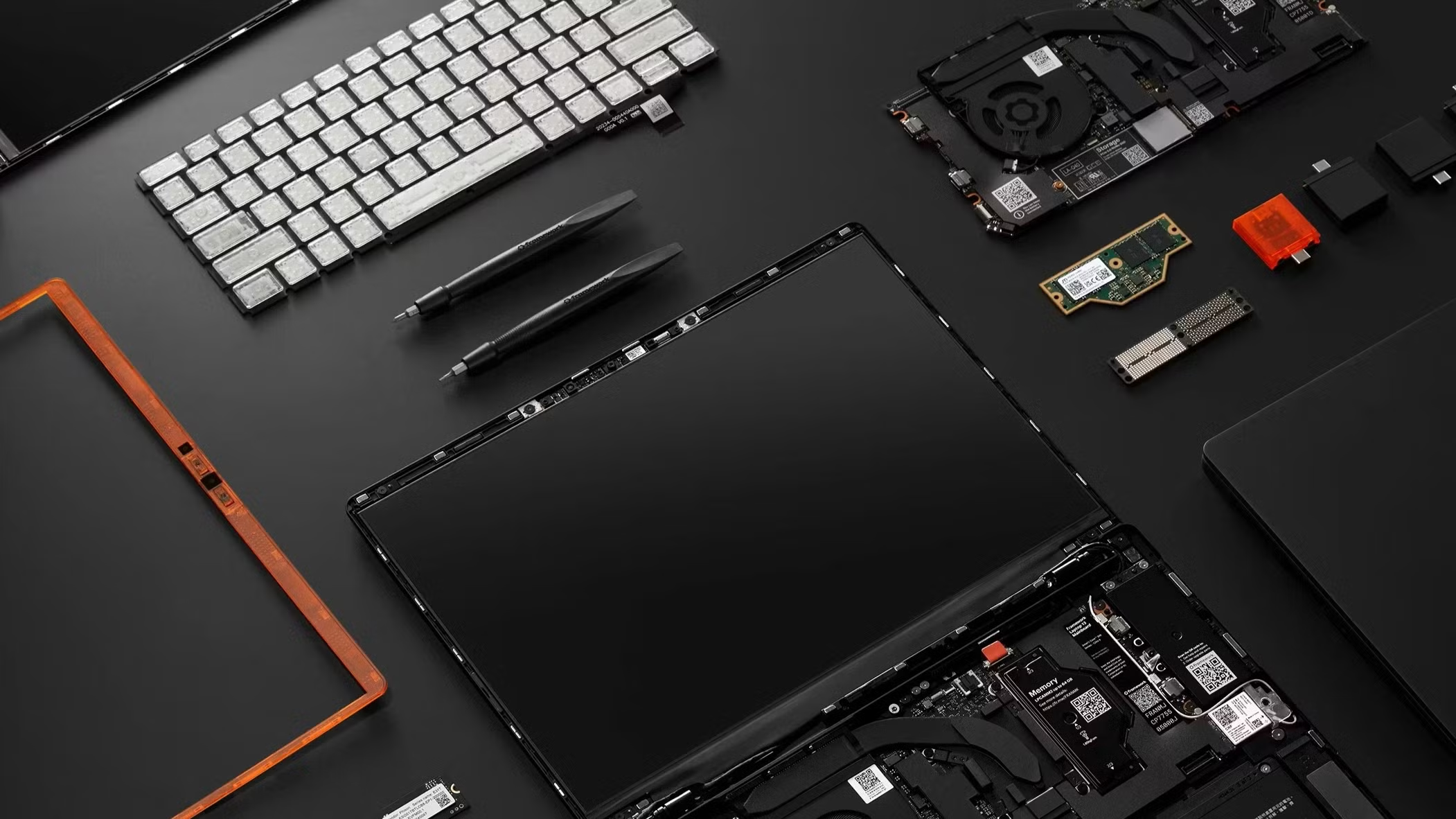
The adoption of Oculink aligns perfectly with Framework’s core philosophy of modularity and open standards. By choosing a royalty-free port, Framework avoids the “Intel tax,” potentially lowering the barrier to entry for high-speed peripherals while promoting a more competitive hardware ecosystem. This implementation is handled through a dedicated Expansion Bay Module, highlighting the Framework Laptop 16’s unique ability to swap out internal components as if they were simple peripherals.
It also addresses future-proofing; as external hardware advances, the Oculink interface ensures that the host machine remains compatible with the fastest NVMe drives and eGPUs on the market without requiring a total motherboard overhaul.
In the broader context of the PC industry, Framework’s pivot to Oculink could signal the end of Thunderbolt’s monopoly on high-speed external connectivity. While Thunderbolt remains popular due to its “one-cable” convenience for power and video, Oculink targets the pure performance enthusiast who prioritizes raw data throughput and minimal latency. As the Small Form Factor (SFF) and modular computing communities continue to grow, the demand for open, high-bandwidth interfaces like Oculink will only increase.
Framework is betting that its users will choose the raw power and modular freedom of an open standard over the proprietary convenience of the status quo.