Executive Summary
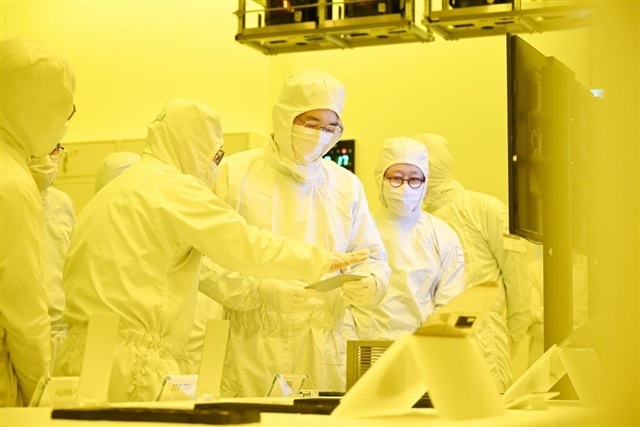
- Driven by AI-related data center demand, Samsung Electronics is resuming NAND expansion at its P5 facility, marking a decisive shift from production cuts to aggressive capacity building alongside rival SK Hynix.
Strategic Deep-Dive
The memory industry in April 2026 is witnessing a dramatic reversal of the “restraint strategy” that defined the previous two years. Samsung Electronics and SK Hynix, the world’s leading memory producers, are now accelerating their capacity expansion plans to meet a surge in NAND flash demand. This shift is primarily fueled by the massive infrastructure requirements of generative AI and the continuous expansion of hyperscale data centers.
High-capacity, high-performance NAND is increasingly critical for AI training and inference tasks that require rapid data access and persistent storage.
Historically, the industry suffered from a massive oversupply in late 2024, leading to historic production cuts and CapEx discipline. However, by mid-2026, the scarcity of high-density enterprise SSDs (eSSDs) has pushed prices up, creating a highly profitable environment for expansion. Samsung, in particular, is refocusing its efforts on its P5 facility in Pyeongtaek.
This facility, which saw construction pauses during the downturn, is now being fast-tracked to become a hub for next-generation NAND production.
The technical focus of this expansion is the transition to 300-layer and even 400-layer 3D NAND. As AI models grow in complexity, the “data gravity” of these models requires storage solutions that can handle massive throughput without becoming a bottleneck. Samsung’s move to accelerate P5 involves not just adding floor space but installing advanced manufacturing equipment capable of high-aspect-ratio etching, a critical requirement for high-layer counts.
SK Hynix is mirroring this acceleration, ensuring it does not lose market share in the high-stakes AI storage market. Both companies are shifting from a “survival mode” to an “aggressive expansion mode.” The resumption of investment at P5 signals Samsung’s confidence that the current AI-driven demand is structural rather than cyclical. This expansion is essential to supporting the “hardware super-cycle,” where the interplay between HBM for compute and high-speed NAND for storage forms the backbone of the AI era.
As these facilities come online in late 2026, the global supply of 232-layer and 300+ layer NAND will rise significantly, potentially stabilizing prices while cementing the dominance of the South Korean giants in the data center value chain.