Executive Summary
- SK Hynix has delivered an extraordinary Q1 2026 earnings report, with operating profits soaring fivefold compared to the previous year. Despite the headwinds of a Middle East energy crisis that spiked operational costs, the company’s dominance in the HBM (High Bandwidth Memory) market and its strategic shift toward specialized AI hardware have propelled it to record-breaking financial heights.
Strategic Deep-Dive
The financial results of SK Hynix for the first quarter of 2026 represent a monumental achievement in the semiconductor sector. Reporting a profit jump that is fivefold higher than Q1 2025, the South Korean tech giant has effectively decoupled itself from the traditional memory cycle. This performance is particularly noteworthy given the macroeconomic environment: the persistent Middle East energy crisis has driven up electricity costs for fabrication plants and disrupted the supply of critical noble gases like neon and krypton, essential for lithography.
SK Hynix’s ability to achieve record margins in this context is a testament to its operational excellence and its focus on high-value-added products.
The “fivefold” surge is primarily driven by the insatiable appetite for AI-specific memory infrastructure. As we move into 2026, the global rollout of large-scale AI clusters requires not just more memory, but significantly faster memory. SK Hynix, having pioneered the HBM3E standard, is now reaping the rewards of its early transition to HBM4.
By utilizing advanced Through-Silicon Via (TSV) technology and maintaining superior yield rates compared to its rivals, SK Hynix has secured lucrative, long-term supply contracts with AI hardware leaders like NVIDIA and various hyperscalers. This HBM dominance has effectively shielded the company from the pricing volatility of the commodity DRAM market.
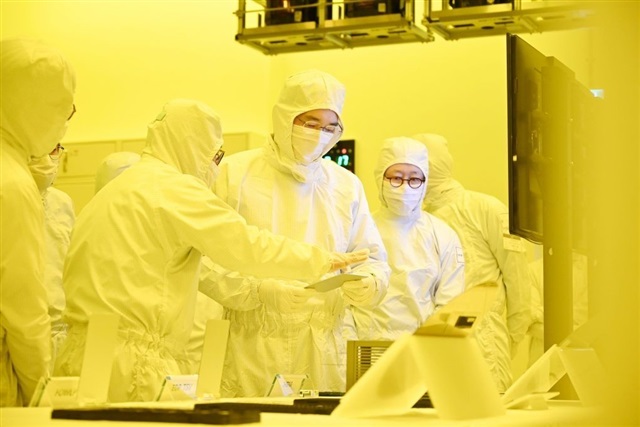
To mitigate the Middle East energy crisis, SK Hynix implemented a dual-track resilience strategy. First, the company accelerated the adoption of ultra-energy-efficient manufacturing processes at its M16 and M15X fabs, reducing the power consumption per wafer by an estimated 15%. Second, it aggressively diversified its raw material supply chain, reducing dependency on energy-vulnerable regions.
By securing multi-year energy pricing contracts and investing in on-site renewable power generation, SK Hynix neutralized the cost spikes that eroded the profits of many global manufacturers. This “resilience-first” approach has become a competitive moat in an era of geopolitical instability.
Looking ahead, the sustainability of this AI-driven boom is the central question for market analysts. While some fear a “chip peak,” the structural shift toward edge AI and autonomous systems suggests that the demand for specialized memory is still in its early stages. SK Hynix is already moving toward 2nm-compatible memory solutions and expanding its advanced packaging capabilities.
By positioning itself as an indispensable partner in the AI supply chain rather than a mere commodity vendor, SK Hynix has fundamentally changed its valuation profile. The Q1 2026 results prove that in the “intelligence era,” the strategic control of high-speed data flow is the ultimate source of corporate power.