Executive Summary
- In the history of computing hardware, few devices embody the “compromise” as clearly as the Solid State Hybrid Drive (SSHD). Introduced during a period when Solid State Drives (SSDs) were prohibitively expensive for mass storage and Hard Disk Drives (HDDs) were the primary bottleneck of every system, SSHDs promised a revolutionary middle ground. By combining a high-capacity spinning platter with a small sliver of flash memory, manufacturers like Seagate, through their “Adaptive Memory Technology,” sought to offer SSD-like speeds at HDD prices. However, looking back, the SSHD serves as a textbo…
Strategic Deep-Dive
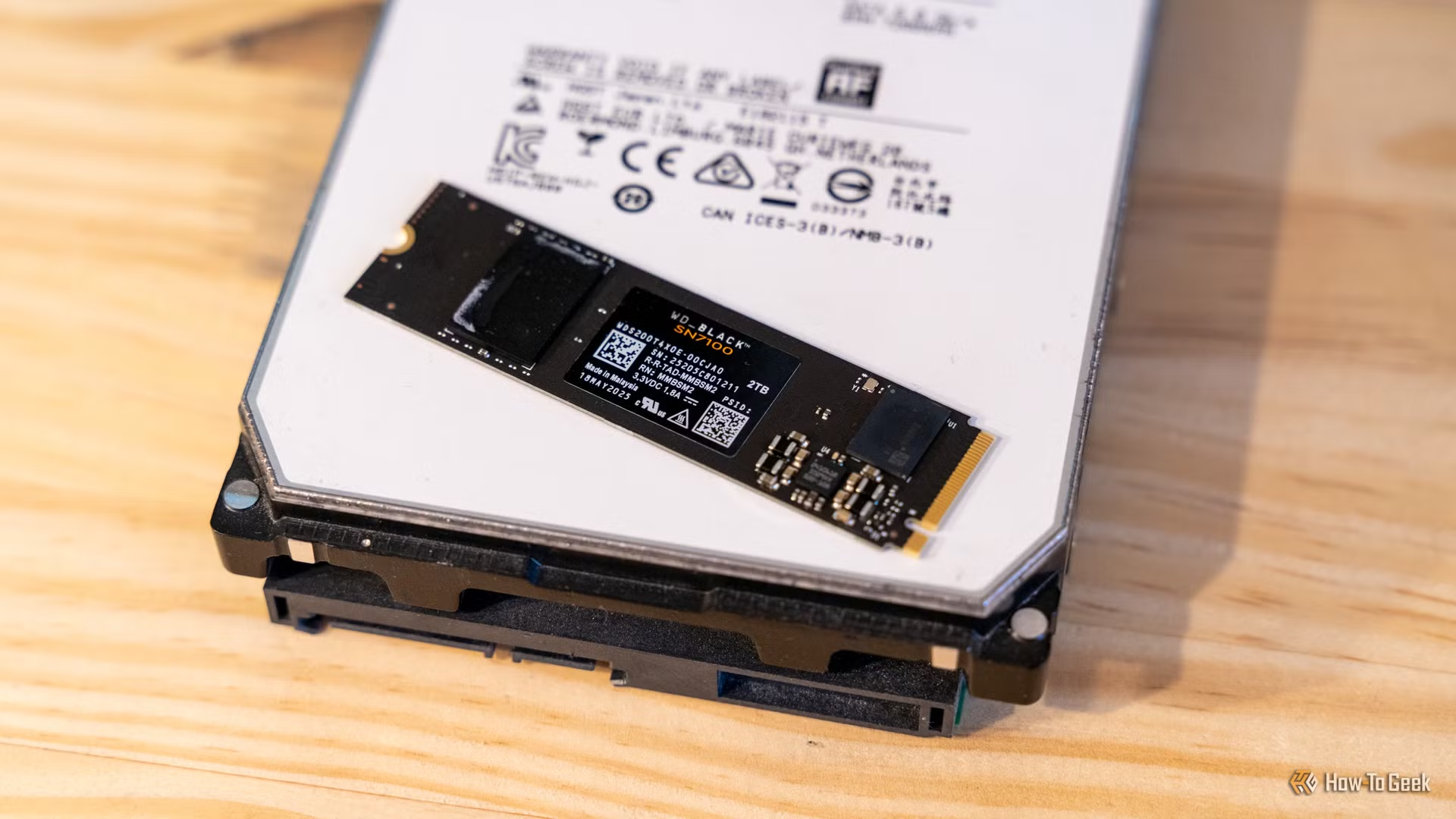
In the history of computing hardware, few devices embody the “compromise” as clearly as the Solid State Hybrid Drive (SSHD). Introduced during a period when Solid State Drives (SSDs) were prohibitively expensive for mass storage and Hard Disk Drives (HDDs) were the primary bottleneck of every system, SSHDs promised a revolutionary middle ground. By combining a high-capacity spinning platter with a small sliver of flash memory, manufacturers like Seagate, through their “Adaptive Memory Technology,” sought to offer SSD-like speeds at HDD prices.
However, looking back, the SSHD serves as a textbook example of how a technical compromise can fail by being “neither here nor there.”
The fatal flaw of the SSHD was its technical architecture, specifically the 8GB of hidden NAND flash storage used as a cache. The internal controller was tasked with an impossible mission: learning which files were accessed most frequently—usually OS boot files—and moving them to this tiny cache. While this resulted in faster Windows boot times that mimicked a true SSD, the performance fell off a cliff the moment a user moved beyond those cached files.
8GB was insufficient for modern workloads. Furthermore, this architecture led to significant NAND wear-leveling issues; since all “frequent” data was slammed into a tiny 8GB area, that flash would degrade faster than the mechanical components, leading to unpredictable drive failures.
The rapid market shift in SSD pricing rendered the SSHD’s value proposition obsolete almost overnight. As manufacturing for NAND flash scaled and transitioned from SLC to MLC and TLC, the price per gigabyte for pure SSDs plummeted. Consumers and system integrators quickly realized that a dual-drive setup—a small 120GB or 250GB SSD for the OS and a 2TB HDD for bulk storage—was far superior to a single 2TB SSHD.
The dual-drive approach offered predictable, consistent performance, whereas the SSHD’s performance was erratic and entirely dependent on the drive’s “guessing” algorithm.
Ultimately, the SSHD failed because it tried to bridge two eras without fully committing to either. It lacked the IOPS (Input/Output Operations Per Second) required for modern multitasking and couldn’t compete with the raw capacity-per-dollar of pure HDDs as they scaled to 10TB and beyond. The legacy of the SSHD is a reminder that in the high-stakes world of systems architecture, an 어설픈 (awkward) bridge is only a temporary fix.
Once pure SSDs became affordable, the bridge was no longer needed, and the SSHD faded into the annals of hardware history as an inefficient, transitional artifact.