Executive Summary
- Anthropic has launched Claude Managed Agents, a cloud-based service designed to eliminate the engineering overhead of building ‘scaffolding’ for AI agents, effectively reducing deployment timelines from months to weeks.
Strategic Deep-Dive
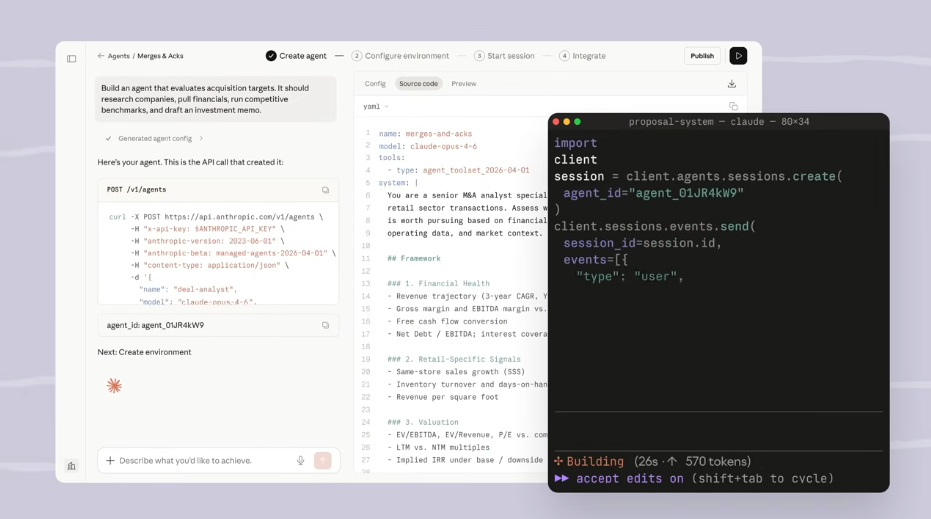
The introduction of Claude Managed Agents by Anthropic PBC represents a major strategic pivot in the generative AI sector, shifting the industry’s focus from raw model inference to a holistic Agent-Infrastructure-as-a-Service (AIaaS) model. Deploying a production-grade AI agent has traditionally been an arduous undertaking, requiring specialized engineering teams to build extensive ‘scaffolding’—the underlying software architecture that manages the agent’s interaction with the real world. This includes critical functions such as state management for long-running conversations, vector database indexing for retrieval-augmented generation (RAG), session persistence across different user interfaces, and robust security guardrails to prevent prompt injection or sensitive data leakage.
Anthropic’s new cloud service abstracts these complexities, offering a pre-integrated environment where these features are available out-of-the-box.
By providing this managed environment, Anthropic addresses the primary friction points of enterprise AI adoption: engineering latency and technical debt. The company asserts that this service can compress a development cycle that typically spans several months into a mere matter of weeks. This acceleration is not just about speed; it is about providing a reliable, scalable foundation for agentic workflows.
For instance, managing API latency and tool-calling reliability often requires sophisticated retry logic and rate-limiting infrastructure. Claude Managed Agents handles these operational challenges within the Anthropic cloud, allowing developers to focus strictly on the business logic and specific utility of their agents. This is particularly vital for enterprises that need to maintain high uptime and strict cost-observability for their AI initiatives.
Moreover, the technical depth of this offering highlights the maturation of the agentic economy. Developers are increasingly moving away from simple, stateless API calls toward multi-step, autonomous behaviors that require persistent memory and sophisticated tool usage. As organizations look to deploy agents in customer-facing or mission-critical roles, the consistency offered by a managed service from a primary model provider becomes indispensable.
Anthropic’s service essentially democratizes access to production-grade agent infrastructure, lowering the barrier to entry for smaller organizations while providing the robust, secure features demanded by global corporations. This move could potentially lead to a new standard in AI deployment, where the emphasis is on the ‘agentic workflow’ rather than just the underlying Large Language Model, positioning Anthropic as a pivotal partner in the enterprise software stack.