Executive Summary
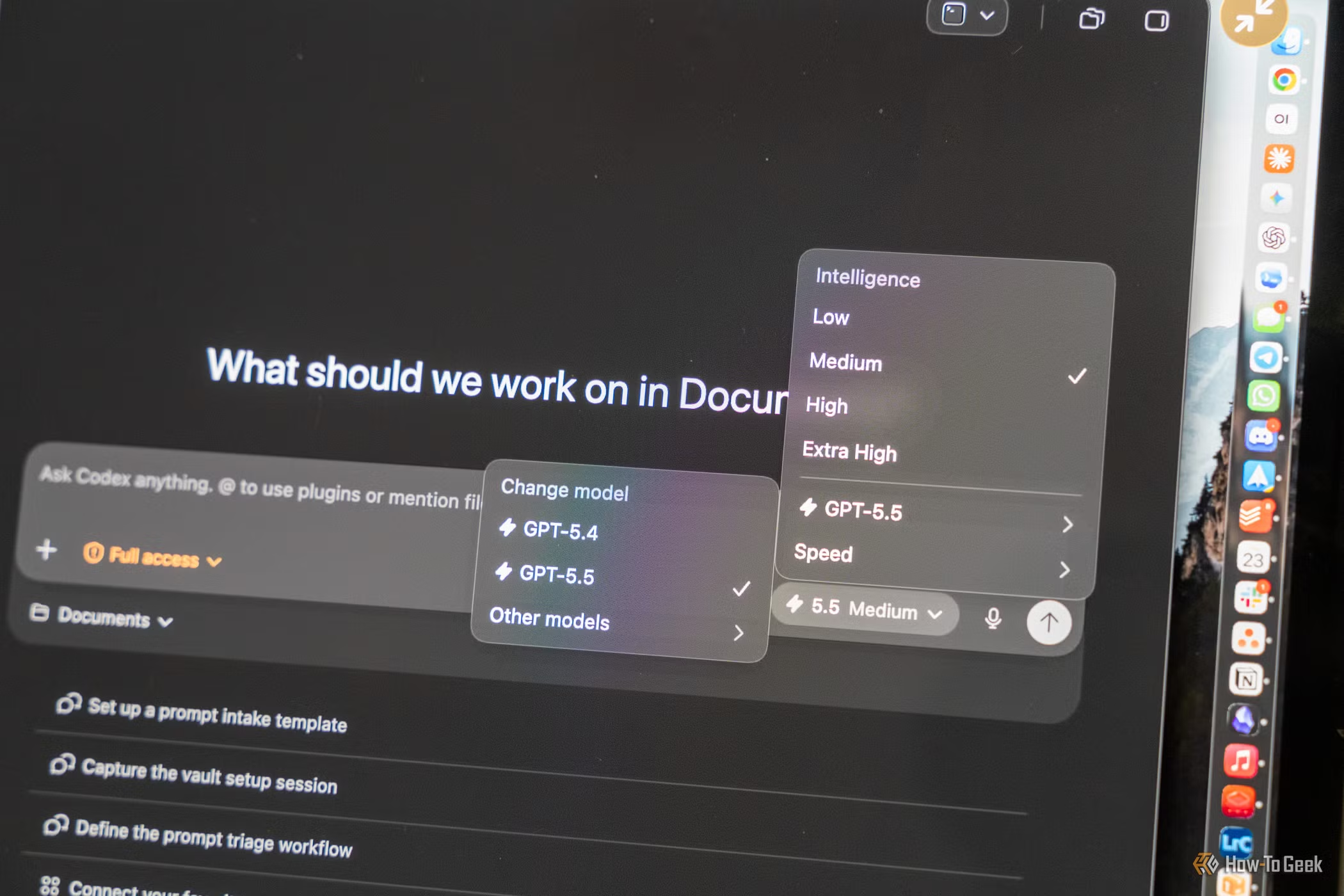
- OpenAI’s newly unveiled GPT-5.5 marks a significant shift from conversational AI to ‘agentic’ AI, specifically optimized for high-level coding and cross-application task execution. By moving beyond simple text interaction, the model can now autonomously navigate computer environments and perform complex work across various software platforms.
Strategic Deep-Dive
The introduction of OpenAI’s GPT-5.5 represents a watershed moment in the history of artificial intelligence, marking the definitive transition from generative models to truly agentic systems. For years, AI was viewed primarily as a sophisticated interface—a way for humans to query information or generate creative content. However, the release of GPT-5.5 signals that the industry is moving toward autonomous execution.
The term ‘agentic’ refers to a model’s inherent ability to act as a proactive agent on behalf of the user, making high-level decisions, selecting appropriate tools, and interacting with diverse software environments to achieve complex goals without constant human intervention.
Technically, GPT-5.5 is specifically engineered to handle ‘difficult coding and computer work,’ which implies a profound enhancement in the model’s multi-step reasoning and environment-awareness capabilities. Coding, at its highest level, requires far more than mere syntactic knowledge; it demands a deep understanding of logical architecture, context-dependent debugging, and the intricate interconnectivity of various systems. GPT-5.5 leverages its improved architecture to not only suggest snippets but to manage entire software pipelines and integrate disparate microservices, effectively acting as a senior-level technical partner.
This evolution is crucial for modern engineering teams who are increasingly burdened by the sheer complexity of legacy codebases and the demands of rapid deployment.
Furthermore, the model’s utility in general computer work is defined by its unprecedented cross-application capabilities. Traditional AI models often operated within a ‘sandbox’ or a single text-based window. GPT-5.5, however, is designed to break these barriers.
By understanding the visual and functional components of different graphical user interfaces (GUIs), it can perform tasks that require shifting context—such as gathering raw data from a web browser, processing it within a complex spreadsheet, and then summarizing the final findings in a project management platform. This cross-app fluency addresses the ‘friction’ inherent in modern digital workflows, where human workers spend a significant portion of their time simply moving information between different tabs and programs.
In professional and enterprise environments, this shift to an agentic model means that AI will no longer just assist; it will execute. The technical implications are vast, ranging from critical security considerations regarding autonomous actions to the immense economic potential of automating mid-to-high level cognitive tasks. As GPT-5.5 integrates into corporate infrastructures, we can expect a redefined relationship between human employees and digital tools, where the primary human role shifts from performing repetitive tasks to supervising and orchestrating multiple AI agents.
This model sets the stage for a future where ‘computer work’ is no longer a manual process of clicking and typing, but a strategic process of goal-setting and high-level AI oversight. The broader socioeconomic impact will likely involve a massive surge in productivity, alongside a necessary evolution in how organizations define roles, responsibilities, and security protocols in an agent-first world.