Executive Summary
- In a move that underscores its unrelenting push toward total vertical integration, Tesla has quietly executed a $2 billion acquisition of an unnamed AI hardware company. The disclosure of this massive transaction was not accompanied by the usual fanfare of a press release; instead, it was buried in a single, cryptic sentence within a routine regulatory filing. This ‘stealth’ strategy highlights Tesla’s preference for operational secrecy as it constructs the infrastructure necessary for a global Robotaxi fleet and the next iteration of its Full Self-Driving (FSD) ecosystem. As a lead data archi…
Strategic Deep-Dive
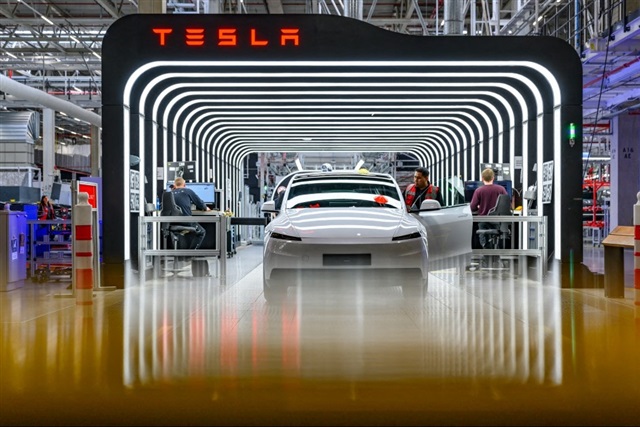
In a move that underscores its unrelenting push toward total vertical integration, Tesla has quietly executed a $2 billion acquisition of an unnamed AI hardware company. The disclosure of this massive transaction was not accompanied by the usual fanfare of a press release; instead, it was buried in a single, cryptic sentence within a routine regulatory filing. This ‘stealth’ strategy highlights Tesla’s preference for operational secrecy as it constructs the infrastructure necessary for a global Robotaxi fleet and the next iteration of its Full Self-Driving (FSD) ecosystem.
As a lead data architect, analyzing this deal reveals a clear intent: Tesla is moving beyond being a consumer of AI silicon and is positioning itself as a premier architect of high-performance compute hardware. The $2 billion valuation suggests that the acquired entity holds critical intellectual property related to neural network accelerators or high-efficiency chip-to-chip interconnects—technologies that are vital for the scaling of Tesla’s Dojo supercomputer. By internalizing these capabilities, Tesla is effectively insulation itself from the pricing volatility and supply constraints of general-purpose AI hardware provided by vendors like Nvidia.
While Nvidia’s Thor platform remains a formidable benchmark, Tesla’s acquisition hints at a bespoke hardware path designed specifically for the unique sparse-matrix calculations and vision-transformer workloads inherent in its FSD v13 and v14 software stacks. This move also reflects CEO Elon Musk’s long-term vision of Tesla as a ‘Full-Stack AI’ company. The ability to design silicon that is perfectly tuned to the requirements of the car’s sensors and control algorithms provides an efficiency dividend that traditional automakers cannot match.
It allows for lower power consumption in the vehicle, which translates to better range, and faster inference times, which are critical for safety in complex urban driving environments. Furthermore, this acquisition likely bolsters Tesla’s efforts to move training workloads in-house, reducing dependency on external cloud providers. In the broader context of the AI hardware race, Tesla’s willingness to spend $2 billion on a ‘hidden’ acquisition signals that it views its internal compute roadmap as its most valuable competitive advantage.
As we see the convergence of robotics and AI, having proprietary silicon at the heart of the machine ensures that Tesla can iterate on its software and hardware in a synchronized, rapid-fire cycle that competitors will find nearly impossible to replicate.