Executive Summary
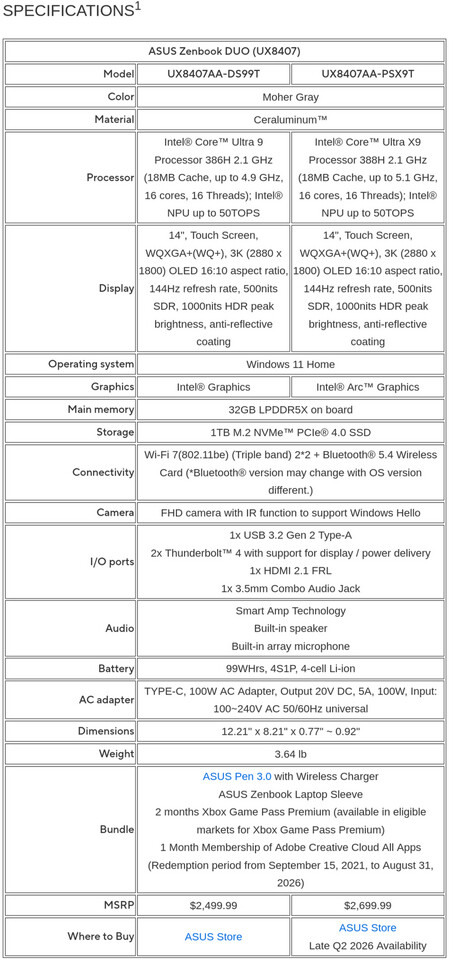
- ASUS has officially brought the Zenbook Duo 2026 to market, priced at $2,499.99. The device leverages Intel’s next-gen Panther Lake architecture alongside dual 144Hz OLED panels. With a redesigned hinge and a unique Ceraluminum finish, it stands as a pinnacle of dual-screen mobile workstation engineering.
Strategic Deep-Dive
The ASUS Zenbook Duo 2026 has officially transitioned from a CES showstopper to a retail flagship, hitting the market with a premium price tag of $2,499.99. From a hardware systems perspective, this laptop represents a masterclass in integrating Intel’s most advanced mobile silicon, Panther Lake, into a high-density dual-display chassis. The adoption of Panther Lake is a pivotal choice; its architectural enhancements in IPC (Instructions Per Cycle) and NPU (Neural Processing Unit) throughput are essential for managing the massive pixel clock requirements of dual 14-inch 144Hz OLED panels.
To drive two such high-refresh displays simultaneously while maintaining a reasonable thermal envelope requires sophisticated power management logic, something that Panther Lake’s improved efficiency cores are specifically designed to handle.
The material science behind the Zenbook Duo 2026 is equally impressive. ASUS has utilized its proprietary ‘Ceraluminum’ finish, a plasma-electrolytic oxidation process that transforms the aluminum surface into a ceramic-like structure. This results in a chassis that is not only exceptionally light but also possesses a unique tactile feel and high resistance to environmental wear and tear.
Furthermore, the mechanical engineering of the hinge has been completely overhauled. By minimizing the dead space between the primary and secondary displays, ASUS has achieved a more cohesive ‘infinite’ screen experience. This reduces the cognitive load on users when moving windows across the two panels, making the dual-screen setup feel like a single, unified workspace rather than two disjointed monitors.
At $2,499.99, the Zenbook Duo 2026 is clearly positioned as a mobile workstation for professionals who prioritize vertical screen real estate. Whether it’s for software development with a full-screen IDE and separate documentation or for video editing with a dedicated timeline on the lower half, the utility offered by this form factor is unparalleled in the 14-inch category. The integration of 144Hz OLED technology across both screens ensures color consistency and fluid motion, which is a critical requirement for high-end visual production.
Following the launch of the Zephyrus Duo gaming variant, the Zenbook Duo completes ASUS’s 2026 offensive on the multi-screen market, proving that they can scale innovative form factors with the necessary thermal and computational overhead to satisfy even the most demanding power users. For the systems architect, this is a clear indication that the future of mobile productivity is increasingly moving toward multi-tile, multi-screen configurations powered by high-efficiency AI-ready silicon.