🔍 Executive Summary
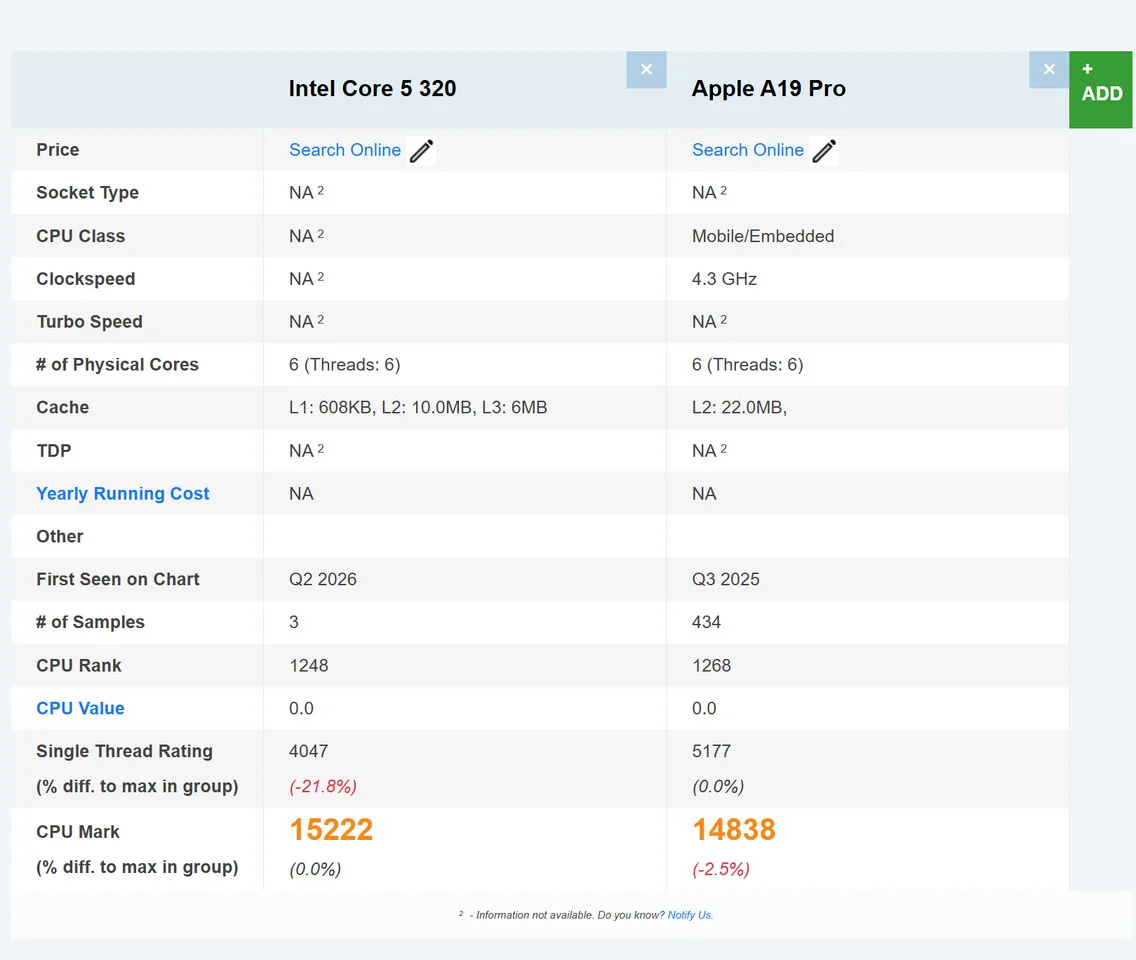
- Early benchmarks for Intel's 'Wildcat Lake' Core 300 series show it outperforming both Apple's MacBook Neo and its projected successor. Featuring a hybrid design with two 'Cougar Cove' P-cores and four 'Darkmont' LPE-cores, these chips mark a strong return for Intel in the entry-level ultraportable segment.
Strategic Deep-Dive
Intel’s ‘Wildcat Lake’ Core 300 series represents an aggressive counter-offensive in the entry-level laptop market, a segment where Apple Silicon has recently enjoyed a comfortable lead in performance-per-watt. Initial benchmark leaks suggest a surprising outcome: Wildcat Lake is not only faster than the current Apple MacBook Neo but is also projected to outperform its upcoming successor in several critical CPU and GPU metrics. This shift signals that Intel has finally refined its hybrid architecture to compete effectively in the ultra-low-power envelope.
The Wildcat Lake processors utilize a strategic mix of two high-performance ‘Cougar Cove’ P-cores and four ‘Darkmont’ Low Power Efficiency (LPE) cores. While the P-cores handle the heavy lifting for bursty workloads, the Darkmont LPE cores are the true stars for the entry-level market. These cores are designed to handle background tasks and media consumption with minimal energy draw, potentially closing the battery life gap that has favored Apple for the last few years.
By optimizing the thread scheduling between these disparate core types, Intel has created a processor that feels snappy and responsive without requiring a massive thermal solution.
The competitive dynamics here are fascinating. For years, Intel struggled to match the efficiency of Apple’s integrated designs. However, the use of Cougar Cove and Darkmont architectures—technologies originally developed for much higher-end chips—shows that Intel is now willing to bring its best IP to the budget and education segments.
If these benchmark results hold true in real-world retail devices, Intel could reclaim significant market share in the $500–$800 laptop category. The focus on ‘LPE’ cores suggests a move toward fanless or near-silent designs, further encroaching on the territory previously dominated by the MacBook Air and Neo. For consumers, this rivalry means entry-level devices will no longer feel like a compromise, offering premium-tier responsiveness at accessible price points.