Executive Summary
- In-depth reviews of the AMD Ryzen 7 9850X3D reveal a concerning trend of escalated power consumption for marginal performance gains, signaling technical hurdles in the evolution of 3D V-Cache efficiency.
Strategic Deep-Dive
AMD’s marketing for the Ryzen 7 9850X3D promised to redefine the high-end gaming market, but actual testing reveals a much more complicated and arguably disappointing reality. The ‘ugly side’ of this new processor is characterized by a significant increase in power draw that does not correlate with its performance output. When AMD first introduced 3D V-Cache with the 5800X3D, it was a masterclass in efficiency, leveraging stacked L3 cache to leapfrog competitors in gaming workloads without requiring massive TDP increases or aggressive voltage scaling.
However, with the 9850X3D, it appears that the law of diminishing returns has firmly set in, exposing the architectural strain of the current Zen 5 implementation when paired with vertical cache stacking.
The technical hurdle lies primarily in the thermal impedance created by the stacked cache die, which sits directly atop the CPU cores. As cache density increases, it acts as an insulator, making it harder for heat to escape from the high-performance cores to the integrated heat spreader (IHS). To eke out additional performance and maintain competitive clock speeds against Intel’s offerings, AMD has pushed the voltage curves higher, necessitating increased Package Power Tracking (PPT) limits.
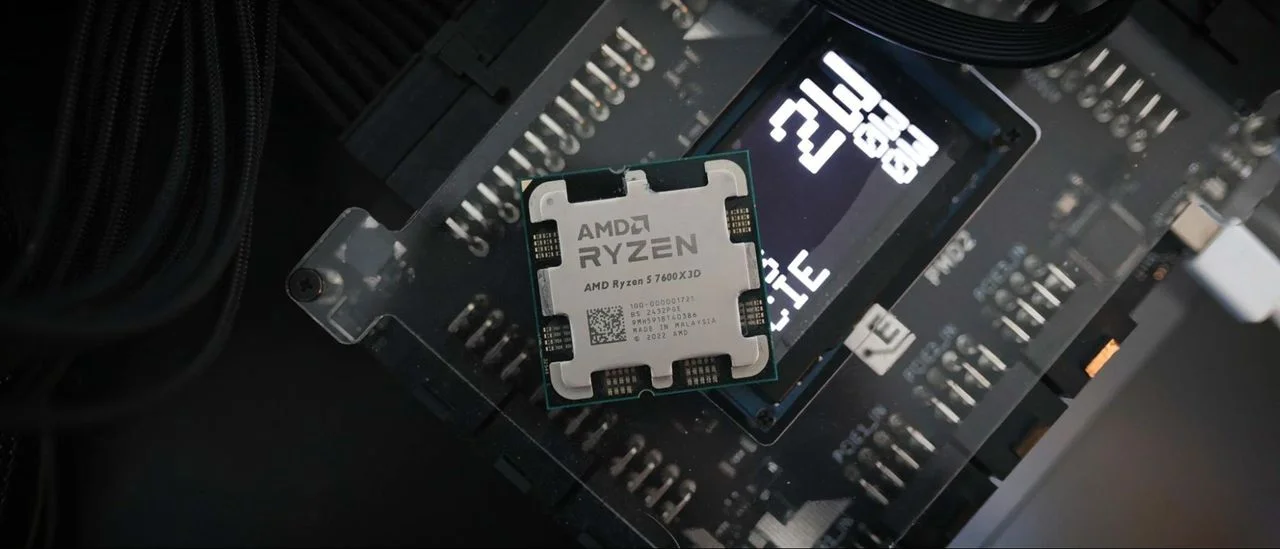
This results in a thermal profile that is significantly harder to manage and a power signature that rivals processors with many more cores. In side-by-side comparisons with the older Ryzen 5 7600X3D, the new flagship struggles to justify its premium pricing. The 7600X3D remains an unbeatable value proposition, offering a leaner, more efficient gaming experience that fits comfortably within the power and cooling constraints of mid-range builds.
From an analyst’s perspective, the 9850X3D’s inability to provide a substantial ‘generational leap’ in efficiency suggests that simply stacking more cache or increasing power limits is no longer a viable path forward for the X3D roadmap. The industry is reaching a point where raw cache size must be balanced with breakthroughs in bonding technology and thermal material science. For hardware enthusiasts, this marks a period of stagnation where the focus must shift from spec-sheet bragging rights to real-world utility.
Until AMD can address these efficiency concerns—perhaps through a more radical redesign of the die-to-die interconnect or moving the cache to a side-by-side configuration—the 9850X3D may be remembered as a product that prioritizes peak performance numbers over the balanced efficiency that made its predecessors legendary. The market’s reaction, characterized by a renewed interest in previous-generation hardware like the 7600X3D, serves as a clear signal that power efficiency remains a top priority for the modern PC builder.