🔍 Executive Summary
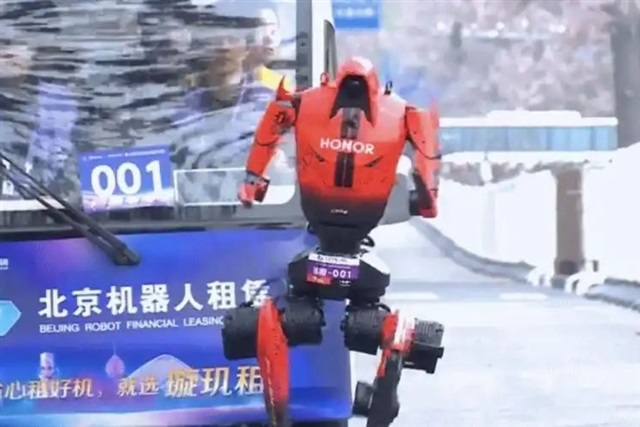
- Honor has stunned the tech world by winning the Beijing humanoid robot half-marathon, signaling a pivot into the robotics sector. By applying its smartphone-derived expertise in NPU scaling and sensor fusion to 'embodied AI,' Honor is challenging established robotics firms and rewriting the competitive playbook for the next generation of AI-driven hardware devices.
Strategic Deep-Dive
The landscape of personal technology is undergoing a radical transformation as smartphone manufacturers aggressively pivot into the field of robotics. Honor’s recent victory at the Beijing humanoid robot half-marathon—a grueling 21-kilometer test of endurance, balance, and computational efficiency—has served as a loud opening salvo in this new era of competition. For a company primarily known for mobile handsets, winning a high-stakes robotics event is a powerful signal of intent.
It suggests that the boundary between ‘mobile devices’ and ‘humanoid machines’ is rapidly dissolving, with the underlying technologies of the former providing a formidable foundation for the latter. The achievement has ignited a global debate on whether the smartphone ecosystem’s mastery of miniaturized compute and energy density is the missing piece of the robotics puzzle.
At the heart of Honor’s strategy is the concept of “Embodied AI.” For years, the artificial intelligence boom has been largely confined to the digital realm—generative models living in data centers or digital assistants on screens. Embodied AI takes these algorithms and gives them a physical form capable of navigating and manipulating the real world. Honor is uniquely positioned to lead this charge because a humanoid robot is, in many ways, an extension of the smartphone engineering philosophy.
The NPU (Neural Processing Unit) scaling required to run complex AI models at the edge, the sensor fusion needed to combine LIDAR, vision, and haptic feedback, and the battery management systems optimized for high-discharge tasks are all technologies that Honor has refined in the cutthroat smartphone market. By porting these capabilities into a bipedal form factor, Honor is proving that the ‘brains’ of the future robot are essentially scaled-up versions of the chips we carry in our pockets.
This cross-sector push into robotics represents a significant market reshuffling. Established robotics firms, which have traditionally focused on industrial precision and high-cost research prototypes, now face competition from consumer electronics giants who understand how to build for the masses. Honor’s ability to leverage its massive, existing supply chains for sensors, actuators, and processors gives it a cost advantage that traditional robotics firms struggle to match.
Furthermore, the entry of a smartphone brand suggests a shift in focus toward ‘consumer-facing’ robotics—machines designed not just for factories, but for homes and offices. If Honor can successfully commercialize a humanoid that interacts seamlessly with the existing mobile ecosystem, it could trigger a displacement of the smartphone as the primary interface for our digital lives.
As we look toward the late 2020s, the emergence of embodied AI will likely be viewed as the logical evolution of the mobile device playbook. Honor’s performance in Beijing has demonstrated that their robotic systems can handle the chaotic, real-world variables of a half-marathon, from terrain changes to heat dissipation. This technical maturity suggests that we are moving past the ‘gimmick’ stage of humanoid development and into an era of practical application.
The question for the industry now is no longer if smartphone makers will enter the robotics space, but how quickly they can redefine it. Honor’s surprise win is just the beginning of a larger narrative where the devices we use don’t just sit on our desks or in our pockets—they walk among us, powered by the same silicon and software that defined the mobile age.