🔍 Executive Summary
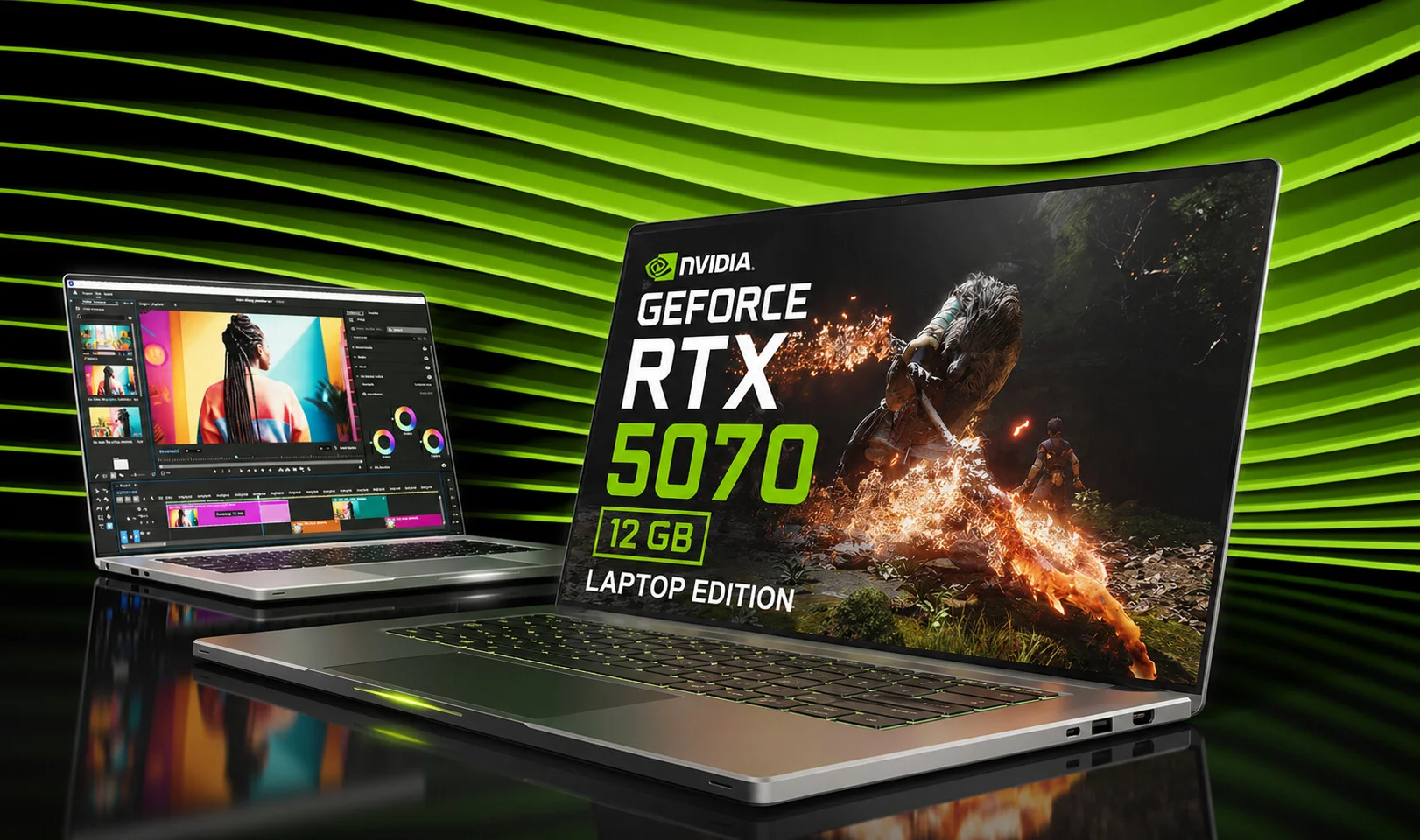
- NVIDIA has officially debuted the RTX 5070 Laptop GPU, leveraging high-density 24 Gb (3 GB) GDDR7 modules to provide a 50% VRAM capacity boost, signaling a massive shift in mobile AI and gaming performance.
Strategic Deep-Dive
In a strategic maneuver that redefines the performance expectations for the 2026 mobile computing era, NVIDIA has officially launched the GeForce RTX 5070 Laptop GPU. While the announcement followed a “quiet release” strategy without the typical fanfare of a GTC keynote, the technical implications are seismic. The headline feature is the integration of 12GB of high-speed GDDR7 VRAM, a 50% capacity increase achieved by transitioning from standard 16 Gb (2 GB) modules to cutting-edge 24 Gb (3 GB) GDDR7 memory modules.
This shift marks the first time high-density GDDR7 has been deployed at scale in the performance laptop segment, directly addressing the industry’s growing hunger for local memory resources.
From a technical standpoint, the move to GDDR7 provides a significant leap in memory bandwidth—expected to exceed 700 GB/s in mobile configurations—while simultaneously improving power efficiency via advanced PAM3 signaling. By utilizing 24 Gb modules, NVIDIA can populate a 192-bit memory bus with 12GB of total capacity, providing a much-needed buffer for 2026-era gaming engines that utilize heavy path-tracing and AI-driven frame synthesis. As PC gaming moves toward complete real-time path tracing, the 8GB VRAM limitations of previous-generation mid-range GPUs had become a primary bottleneck.
The 12GB upgrade effectively removes this ceiling, allowing for higher resolution textures and more complex geometry without frame-time stuttering.
Beyond gaming, the RTX 5070’s 12GB configuration is a targeted response to the surge in On-device AI applications. For data architects and AI developers, the ability to run Large Language Models (LLMs) with high parameter counts locally is contingent on available VRAM. This GPU offers the necessary headroom for complex AI inference tasks that were previously reserved for flagship ‘90-class’ hardware.
Compared to the expected mobile offerings from AMD’s RDNA 4 and Intel’s Celestial architectures, NVIDIA is leveraging its lead in memory density to consolidate its dominance in the creative and professional laptop markets.
Furthermore, the increased AI TOPS (Tera Operations Per Second) throughput facilitated by the faster GDDR7 interface ensures that DLSS 4.0 and future generative AI workloads run with unprecedented fluidity. As we look at the 2026 laptop market landscape, 12GB of VRAM is no longer a luxury but a fundamental requirement for any machine claiming ‘AI PC’ status. This release confirms NVIDIA’s commitment to evolving the mobile hardware stack to match the rapid advancements in software intelligence.
The RTX 5070 12GB thus stands as a strategic anchor, ensuring that the 2026 mobile performance tier can handle the next decade of digital content creation and neural processing, setting a high bar for competitors to follow in the battle for mobile graphics supremacy.