🔍 Executive Summary
- Taiwanese President Lai Ching-te has formally launched a national strategic initiative to transform the nation into an 'AI Island,' centered on the deployment of an All-Photonic Network (APN). In a high-level partnership with Japan’s NTT, the National Science and Technology Council (NSTC) is spearheading the acquisition of IOWN (Innovative Optical and Wireless Network) technology. Collaborating with local giants Chunghwa Telecom and Accton Technology, the project aims to establish a next-generation communication infrastructure that eliminates electrical conversion bottlenecks. This APN infrastructure is designed to provide unparalleled data center resilience and seamless AI computing backup, ensuring Taiwan remains the foundational hub of the global AI hardware and services ecosystem.
Strategic Deep-Dive
Technical Synthesis: Taiwan’s APN Deployment as a Strategic Moat for the AI Island
Taiwan’s ‘AI Island’ initiative, championed by President Lai Ching-te, represents a fundamental shift in national industrial policy—moving from a focus on individual semiconductor components to the holistic orchestration of AI infrastructure. At the heart of this strategy is the deployment of an All-Photonic Network (APN), a technology designed to bypass the physical limitations of current copper and hybrid fiber networks. By establishing a partnership with Japan’s NTT and leveraging the expertise of Chunghwa Telecom and Accton Technology, the National Science and Technology Council (NSTC) is building a specialized, high-velocity fabric tailored for the exigencies of distributed AI workloads.
The Architecture of the All-Photonic Network (APN)
Technically, the APN is the physical layer realization of the IOWN (Innovative Optical and Wireless Network) vision. Conventional networking architectures rely on high-frequency electrical signals within routers and switches, necessitating repeated Optical-to-Electrical (O-E) and Electrical-to-Optical (E-O) conversions. Each conversion stage introduces nanoseconds of latency and significant thermal overhead.
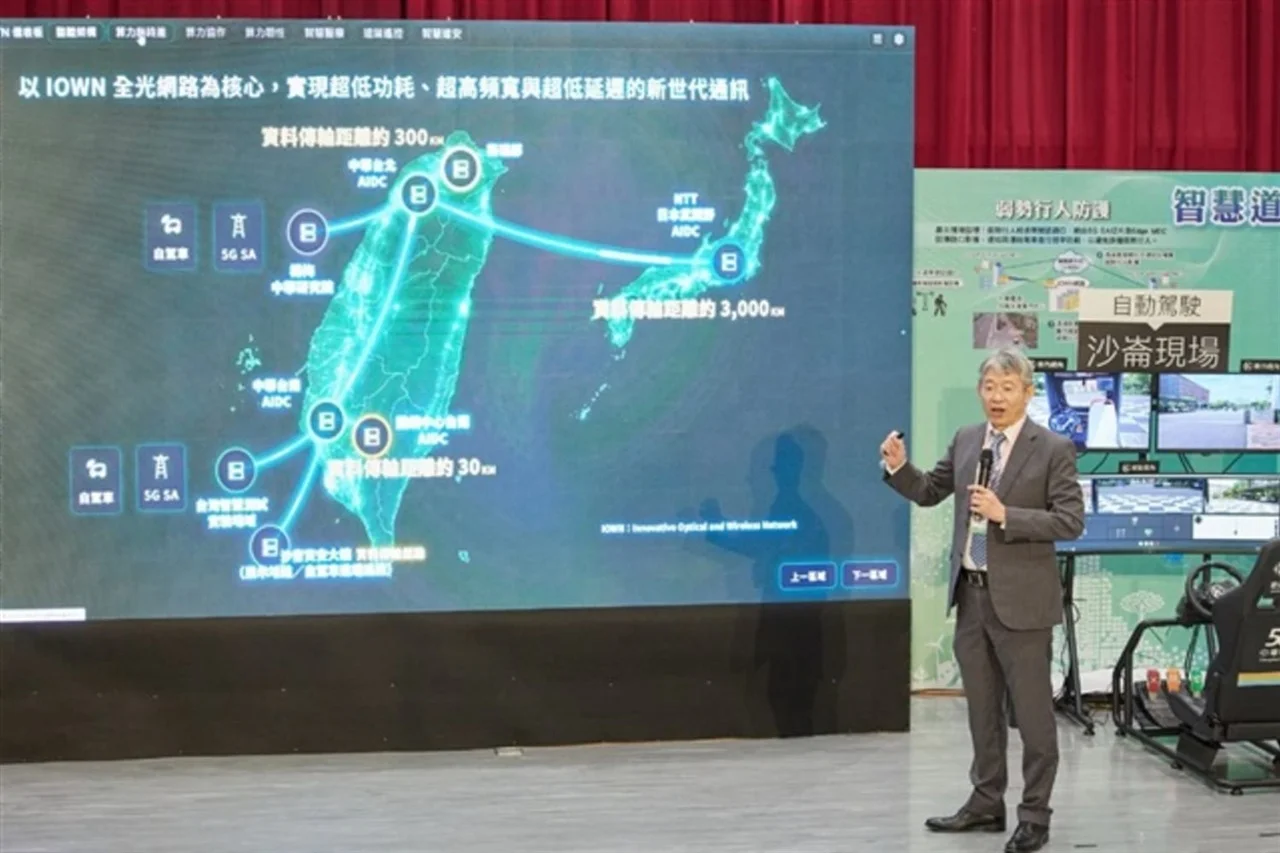
The APN architecture eliminates these stages by maintaining the signal in the optical domain from the point of origin to the destination. For AI data centers, where synchronization between thousands of GPUs is paramount, the APN provides a near-zero latency environment. This allows for the scaling of Large Language Model (LLM) training across geographically disparate facilities, effectively treating remote data centers as a single, unified virtual supercomputer.
This is critical for the next generation of AI, which requires massive parallelization and real-time data ingestion.
Enhancing Data Center Resilience and Computing Redundancy
A primary driver for Taiwan’s aggressive adoption of APN is the requirement for operational continuity in the face of regional risks. Taiwan’s unique geopolitical position and its vulnerability to seismic activity necessitate a highly resilient digital infrastructure. The low-latency characteristic of APN enables ‘Synchronous Backup,’ where AI computing tasks can be mirrored in real-time between Northern and Southern Taiwan data centers.
In the event of a power grid failure or physical link interdiction in one region, the APN allows for the seamless, instantaneous failover of computing resources. This high-availability architecture is designed to convince global hyperscalers that Taiwan is the most secure and reliable location to host critical AI models, effectively creating a ‘digital silicon shield’ that complements the nation’s manufacturing dominance.
Energy Efficiency and Geopolitical Strategy
Beyond performance and resilience, the APN offers a transformative advantage in power efficiency. By removing the energy-intensive E-O-E conversion stages, APN-equipped data centers can reduce their networking power consumption by up to 100 times compared to traditional architectures. In a world where AI energy demand is spiraling, Taiwan’s investment in APN provides a sustainable pathway for scaling its ‘AI Island’ vision without overwhelming the national energy grid.
Furthermore, this initiative solidifies a strategic technology alliance with Japan. By adopting Japanese-pioneered IOWN standards, Taiwan integrates its hardware ecosystem more deeply with democratic allies, creating a standardized, high-tech sanctuary for the global digital economy. This project is not merely an upgrade to internet speeds; it is the construction of a premier, all-optical foundation for the century of artificial intelligence, ensuring Taiwan’s role as the indispensable architect of the AI future.