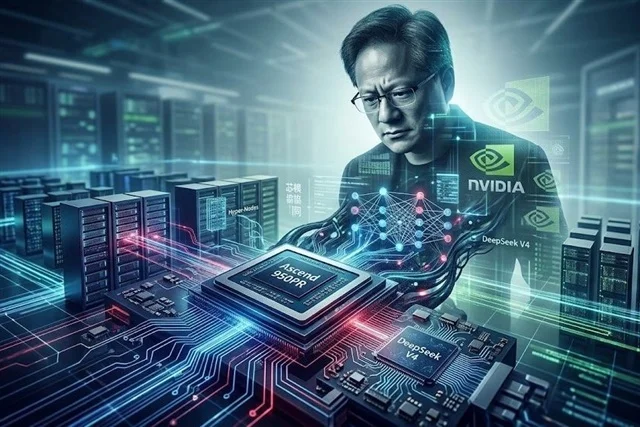
🔍 Executive Summary
- The global AI landscape in 2026 has entered a fierce 'Inference Cost War,' characterized by DeepSeek V4’s strategic optimization for Huawei Ascend hardware. By proving that elite-level AI performance can be decoupled from the Nvidia ecosystem, DeepSeek is fundamentally rewriting the economics of AI deployment and challenging the TCO advantages long held by Western hardware incumbents.
Strategic Deep-Dive
The artificial intelligence sector in 2026 is grappling with a new operational reality: the ‘Inference Cost War.’ For the past several years, the industry was focused on the capital-intensive race to train the largest Large Language Models (LLMs). However, as these models move into widespread commercial production, the focus has shifted toward the Total Cost of Ownership (TCO) of inference. DeepSeek V4 has emerged as a disruptive force in this environment, not merely through algorithmic prowess but through a strategic ‘chip-model’ co-optimization strategy.
By tailoring its architecture specifically for Huawei’s Ascend 910 series (and its successors), DeepSeek has demonstrated that it is possible to achieve state-of-the-art performance without relying on Nvidia’s H200 or Blackwell architectures.
This shift represents a fundamental challenge to the ‘CUDA Moat.’ Historically, Nvidia’s dominance was protected by the immense difficulty of porting high-performance models to alternative silicon. DeepSeek has bypassed this barrier by building its V4 model from the ground up with Ascend-specific optimizations, leveraging Mixture of Experts (MoE) architectures that minimize active parameter count during inference, thereby reducing the memory bandwidth strain that often bottlenecks domestic Chinese hardware. The result is a price-per-token that is significantly lower than that of Western counterparts running on standard cloud instances.
For enterprise users, especially within the Asia-Pacific region, the economic argument for switching to a DeepSeek-Huawei stack is becoming increasingly compelling.
From a data analyst’s perspective, this trend marks the beginning of the ‘commoditization’ of AI compute. As inference volume grows to represent over 80% of total data center AI workloads, the market is becoming hypersensitive to energy efficiency and throughput-per-dollar. DeepSeek’s success provides a blueprint for other localized AI ecosystems to develop ‘vertical’ stacks where hardware and software are inseparable.
This democratization of high-performance AI through architectural efficiency poses a strategic threat to Nvidia’s high-margin business model. If model-specific optimizations can bridge the raw performance gap of 20-30% between domestic and Western chips, the incentive for Chinese firms to pay the ‘Nvidia premium’—or to navigate complex export workarounds—evaporates. In the long run, the 2026 inference war may be remembered as the moment when the AI industry realized that the most efficient way to scale was not through more power, but through smarter, hardware-aware design.
This decoupling of elite AI from Western hardware supremacy signals a multipolar future for AI infrastructure, where regional economic factors and hardware availability dictate the architecture of the next generation of intelligence.