🔍 Executive Summary
- Intel and Saimemory, a subsidiary of SoftBank, are collaborating on a new high-bandwidth memory alternative called HB3DM. Utilizing Z-Angle Memory (ZAM) technology, the project aims to leapfrog current HBM standards by offering superior bandwidth and capacity for AI hardware, with a major technical presentation set for the VLSI 2026 symposium.
Strategic Deep-Dive
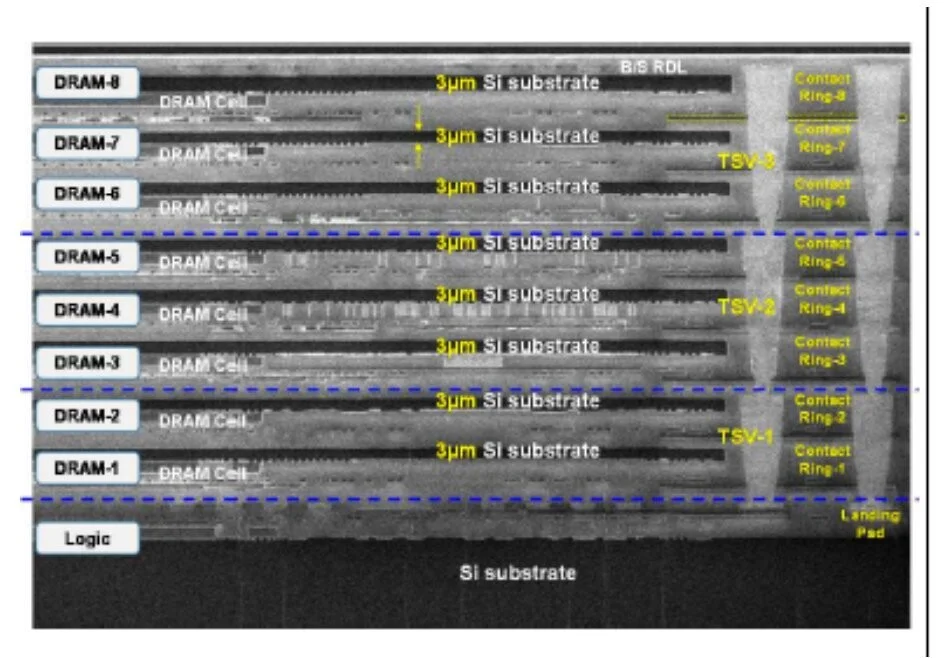
In a strategic maneuver to disrupt the current AI memory landscape, Intel and SoftBank subsidiary Saimemory have announced the development of HB3DM—a high-bandwidth 3D memory architecture designed to surpass the inherent limitations of existing HBM (High Bandwidth Memory) standards. As AI training and inference demand increasingly data-intensive workloads, the Intel-Saimemory partnership focuses on delivering a solution that provides both higher bandwidth and significantly larger capacity than today’s HBM3e or the upcoming HBM4 protocols. The core of this breakthrough is the Z-Angle Memory (ZAM) technology, which reimagines the physical interconnection and stacking methodology of memory cells to achieve unprecedented density and throughput.
The development of HB3DM represents a critical pillar of Intel’s broader strategy to integrate advanced, proprietary memory solutions directly with its high-performance AI accelerators like the Gaudi series or future Falcon Shores chips. By leveraging Saimemory’s innovative ZAM architecture, Intel aims to mitigate the ‘memory wall’ that currently restricts the performance of trillion-parameter large language models. The industry is closely watching the upcoming VLSI 2026 Symposium in Honolulu, Hawaii, where Saimemory is scheduled to present a comprehensive technical paper detailing the HB3DM technology.
This presentation is expected to provide critical benchmarks on data transfer speeds, thermal management advantages, and power efficiency metrics that could set a new high-water mark for the semiconductor industry.
From a competitive standpoint, HB3DM is being positioned by analysts as a potential ‘HBM killer,’ signaling Intel’s intent to reduce its reliance on external vendors like SK Hynix or Samsung and create a vertically integrated advantage. For SoftBank, this venture serves as another high-stakes strategic placement in the AI hardware ecosystem through its subsidiary, Saimemory, aligning with Masayoshi Son’s vision of a ubiquitous AI future. If HB3DM can deliver the promised gains in density and latency, it may force a significant realignment in the semiconductor supply chain.
Traditional HBM manufacturers may find their margins under pressure if Intel—one of the world’s largest IDMs—successfully commercializes an alternative that is natively optimized for 3D stacking environments and hybrid bonding. The implications for the AI accelerator market are profound, as the bottleneck shifts from compute power to memory accessibility, making HB3DM a potential kingmaker in the next era of silicon dominance.