🔍 Executive Summary
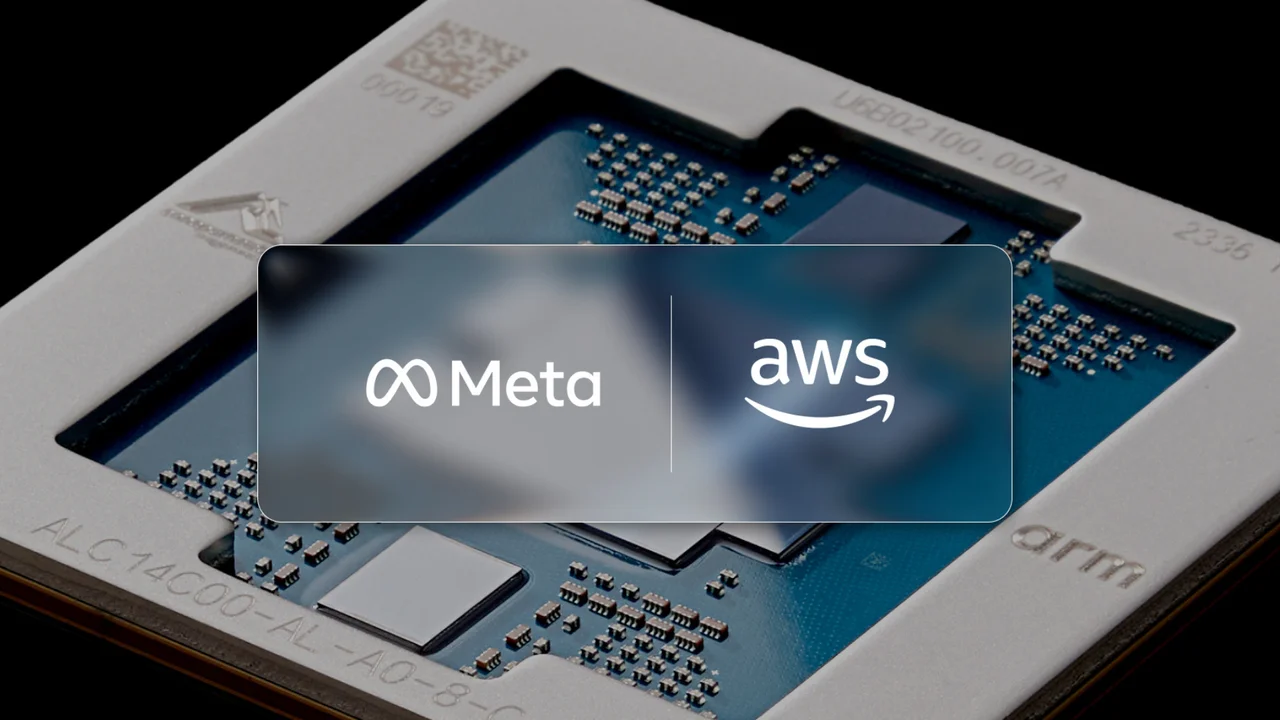
- Meta has signed a massive, multi-billion-dollar deal with AWS to deploy tens of millions of Graviton5 CPU cores, signaling a fundamental architectural shift as 'Agentic' AI workloads create new bottlenecks beyond the GPU.
Strategic Deep-Dive
The landscape of artificial intelligence infrastructure is undergoing its most significant architectural pivot since the rise of the large language model. Meta’s recent announcement of a multi-billion-dollar, multi-year agreement with Amazon Web Services (AWS) to deploy tens of millions of Graviton5 CPU cores is a definitive signal that the ‘GPU-only’ era of AI scaling is hitting a wall. While the industry has been hyper-focused on GPU scarcity, a new bottleneck has emerged in the form of general-purpose compute capacity.
As Meta integrates deeper AI capabilities across Facebook, Instagram, and WhatsApp, the company is finding that the ‘brain’ directing the GPU’s ‘muscle’ is becoming the primary constraint on system performance and cost-efficiency.
At the technical heart of this strategic shift is the rise of ‘Agentic inference.’ Traditional inference is largely a linear mathematical exercise—predicting the next token in a sequence—which plays directly to the massive parallel processing strengths of a GPU. However, Agentic AI introduces a layer of cognitive complexity. These models don’t just generate text; they reason, plan, and execute multi-step tasks that involve complex branching logic and recursive decision-making processes.
In computer science terms, this is a ‘control flow’ problem. GPUs are notoriously inefficient at handling deep conditional logic and non-linear code execution. Conversely, high-performance CPU cores like AWS’s Graviton5, built on the latest Arm architecture, are specifically designed to excel at these serial and branching workloads.
By offloading these logical ‘orchestration’ tasks to tens of millions of Graviton5 cores, Meta can maximize the utilization of its expensive GPU clusters, ensuring they are only crunching tensors while the CPUs handle the complex ’thinking’ and ‘routing.’
Meta’s commitment to tens of millions of cores represents an unprecedented scale for a cloud-based CPU deployment. It reflects a sobering reality in the semiconductor market: CPU shortages are now a tangible threat to AI roadmap execution. By securing a massive, dedicated pipeline of Graviton5 silicon, Meta is insulating itself from the supply volatility affecting traditional x86 providers like Intel and AMD.
Furthermore, the Graviton5 offers a superior performance-per-watt profile, which is critical for a company operating data centers at Meta’s global scale. Reducing the power footprint of each inference call is the only way to sustainably scale ‘agentic’ features to billions of users without overwhelming the power grid or the company’s operational budget.
As a Senior Global Tech Analyst, I view this deal as the beginning of a ‘rebalancing’ in hardware budgets. For the past three years, capital expenditure has been overwhelmingly tilted toward AI accelerators. We are now entering a phase where the ‘System-on-a-Cluster’ approach requires equally robust investments in high-efficiency, general-purpose compute.
Meta is essentially building a specialized, hybrid inference engine that treats the CPU and GPU as co-equal partners in the agentic workflow. This deal cements AWS’s position as a premier silicon designer and forces every other hyperscaler to reconsider their CPU-to-GPU ratios. The era of the autonomous AI agent will be defined not just by how many FLOPS you can generate, but by how efficiently you can manage the complex logic that makes those FLOPS meaningful.
Meta’s strategic partnership with AWS ensures it has the foundational architecture to dominate the next decade of AI-driven application growth, placing it miles ahead of competitors who remain stuck in the GPU-centric paradigm.