🔍 Executive Summary
- OpenAI is aggressively expanding into the personal terminal market with a 2028 AI agent-centric smartphone, leveraging customized silicon from MediaTek and Qualcomm and exclusive manufacturing by Luxshare to bypass traditional app-based ecosystems.
Strategic Deep-Dive
OpenAI’s foray into the hardware sector is a calculated strategic move designed to secure the ’last mile’ of the user experience: the personal terminal. By targeting a 2028 launch for an AI agent-centric smartphone, OpenAI is attempting to disrupt the established duopoly of Apple and Google by fundamentally changing how humans interact with silicon. The technical heart of this initiative lies in a bespoke processor development program involving MediaTek and Qualcomm.
From a lead data architect’s perspective, the goal is to design a System-on-Chip (SoC) that prioritizes NPU (Neural Processing Unit) throughput and ultra-low-latency memory access specifically for agentic workflows, moving away from the general-purpose optimization found in current Snapdragon or Dimensity chips. The partnership with Luxshare Precision Industry as the exclusive system integrator is a masterstroke in supply chain engineering. Luxshare’s proven track record with high-complexity assembly for the world’s leading smartphone brands provides OpenAI with the manufacturing sophistication required to build a premium device without the initial growing pains of a hardware novice.
The 2028 timeline is telling; it reflects the time needed to solve the current power-to-performance challenges of running heavy inference models on-device. To achieve a truly ‘agentic’ experience, where the AI proactively manages life tasks rather than just responding to prompts, the hardware must sustain high TOPS (Tera Operations Per Second) performance within a strict TDP (Thermal Design Power) envelope to prevent thermal throttling. OpenAI is not just building a phone; they are building an ‘Agentic Operating System’ where the hardware is co-designed to minimize the energy cost per inference.
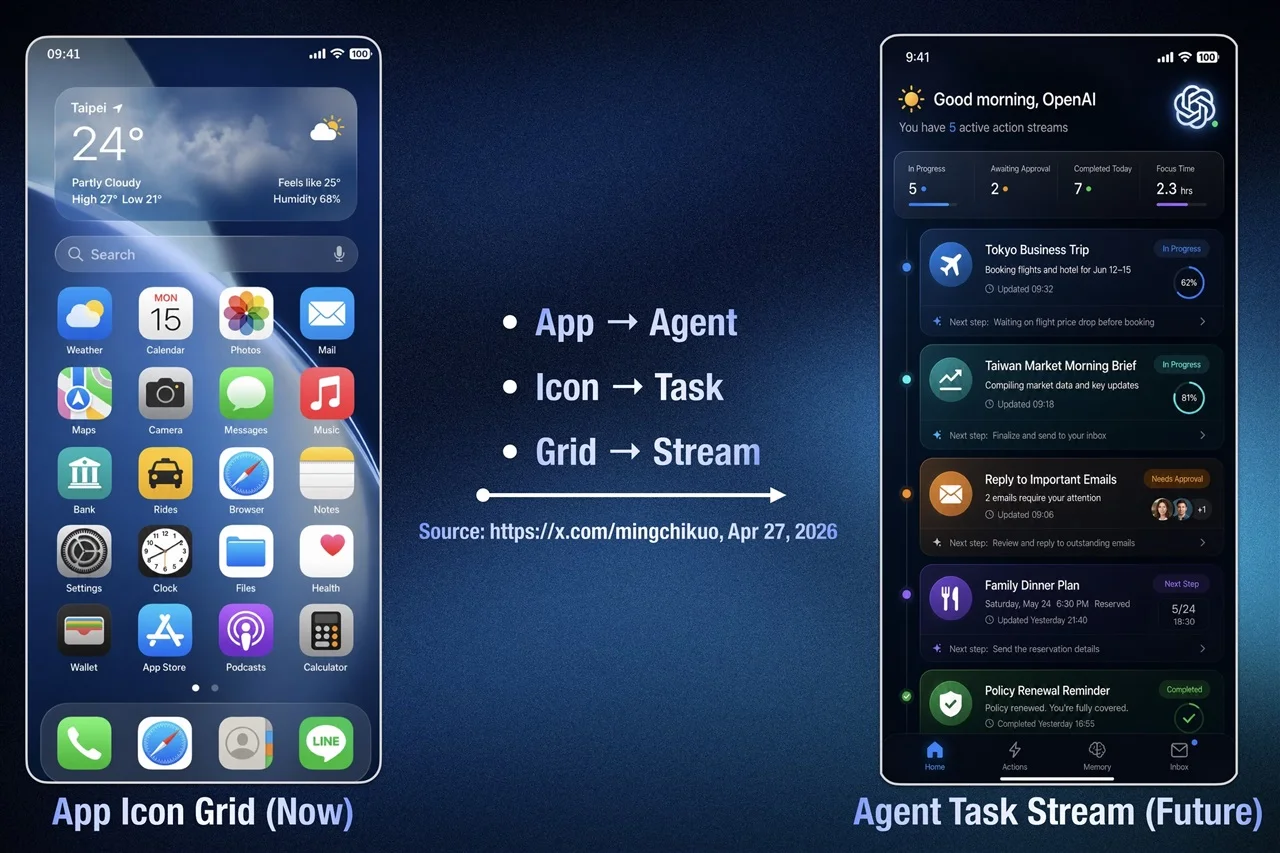
This vertical integration allows OpenAI to bypass the inefficiencies of traditional app layers, creating a seamless interface where the AI agent has direct access to system-level APIs. The competitive implication is clear: if OpenAI can own the hardware, they can own the data generated by that hardware, creating a feedback loop that will accelerate the personalization of their models. While previous attempts by software companies to enter the hardware market have often failed, the unique ‘AI-first’ paradigm shift offers OpenAI a once-in-a-generation window.
By the time this device hits mass production in 2028, the smartphone market will likely be saturated and desperate for a new category-defining product. OpenAI’s agent phone aims to be exactly that—a device that marks the end of the app era and the beginning of the autonomous personal terminal era. The success of this venture will depend on whether Luxshare can scale this vision into a physical reality that matches the intelligence of OpenAI’s models.