🔍 Executive Summary
- Lightelligence, a pioneer in silicon photonics, successfully listed on the Hong Kong Stock Exchange on April 28, 2026, achieving a market capitalization of HK$77.8 billion. This event highlights the industry's critical shift toward Co-Packaged Optics (CPO) as traditional electrical interconnects hit physical and power-efficiency walls amidst the generative AI boom, signaling a major transition in AI hardware architecture.
Strategic Deep-Dive
The emergence and rapid scaling of generative AI have fundamentally altered the landscape of computational requirements, pushing traditional hardware architectures to their absolute physical limits. As of late April 2026, the global technology sector is witnessing a pivotal transition from electrical interconnects to integrated optical solutions. This monumental shift is best exemplified by the high-profile initial public offering (IPO) of Lightelligence on the Hong Kong Stock Exchange (HKEX).
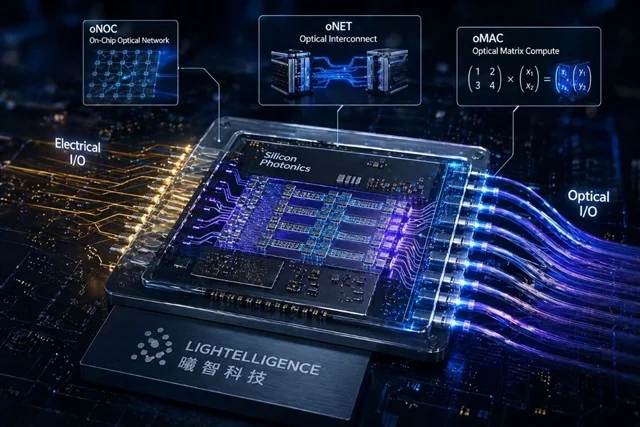
Based in China, Lightelligence has established itself as a global leader in silicon photonics—a discipline that integrates laser and optical technologies directly onto silicon substrates to facilitate high-speed data transmission with minimal energy loss and thermal overhead.
On April 28, 2026, the company made its debut on the HKEX, and the market response was immediate and overwhelmingly positive. Lightelligence’s valuation briefly touched HK$77.8 billion shortly after the opening bell, reflecting deep investor confidence in the necessity of Co-Packaged Optics (CPO) technology. The technical justification for this valuation lies in the ’thermal wall’ and the power density limitations of copper-based interconnects.
In modern data centers, as signal speeds increase, the energy required to transmit data across a motherboard or backplane using electrical pulses increases disproportionately. Silicon photonics addresses this by moving data via photons, which experience significantly less attenuation and produce almost no heat during transmission.
CPO technology takes this a step further by relocating the optical engine from a pluggable module on the periphery of the board to a position immediately adjacent to the processor within the same package. This minimizes the distance the signal must travel over lossy copper traces, drastically reducing latency and the power overhead required for massive AI training and inference workloads. For hyper-scale data center operators, the adoption of CPO is no longer an elective upgrade but a structural requirement to maintain performance scaling.
Lightelligence’s successful listing serves as a critical benchmark for the commercialization of silicon photonics. It underscores a broader industry trend where the primary bottleneck in AI performance is no longer just the logic gates of the chip itself, but how effectively data is moved between high-performance computing (HPC) nodes. The capital raised and the market validation received by Lightelligence provide the necessary momentum to accelerate the manufacturing of these advanced optical chips.
Looking forward, we expect an industry-wide scramble to secure CPO manufacturing capacity, as the pure electrical era for high-performance interconnects reaches its sunset. The success of Lightelligence provides a roadmap for how specialized hardware startups can challenge established norms by solving the most fundamental physical constraints of the AI era.