🔍 Executive Summary
- The Intel Arc Pro B70 workstation GPU disrupts the mid-range professional market with a massive 32GB VRAM buffer and superior ray tracing performance that nearly matches the RTX 5060 Ti within a 2.9% margin.
Strategic Deep-Dive
Architectural Ambition: The Arc Pro B70 and the VRAM Revolution
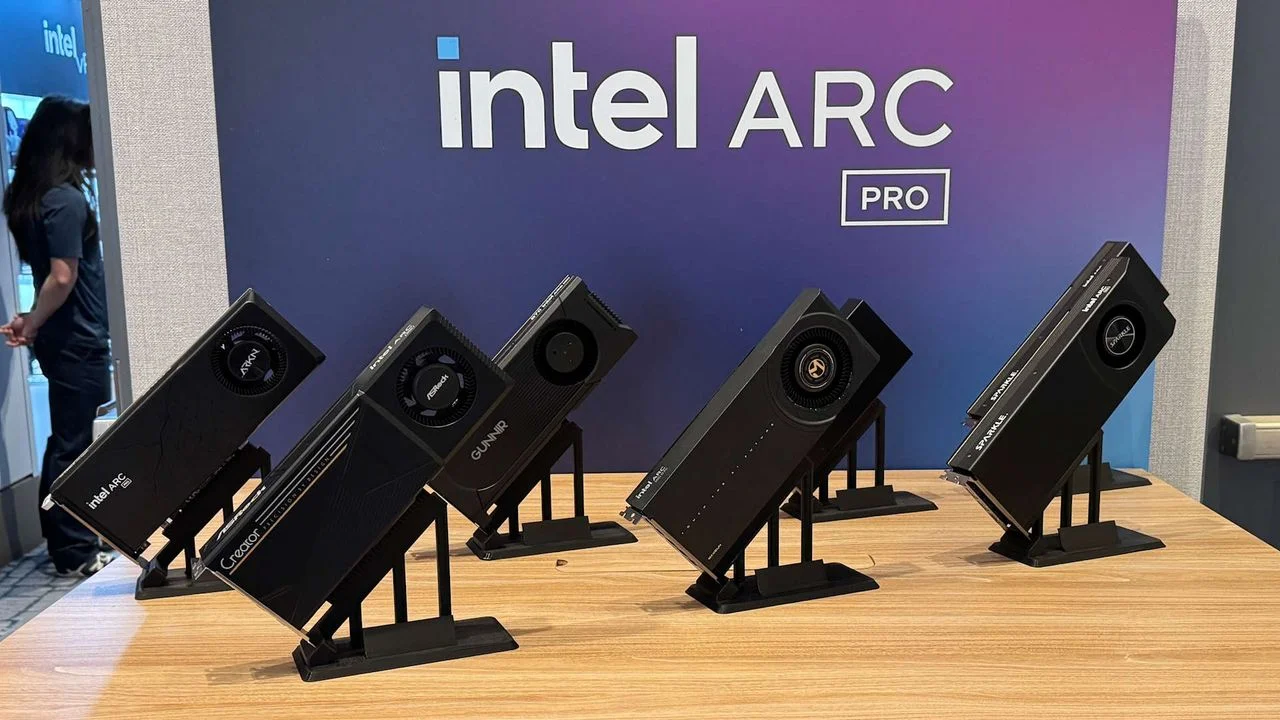
Intel’s graphics division has reached a significant milestone with the release of the Arc Pro B70, a workstation-class GPU designed to offer high-end professional features at a competitive price point. The headline specification is undoubtedly the 32GB of VRAM. By equipping a mid-range professional card with such a massive memory buffer, Intel is directly attacking a long-standing criticism of the market leader, Nvidia: the perceived ‘stinginess’ with VRAM on non-flagship hardware.
For data scientists working on local AI inference and creative professionals handling complex 8K timelines, 32GB of memory provides a level of ‘headroom’ that ensures system stability and performance consistency that 16GB cards simply cannot match. This move positions the B70 as a disruptor capable of handling professional datasets that were previously the exclusive domain of much more expensive enterprise hardware.
Benchmarking the Competitive Landscape: B70 vs. RTX 5060 Ti
In a series of rigorous benchmarks conducted at 1440p resolution—the current ‘sweet spot’ for professional displays—the Arc Pro B70 was pitted against the Nvidia GeForce RTX 5060 Ti 16GB. The results revealed a fascinating technical dichotomy. In traditional rasterization workloads, where raw pixel-pushing power is the primary metric, the RTX 5060 Ti maintained a slight lead.
However, the paradigm shifted entirely in ray tracing (RT) scenarios. The Arc Pro B70 demonstrated superior RT hardware acceleration, consistently surpassing the RTX 5060 Ti in frames per second and frame-time consistency. This indicates that Intel’s dedicated ray-tracing units (RTUs) within the Battlemage-derived architecture are highly efficient at handling the complex intersection calculations required for modern cinematic rendering and lighting simulations.
The 2.9% Delta and Strategic Implications
When aggregating the data from a diverse suite of five gaming and professional rendering titles, the performance delta between the Arc Pro B70 and the RTX 5060 Ti was a mere 2.9%. In the world of high-performance computing, a margin of less than 3% is considered functional parity. This is a monumental achievement for Intel, as it demonstrates that their graphics drivers—once a point of weakness—have matured to a level where they can extract near-maximum efficiency from the silicon.
Furthermore, the B70 proved to be roughly twice as fast as the entry-level Arc B580, showing a well-defined product stack with clear performance scaling. For organizations looking to equip their fleets with reliable workstation hardware, the B70 offers a compelling value proposition: superior memory capacity for professional workloads and class-leading ray tracing performance, all while remaining within 3% of the overall throughput of its primary Nvidia competitor. This release signals Intel’s transition from an underdog to a legitimate powerhouse in the professional GPU sector.