🔍 Executive Summary
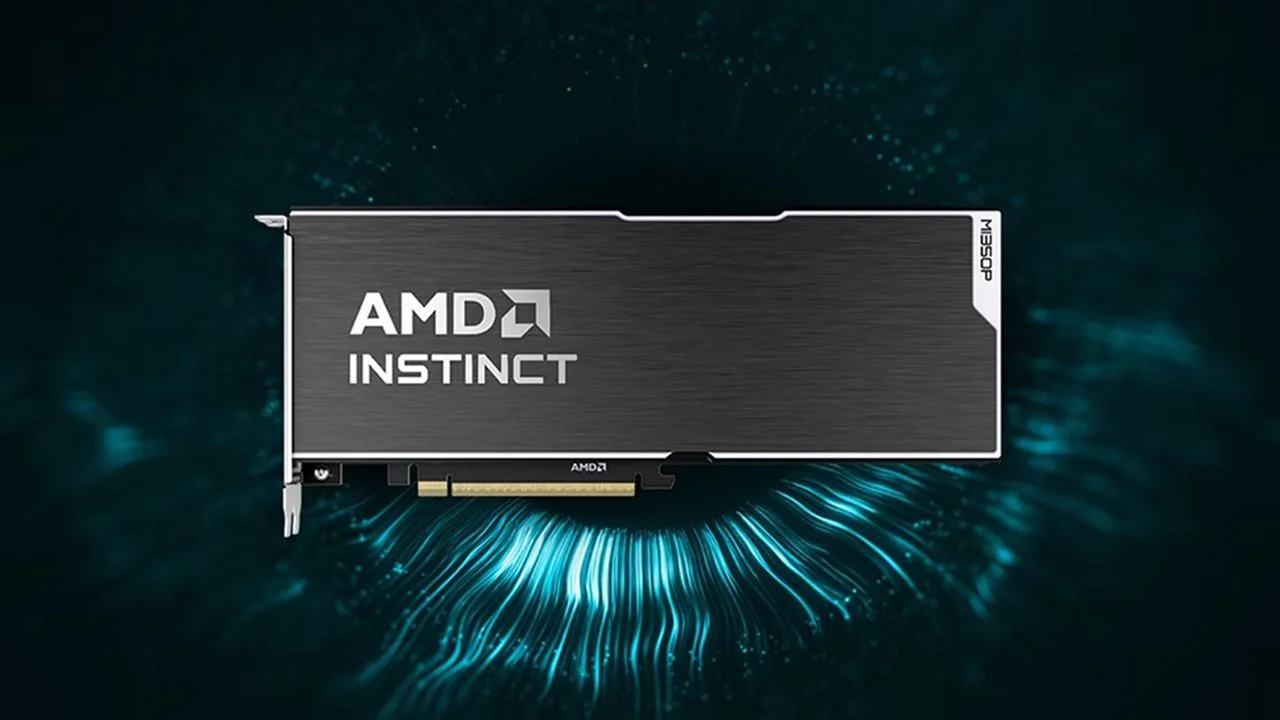
- AMD is intensifying its rivalry with Nvidia by launching the MI350P PCIe AI accelerator. Featuring 144GB of high-speed HBM3E memory, the card offers a strategic 40% performance advantage in FP16 and FP8 compute tasks compared to Nvidia’s H200 NVL, specifically designed for seamless integration into existing air-cooled data center environments.
Strategic Deep-Dive
AMD has significantly escalated the AI hardware arms race with the unveiling of the Instinct MI350P PCIe AI accelerator. This new offering is meticulously engineered to bridge the gap between niche flagship performance and mass-market enterprise scalability. Featuring 144GB of high-speed HBM3E memory, the MI350P is positioned as a direct challenger to Nvidia’s H200 NVL.
While the MI350P features roughly half the compute cores and memory of its flagship sibling, the MI355X, its strategic value lies in its power efficiency and physical compatibility. According to technical specifications, the MI350P delivers a staggering 40% lead in theoretical FP16 and FP8 compute throughput compared to Nvidia’s H200 NVL, making it a powerhouse for large language model (LLM) inference and fine-tuning workloads.
The true brilliance of AMD’s strategy with the MI350P is its focus on the ‘drop-in’ upgrade cycle. As the AI industry matures, many data center operators are hitting a wall with thermal management. Nvidia’s highest-end clusters often require specialized liquid-cooling infrastructure, which can be prohibitively expensive to retrofit into existing facilities.
AMD’s MI350P, utilizing the standard PCIe form factor and optimized for air-cooled environments, allows organizations to maximize their existing server rack density without requiring a total architectural overhaul. This ‘plug-and-play’ approach for high-performance AI silicon is a major moat that AMD is building to erode Nvidia’s dominance in the enterprise sector.
Architecturally, the integration of 144GB of HBM3E ensures that memory bandwidth bottlenecks—a common hurdle in AI training—are minimized. By providing 40% more compute headroom at standard precision levels, AMD is offering a compelling economic argument for hyperscalers and private cloud operators who need to scale their AI capabilities rapidly. As we approach 2026, the demand for hardware that balances raw power with operational ease will be at an all-time high.
The MI350P represents AMD’s deepest penetration into the enterprise AI market yet, signaling that they are no longer just a second-source supplier but a primary architect of AI infrastructure. By outperforming the H200 NVL in raw throughput while maintaining a lower barrier to entry for deployment, AMD is setting a new standard for what enterprise-grade AI accelerators should deliver, effectively forcing Nvidia to rethink its mid-tier data center roadmap.