🔍 Executive Summary
- The release of DeepSeek V4 marks a watershed moment in AI hardware efficiency, demonstrating that optimized architectures like Mixture-of-Experts can run high-end AI on non-Western hardware stacks like Huawei's NPUs.
Strategic Deep-Dive
Democratizing High-Efficiency Inference
The preview release of DeepSeek V4 represents more than just a software update; it is a declaration of independence in the AI hardware arms race. While the industry has long been obsessed with raw compute power and monolithic training runs, DeepSeek V4 shifts the focus to extreme inference optimization. Initial data suggests that this new model cuts operational costs to a mere fraction of what was required for its predecessor, the R1 model.
This isn’t achieved through simple pruning, but through sophisticated architectural innovations such as Mixture-of-Experts (MoE) and advanced knowledge distillation. These techniques allow the model to activate only a fraction of its total parameters during any given inference task, drastically reducing the thermal and electrical overhead. This efficiency lowers the barrier to entry for resource-constrained enterprises, enabling sophisticated AI deployment in environments where NVIDIA’s top-tier GPUs are unavailable or unaffordable.
The Huawei NPU Synergy and Hardware Sovereignty
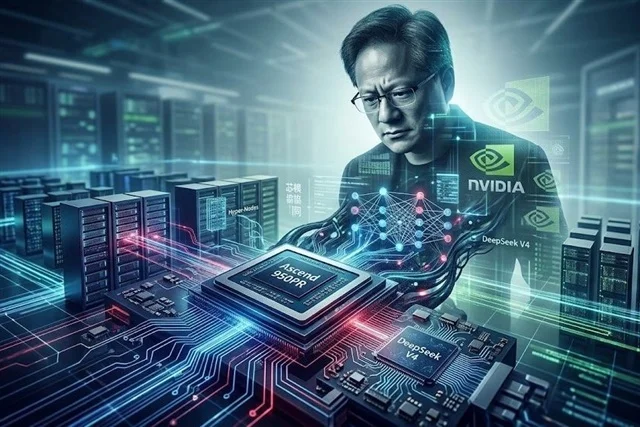
The most strategically significant element of DeepSeek V4 is its native optimization for Huawei’s Neural Processing Units (NPUs). In an era of tightening export controls and geopolitical tension, DeepSeek’s ability to run high-end AI on non-Western hardware stacks is a masterstroke of technological sovereignty. The metaphor that these models could ‘run on a toaster’ reflects the extreme efficiency of the DeepSeek-Huawei synergy.
By proving that non-CUDA architectures can handle complex, large-scale inference with high reliability, DeepSeek is providing a blueprint for a parallel AI economy. This synergy demonstrates that architectural ingenuity can effectively bridge the gap created by hardware scarcity. It challenges the assumption that AI progress is inherently tethered to a specific Silicon Valley supply chain, offering an alternative path for global markets looking to decouple from traditional GPU reliance.
Insight: The Global Decoupling of the AI Ecosystem
The long-term impact of DeepSeek V4 extends far beyond cost savings; it marks the beginning of a global decoupling of the AI hardware market. For years, the industry has been criticized for its over-reliance on a monolithic CUDA-based infrastructure. DeepSeek V4 shatters this status quo by proving that high-performance intelligence can be democratized through hardware diversity.
If NPUs and other specialized architectures can deliver competitive results at a fraction of the cost, the strategic advantage currently held by Western GPU manufacturers will begin to erode. This ‘democratization of inference’ means that AI capabilities will soon permeate sectors previously deemed too resource-heavy. The critique of the current market is its lack of resilience—by diversifying the hardware on which intelligence can run, DeepSeek is making the global AI ecosystem more robust and less susceptible to geopolitical leverage.
The next phase of competition will be won by those who can optimize for the most diverse and cost-effective hardware stacks, not just those with the largest compute budgets.