🔍 Executive Summary
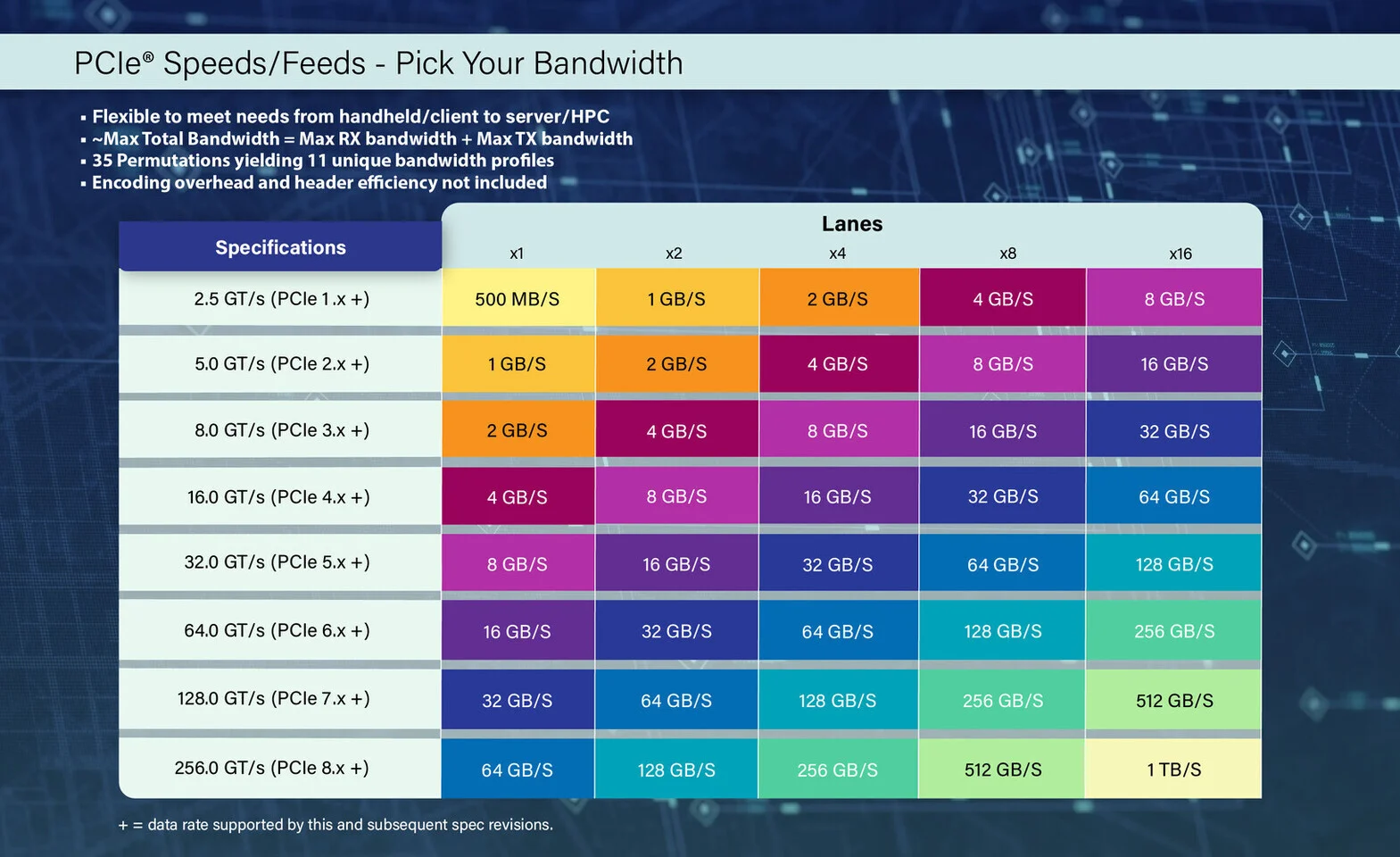
- The advancement of PCIe 8.0 to draft 0.5 marks a critical move toward 1 TB/s bidirectional bandwidth, with the PCI-SIG exploring a mandatory shift in connector design to handle the extreme 256.0 GT/s signaling requirements.
Strategic Deep-Dive
Advancing to PCIe 8.0: The Quest for 1 TB/s Bandwidth
The PCI-SIG (Peripheral Component Interconnect Special Interest Group) has recently announced the progression of the PCIe 8.0 standard to its draft 0.5 milestone. This is a critical development for the future of high-performance computing, particularly as AI workloads continue to outpace the throughput capabilities of current-generation hardware. The primary ambition for PCIe 8.0 is to reach a bidirectional bandwidth of 1 TB/s, a figure that would have been unthinkable just a decade ago.
This doubling of performance from the already high targets of PCIe 7.0 is intended to facilitate the seamless movement of massive datasets across AI clusters and high-speed storage arrays, effectively mitigating the I/O bottlenecks that currently plague hyperscale data centers.
Technical Specifications: 256.0 GT/s and the Signal Integrity Crisis
Achieving the stated performance goals of PCIe 8.0 requires a raw bit rate of 256.0 GT/s. From an electrical engineering perspective, this represents a monumental challenge. As signaling frequencies increase, the physical properties of traditional copper traces on a PCB become problematic.
Signal attenuation—the loss of signal strength over distance—and electromagnetic interference (EMI) become exponentially more difficult to manage at these speeds. To maintain data integrity, the industry must transition toward more sophisticated signaling techniques, such as higher-order Pulse Amplitude Modulation (PAM) or even optical interconnects within the server chassis.
One of the most intriguing aspects of the v0.5 draft is the explicit mention of a potential new connector standard. For nearly two decades, the PCIe physical slot has remained a relatively consistent fixture in hardware design, offering a familiar form factor and reliable backward compatibility. However, at 256.0 GT/s, the mechanical tolerances and electrical characteristics of current slot designs are reaching their absolute breaking point.
A new connector would be engineered to minimize parasitic capacitance and maximize signal-to-noise ratios. This potential transition signifies a ‘clean break’ from the past, suggesting that the industry may prioritize raw performance over legacy compatibility to meet the demands of the next generation of hardware accelerators.
Implications for Future Hardware and Thermal Architectures
The adoption of a new physical connector for PCIe 8.0 would trigger a massive redesign cycle across the entire hardware ecosystem. Motherboard manufacturers would need to implement new trace routing strategies and potentially use more expensive, low-loss PCB materials. Furthermore, the increased bandwidth inevitably leads to higher power delivery requirements and greater heat dissipation in a concentrated area.
This means the entire thermal envelope of the server—from the GPU heatsinks to the airflow patterns within the chassis—will need to be re-evaluated.
For enterprise customers, the arrival of PCIe 8.0 will represent a major upgrade cycle. While it promises to unlock the full potential of next-generation NVMe drives and AI accelerators, it also introduces a layer of complexity regarding infrastructure longevity. As the standard moves toward version 1.0, the industry will be watching closely to see how the PCI-SIG balances the desperate need for speed with the logistical realities of hardware manufacturing.
Ultimately, PCIe 8.0 will be the bedrock of the 2027-2028 computing landscape, providing the necessary pipes for the ever-expanding oceans of data that power modern artificial intelligence.