🔍 Executive Summary
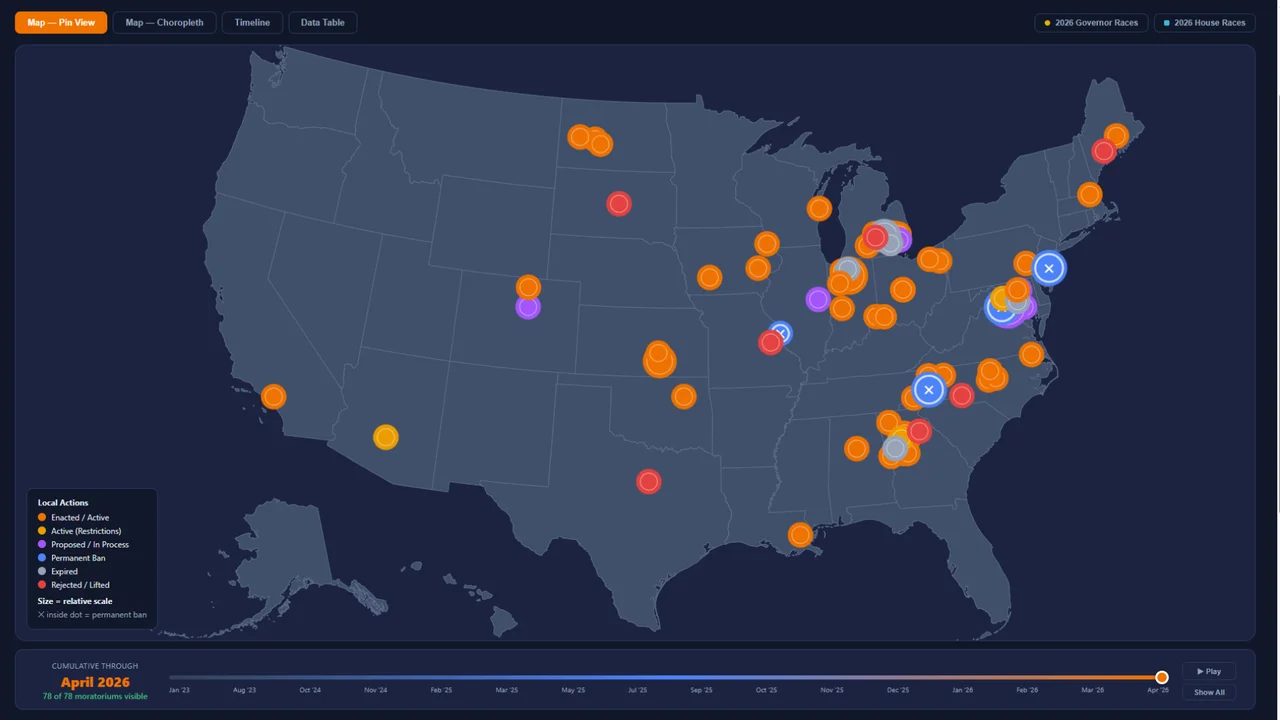
- The rapid proliferation of localized bans across 69 US jurisdictions, with 50 currently active as of April 2026, marks a significant regulatory obstacle for AI infrastructure scaling and hyperscale development.
Strategic Deep-Dive
The expansion of AI infrastructure in the United States is facing a critical bottleneck as local governance increasingly clashes with the needs of hyperscale developers. As of April 2026, the data points to a massive surge in regulatory pushback: 69 jurisdictions have initiated efforts to block new data center builds, with 50 individual bans currently in active effect. This regulatory contagion reflects a growing friction between the global race for AI dominance and the local concerns of communities regarding resource consumption, electricity grid stability, and environmental sustainability.
For the first time, the industry is seeing that raw capital and national security arguments are no longer sufficient to override local zoning boards and environmental protection agencies.
From a data architecture and infrastructure perspective, the scale of these bans is staggering. Hyperscalers like Google, Microsoft, and Amazon are attempting to deploy clusters that require hundreds of megawatts (MW) or even gigawatts (GW) of power capacity. In many of the 69 jurisdictions cited, this demand exceeds the available headroom of the aging US electrical grid, leading to fears of localized blackouts or sharp increases in utility costs for residential consumers.
Furthermore, the cooling requirements for H100/B200-class GPU clusters consume millions of gallons of water daily, a resource that is increasingly scarce in key development regions. The source’s most alarming detail is the classification of four of these moves as permanent. While a ‘moratorium’ is usually a temporary pause to allow for infrastructure assessment, a permanent ban signals a fundamental and final rejection of the data center industry as a compatible local partner.
This structural resistance suggests that the ‘NIMBY’ (Not In My Backyard) sentiment has evolved into a sophisticated regulatory movement equipped with technical arguments regarding carbon footprints and grid parity.
The implications for US AI leadership are profound and potentially damaging. If the physical hardware required to train next-generation models cannot scale due to domestic regulatory barriers, hyperscalers may be forced to look elsewhere—potentially leading to a decentralized or international shift in AI compute power to regions with more lenient environmental standards but higher geopolitical risks. The scale of the current opposition—affecting dozens of jurisdictions simultaneously—indicates that the industry has failed to address the ’externalities’ of AI growth.
We are witnessing the end of the era of unfettered data center expansion in the United States, replaced by a complex landscape of local veto power and stringent resource-usage mandates. To overcome this, tech giants must transition from being mere consumers of local resources to becoming active infrastructure partners, investing in localized renewable energy plants and advanced closed-loop cooling systems. Without such a shift, the 69 jurisdictions currently blocking development could soon become the majority, effectively capping the growth of the American AI sector at a time when global competition is at its peak.