🔍 Executive Summary
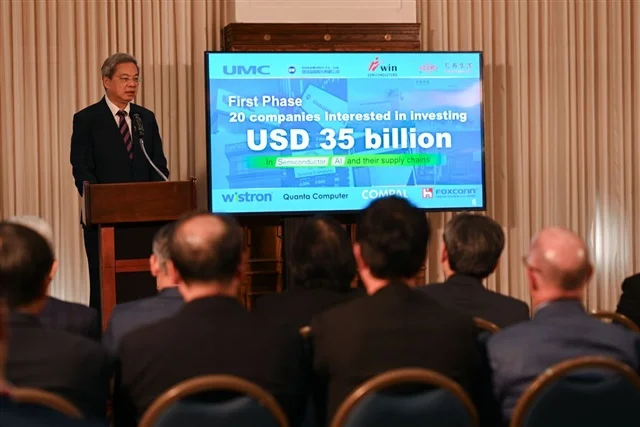
- Taiwanese firms, excluding TSMC, are set to invest $35 billion in the US, supported by a $50 billion government financing package. This movement is accelerated by April 2025 reciprocal tariff policies and strengthening bilateral trade ties.
Strategic Deep-Dive
The landscape of global technology manufacturing is undergoing a seismic shift as the Ministry of Economic Affairs (MOEA) of Taiwan officially confirmed a massive capital injection into the United States industrial base. According to the announcement made on May 6, 2026, approximately 20 prominent Taiwanese firms—notably excluding the foundry giant TSMC—have committed to investing a combined US$35 billion in US-based operations. This strategic move is being bolstered by the Taiwanese government’s proactive financial diplomacy, which involves lining up a staggering US$50 billion in financing to ensure these high-tech expansions are insulated from capital volatility.
This capital flight is not merely a corporate decision but a calculated response to the geopolitical and trade environment established by US President Donald Trump. The implementation of reciprocal tariffs in April 2025 was initially perceived as a protectionist barrier that might stifle trade. However, as a Senior Global Tech Journalist, I observe a fascinating paradox: these tariffs have acted as the ultimate catalyst for diplomatic progress.
The long-stalled negotiations for a comprehensive Taiwan-US economic and trade agreement have suddenly gained unprecedented momentum. By incentivizing local manufacturing through tariff pressure, the US administration has effectively forced a relocation of the supply chain, while the Taiwanese government has leveraged this to secure a more formalized trade status.
The logistical challenges of moving sophisticated supply chains from the dense industrial clusters of Asia to the United States are immense. Companies are grappling with higher labor costs, complex regulatory environments, and the need for a localized workforce skilled in advanced manufacturing. The US$50 billion financing package orchestrated by the MOEA is specifically designed to mitigate these ‘migration risks,’ providing the necessary liquidity for land acquisition, infrastructure development, and the integration of smart manufacturing technologies.
Furthermore, this US$35 billion investment serves as a strategic hedge. With the upcoming Trump-Xi summit in Beijing on May 14-15, Taiwanese firms are positioning themselves as indispensable components of the US domestic economy. By embedding their manufacturing capabilities within US borders, these 20 companies are essentially creating a ‘silicon insurance policy’ that protects them from potential shifts in US-China relations.
This proactive localization ensures that regardless of the summit’s outcome, Taiwan’s economic relevance remains anchored in American soil.
Ultimately, this movement signifies the end of the era of ‘globalization via cost-optimization’ and the birth of ‘globalization via geopolitical alignment.’ The unexpected diplomatic side effect of the 2025 tariff policy is a tighter, more resilient economic bond between Washington and Taipei, one where the flow of capital and technology is governed by shared security interests rather than just market efficiency. The US$35 billion is the stake, the US$50 billion is the fuel, and the trade agreement is the final destination for this new trans-Pacific economic architecture.