🔍 Executive Summary
- AMD's Ryzen 9 9950X3D2 introduces 3D V-Cache across both CCDs, addressing legacy inter-die latency. Benchmarks show significant gains in cache-sensitive tasks, but high thermal density and premium pricing position it as a niche enthusiast product.
Strategic Deep-Dive
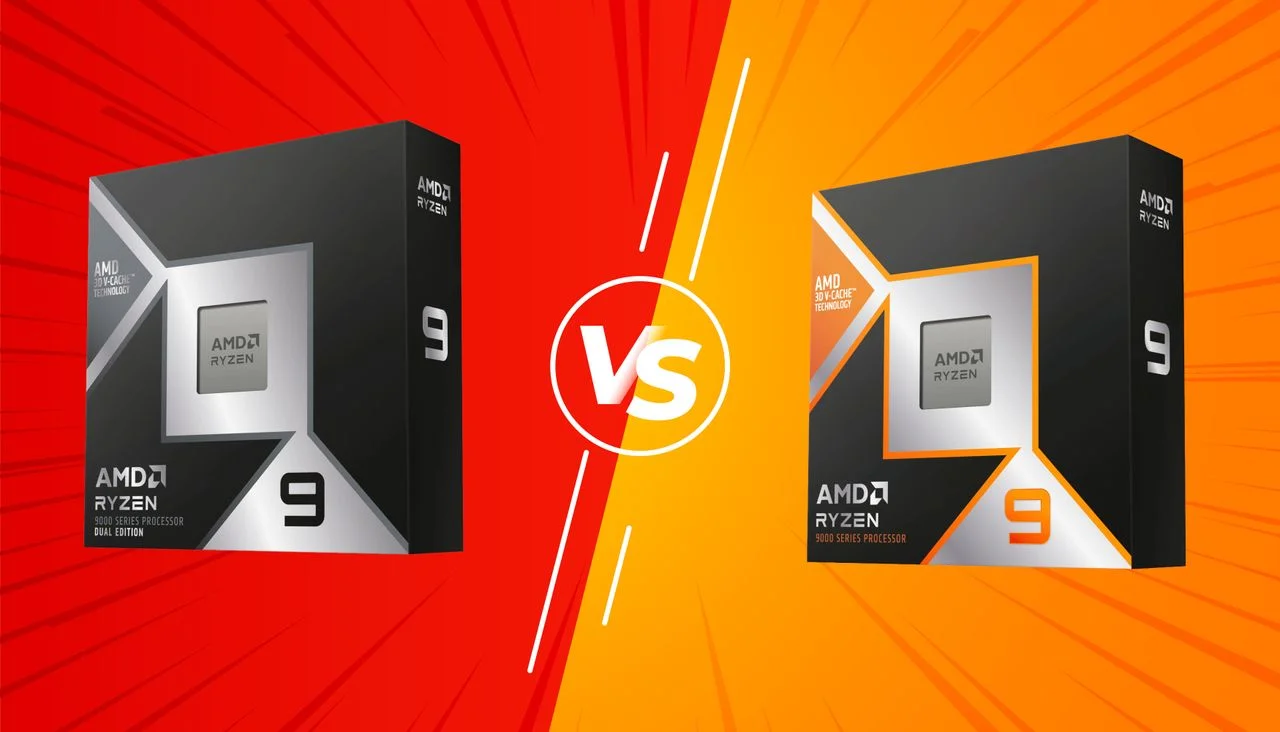
The launch of the AMD Ryzen 9 9950X3D2 represents a definitive answer to the architectural compromises that have defined the Zen-based enthusiast lineup for years. Historically, AMD’s 12 and 16-core X3D parts utilized an asymmetric design: one CCD featured the stacked 3D V-Cache, while the other was a standard high-frequency die. This created a persistent software headache, requiring Windows Game Mode or specialized drivers to steer latency-sensitive threads toward the ‘cache’ die.
The 9950X3D2 shatters this paradigm by implementing dual-cache stacking—placing a 64MB 3D V-Cache slice on top of both CCDs. This technical leap is enabled by refined Hybrid Bonding and Through-Silicon Via (TSV) technology, allowing for a seamless, high-bandwidth vertical interconnect that doesn’t significantly compromise the structural integrity of the silicon.
Our ‘six-round gauntlet’ of benchmarking reveals the tangible benefits of this symmetrical approach. In gaming, the primary advantage is the elimination of the ‘scheduling penalty.’ When a game thread accidentally migrated to the non-cache CCD on previous models, performance plummeted; on the 9950X3D2, every core is a ‘cache core.’ This leads to vastly improved frame-time consistency in titles with complex NPC AI or heavy physics calculations. Beyond gaming, the 9950X3D2 shines in specialized productivity workloads.
Scientific simulations, large-scale software compilation, and certain CAD applications that benefit from massive L3 pools see scaling that single-cache variants simply cannot match. The dual-cache layout effectively reduces the need for the CPU to fetch data from much slower system RAM, keeping the 16 cores fed with data more efficiently than any consumer-grade processor to date.
However, as a senior analyst, I must highlight the physical and economic trade-offs of this ‘more is more’ philosophy. Thermal density is the primary adversary here. Stacking silicon acts as an insulator, making it harder to dissipate heat from the core logic underneath.
To maintain peak boost clocks, users will need top-tier 360mm or 420mm AIO coolers, or custom loops. Furthermore, the yield rates for such complex 3D packaging are lower than standard dies, translating to a significant price premium. While the 9950X3D2 is a masterclass in semiconductor packaging, its market position is clear: it is an ‘Application Specific’ consumer chip for those whose workloads demand extreme memory throughput.
My prediction is that this dual-cache configuration will remain a halo product for the next two generations before the packaging costs drop enough to allow for a ‘700-series’ equivalent. For now, it is a glorious, expensive proof of concept that AMD currently owns the high-end packaging crown.