🔍 Executive Summary
- In-depth technical analysis reveals that the Galaxy Watch's Always-on Display can actually extend battery life by reducing energy-intensive sensor polling and preventing frequent CPU interrupts associated with gesture-based activation.
Strategic Deep-Dive
The prevailing wisdom in the world of wearable technology has long suggested that disabling the Always-on Display (AOD) is the primary method for extending a smartwatch’s battery life. However, a sophisticated technical audit of the Samsung Galaxy Watch’s hardware architecture reveals a fascinating counter-intuitive phenomenon. In many real-world usage scenarios, maintaining an active AOD can actually lead to lower overall power consumption than relying on the ‘Raise to Wake’ or gesture-based activation settings.
Understanding this paradox requires a deep dive into the interplay between sensor polling rates, CPU interrupt cycles, and the physics of modern display backplanes.
At the center of this efficiency equation is the energy cost of motion sensing. When a Galaxy Watch is configured for gesture recognition, its internal sensor suite—specifically the accelerometer and gyroscope—must remain in a high-sensitivity, high-frequency sampling state. This is necessary to ensure the device can instantly detect the subtle rotation of a user’s wrist.
While the power draw of the sensors themselves is relatively low, the constant stream of data requires the sensor hub to stay active and periodically wake the main application processor to interpret movement patterns. Furthermore, for active individuals, ‘false positives’ are frequent. Every time the watch incorrectly triggers a screen-on event during common activities like walking or driving, the system undergoes a full cold start.
This forces the display to jump to high brightness and the OS to load the full user interface, creating massive power spikes that are significantly more damaging to battery longevity than a consistent, low-level discharge.
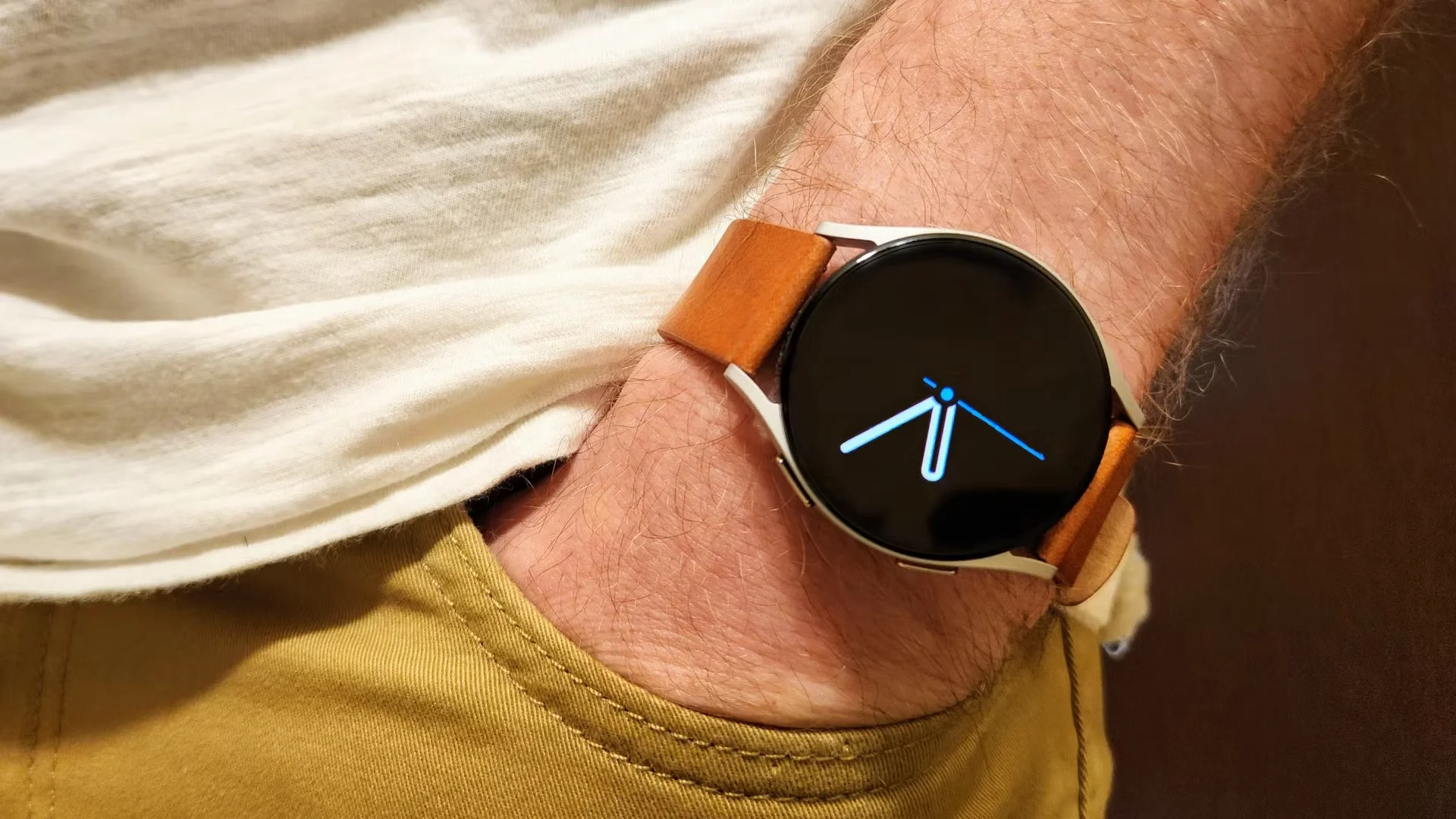
In contrast, the Galaxy Watch utilizes advanced LTPO (Low-Temperature Polycrystalline Oxide) display technology. In AOD mode, this allows the screen to operate at a refresh rate as low as 1Hz, or one frame per second. At this rate, the display driver IC consumes negligible power, and the pixels require only a fraction of the energy needed for full illumination.
Because the time and basic complications are already visible, the user does not need to perform exaggerated movements to check the device, allowing the motion sensors to shift into a low-power, low-sensitivity monitoring mode. More importantly, the system’s main processor can remain in a deep sleep state for extended periods, as it no longer needs to manage the constant cycle of waking the UI and putting it back to sleep.
Ultimately, for the modern user who checks their device dozens of times an hour, the cumulative energy cost of these ‘wake-up’ cycles far exceeds the steady background energy used by a static, low-refresh AOD. This highlights a fundamental evolution in wearable design where maintaining a constant, low-energy state is technologically superior to a volatile cycle of high-energy bursts. Consequently, as LTPO technology continues to mature, the AOD feature is transforming from a luxury that drains power into a sophisticated tool for stabilizing a device’s daily energy profile, proving that in the realm of power management, a steady flame is often more efficient than a series of sparks.