🔍 Executive Summary
- AMD has introduced DGF SuperCompression (DGFS), an advanced iteration of its Dense Geometry Format graphics stack. By achieving an additional 22% reduction in geometry file sizes, the technology directly competes with NVIDIA’s RTX Mega Geometry to optimize VRAM and storage efficiency in high-fidelity gaming.
Strategic Deep-Dive
As AAA game assets continue to swell in size, the graphics industry is shifting its focus toward sophisticated data management. AMD’s newly announced DGF SuperCompression (DGFS) represents a significant milestone in this evolution. Building on the Dense Geometry Format (DGF) framework introduced last year, DGFS is a specialized compression algorithm within the graphics stack designed to tackle the ballooning complexity of 3D meshes and vertex data.
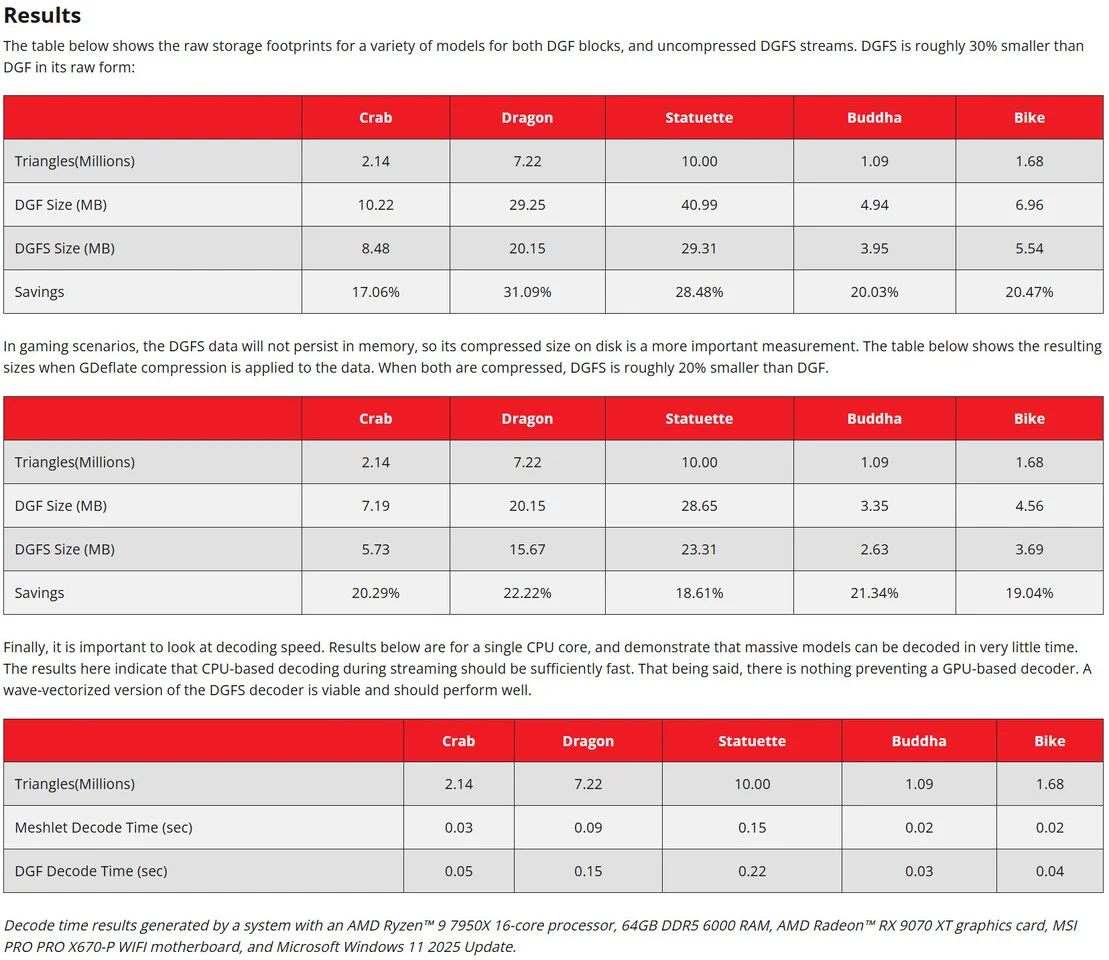
Technically, DGFS serves as a potent response to NVIDIA’s RTX Mega Geometry suite. By leveraging advanced entropy encoding and geometric simplification patterns, DGFS is capable of shrinking geometry file footprints by up to 22% compared to the standard DGF format. This 22% reduction is critical; it directly translates to improved effective VRAM bandwidth.
By moving fewer bits across the system bus for the same level of geometric detail, the GPU can allocate more cycles to complex shader operations and ray-tracing calculations rather than waiting for data to be fetched from storage or system memory.
The implications for modern game development are profound. With the industry moving toward ultra-dense assets—often inspired by film-grade photogrammetry—storage drives and memory controllers are becoming the primary performance bottlenecks. DGFS allows developers to pack more high-fidelity detail into a limited memory budget, enabling richer environments without requiring a jump to a higher tier of hardware.
As software-defined optimization becomes as important as raw transistor counts, AMD’s DGFS provides a scalable path forward for the Radeon ecosystem to maintain parity in the high-end gaming market.