🔍 Executive Summary
- MIT researchers have successfully utilized additive manufacturing to realize a 40-year-old triangular zipper mechanism that allows robotic structures to transition from extreme flexibility to high structural rigidity.
Strategic Deep-Dive
The Rebirth of a Dormant Mechanical Concept
In a landmark development for structural engineering, researchers at the Massachusetts Institute of Technology (MIT) have successfully operationalized the ‘Y-Zipper,’ a mechanical concept first theorized over four decades ago. While the triangular interlocking mechanism was conceptually sound in the 1980s, the manufacturing tolerances required to produce such intricate, three-dimensional interlocking teeth were beyond the reach of traditional machining. The advent of high-resolution 3D printing has served as the technological catalyst, allowing engineers to fabricate these complex geometries with sub-millimeter precision.
This revival signifies more than just a historical nod; it represents a fundamental shift in how we approach the duality of flexibility and rigidity in robotic systems.
Engineering the Mechanical Phase Change
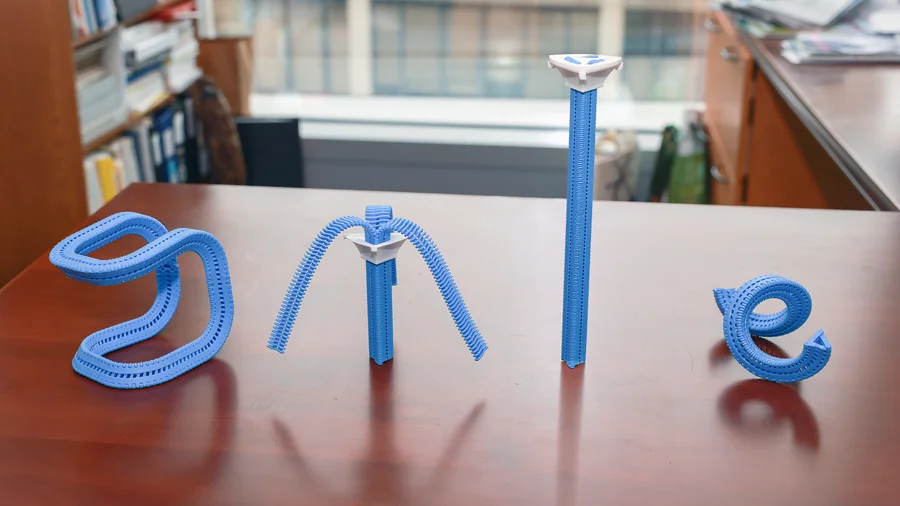
From a systems architecture perspective, the Y-Zipper operates on a principle of ‘geometric constraint.’ The system consists of three flexible, 3D-printed strands featuring a specific triangular profile. When disengaged, these strands possess high compliance, behaving much like ‘floppy tentacles’ that can navigate complex, non-linear environments. However, the moment the zipper mechanism engages, the three strands converge into a unified triangular column.
This transition causes an exponential increase in the second moment of area—a critical engineering metric for structural stiffness.
What makes the MIT implementation unique is the stress-distribution properties inherent in the Y-Zipper’s geometry. Unlike traditional joints that concentrate stress at a single pivot point, the Y-Zipper distributes mechanical loads across the entire length of the interlocked structure. This design effectively creates a rigid beam capable of supporting significant weights while maintaining a lightweight profile.
The speed of this transition—moving from high-compliance flexibility to high-stiffness rigidity in seconds—allows for a dynamic response to environmental stimuli that was previously impossible with rigid-link robotics.
Implications for Modular and Deployable Systems
The broader implications for industrial and soft robotics are profound. We are moving toward a future of ‘variable stiffness’ systems. In the context of aerospace engineering, the Y-Zipper offers a revolutionary solution for deployable frameworks.
Imagine a compact, flexible coil transported within a satellite’s payload that, upon reaching orbit, zips into a rigid 10-meter truss to support solar arrays or communication dishes. The weight savings and reliability of a purely mechanical locking system, devoid of complex hydraulics or electronic actuators at every joint, cannot be overstated.
Furthermore, this technology enhances the modularity of robotic limbs. By integrating Y-Zipper segments into robotic architectures, developers can create ’liminal’ machines that transition between the adaptability of soft robotics and the precision of industrial automation. As we look toward the next generation of automated systems, the ability to program physical matter to change its mechanical properties on demand—moving from a state of latency to structural reliability—will be the cornerstone of resilient, adaptive infrastructure.
MIT’s breakthrough proves that sometimes the most futuristic solutions are found by applying modern data-driven manufacturing to the visionary concepts of the past.