🔍 Executive Summary
- In a bid to eliminate performance bottlenecks in massive GPU clusters, OpenAI has partnered with Nvidia, AMD, Intel, Microsoft, and Broadcom to establish the MRC protocol, a new standard for AI training reliability.
Strategic Deep-Dive
Deconstructing the AI Training Bottleneck: The Advent of MRC
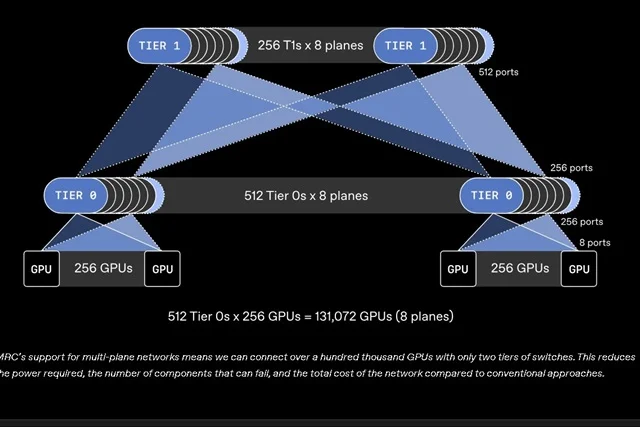
As AI models scale toward trillions of parameters, the primary constraint on performance has shifted from raw compute power to the efficiency of the interconnect fabric. Large-scale training runs are frequently plagued by synchronization overhead and hardware failures that can derail progress for days. To address this, OpenAI has spearheaded a formidable alliance with industry titans—including Nvidia, AMD, Intel, Microsoft, and Broadcom—to develop and implement the MRC (Memory-Reliability-Communication) protocol.
From the perspective of a Senior Data Architect, MRC is a response to the inherent limitations of existing standards like InfiniBand and RoCE (RDMA over Converged Ethernet) when applied to the specific, deterministic patterns of AI collective communication. The protocol aims to mitigate the ‘straggler effect,’ where a single lagging GPU node forces the entire 100,000-node cluster to idle, resulting in millions of dollars in wasted compute time.
Solving Tail Latency and Synchronization Overhead
The technical core of the MRC protocol focuses on minimizing tail latency—the delay of the slowest packet—which is the Achilles’ heel of distributed AI training. In traditional networking, packet loss recovery often involves high-overhead retransmission cycles that are incompatible with the real-time requirements of All-Reduce and All-to-All communication primitives. MRC introduces a more granular, software-defined congestion control mechanism that allows the AI orchestration layer to prioritize critical synchronization traffic over less sensitive data flows.
By integrating AMD, Nvidia, and Intel into a single protocol framework, OpenAI is ensuring that heterogeneous hardware environments can operate with the same level of deterministic performance previously only available in monolithic, single-vendor ecosystems. This level of architectural synchronization is essential for preventing thermal throttling and synchronization-induced stalls that occur during peak training loads.
The Software-Defined Standard: A Paradigm Shift in Power Dynamics
The formation of the MRC consortium represents a historic power shift in the tech ecosystem. Historically, hardware vendors like Nvidia dictated the interconnect topology and networking standards, forcing software developers to adapt. Now, the roles are reversed.
OpenAI, as the primary consumer of high-end compute, is effectively dictating the terms of hardware networking to suit its software architecture. By bringing together fierce competitors under the MRC banner, OpenAI is fostering a collaborative ecosystem that prioritizes infrastructure uptime and training reliability over proprietary hardware lock-in. For a Data Architect, this signifies the rise of ‘software-defined hardware,’ where the networking fabric is no longer a static component but a dynamic layer that evolves in response to the specific requirements of large-scale generative models.
The MRC protocol is poised to become the benchmark for reliability in the AI era, ensuring that the next generation of infrastructure can scale without being crippled by the very interconnects meant to power it.