🔍 Executive Summary
- In response to the unprecedented thermal challenges of generative AI, Chenbro is pivoting from a high-volume chassis manufacturer to a specialized provider of AI infrastructure solutions, focusing on liquid-cooling systems and integrated rack architectures.
Strategic Deep-Dive
Chenbro, a name long synonymous with robust server chassis manufacturing, is currently executing one of the most critical pivots in its corporate history. As the CEO, Corona Chen, has articulated, the explosion in generative AI demand is not merely a software trend; it is a physical architecture crisis for modern data centers. With the industry moving toward ultra-high-density clusters—specifically those housing NVIDIA’s Blackwell architecture—the traditional air-cooled server chassis is rapidly becoming obsolete.
In response, Chenbro is expanding its operational scope to encompass the entire thermal and mechanical envelope of the AI rack, moving aggressively into Cooling Distribution Units (CDUs) and advanced liquid-cooling cabinets.
From a data systems architect’s perspective, the transition to liquid cooling is a non-optional requirement for racks exceeding 50kW of power density. Typical high-performance AI clusters are now pushing 100kW to 120kW per rack, where the thermal resistance of air is simply too high to prevent GPU throttling. Chenbro is leveraging its decades of expertise in precision mechanical design to solve these issues.
Designing a CDU involves more than just plumbing; it requires sophisticated control logic for flow rates, pressure differential monitoring, and integration with the primary and secondary cooling loops of the data center. By mastering the mechanical integrity of manifolds and the hydraulic dynamics of Direct-to-Chip (D2C) systems, Chenbro is positioning itself to be more than a vendor—it is becoming a systems integrator.
The shift from a component manufacturer to a rack-level solution provider reflects a broader trend in the hardware supply chain. Large-scale cloud service providers (CSPs) and hyperscalers are increasingly seeking turnkey infrastructure. This means Chenbro is now responsible for the mechanical interplay between the GPU servers, the power shelf, and the liquid-to-liquid heat exchangers.
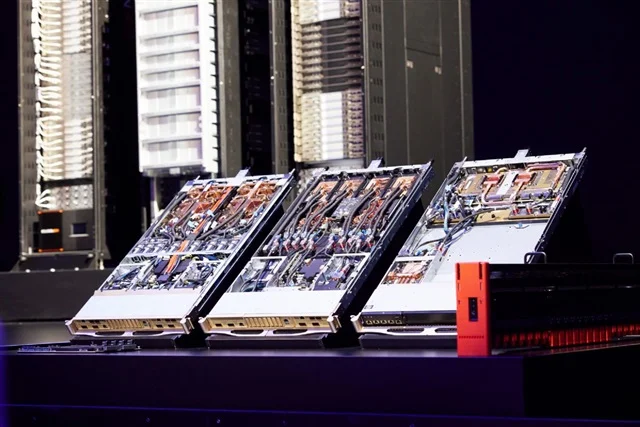
Their new portfolio includes IT racks with integrated manifold systems that allow for ‘blind-mate’ liquid connections, reducing the risk of human error during maintenance and increasing the serviceability of high-density AI clusters.
Furthermore, this pivot addresses the ‘Watt-per-rack’ challenge that is currently bottlenecking global AI deployments. By providing pre-validated, liquid-cooled rack architectures, Chenbro helps data center operators reduce their Power Usage Effectiveness (PUE) and increase the compute density of existing floor space. This strategy is not only about following the AI hype; it is a calculated expansion into the high-margin sector of thermal management hardware.
As the market moves toward 2026, the ability to provide a complete mechanical and thermal solution will differentiate winners in the server supply chain. Chenbro’s evolution from sheet metal bending to complex hydraulic and thermal engineering is a textbook case of how hardware leaders must adapt to the relentless power requirements of the silicon they house.