🔍 Executive Summary
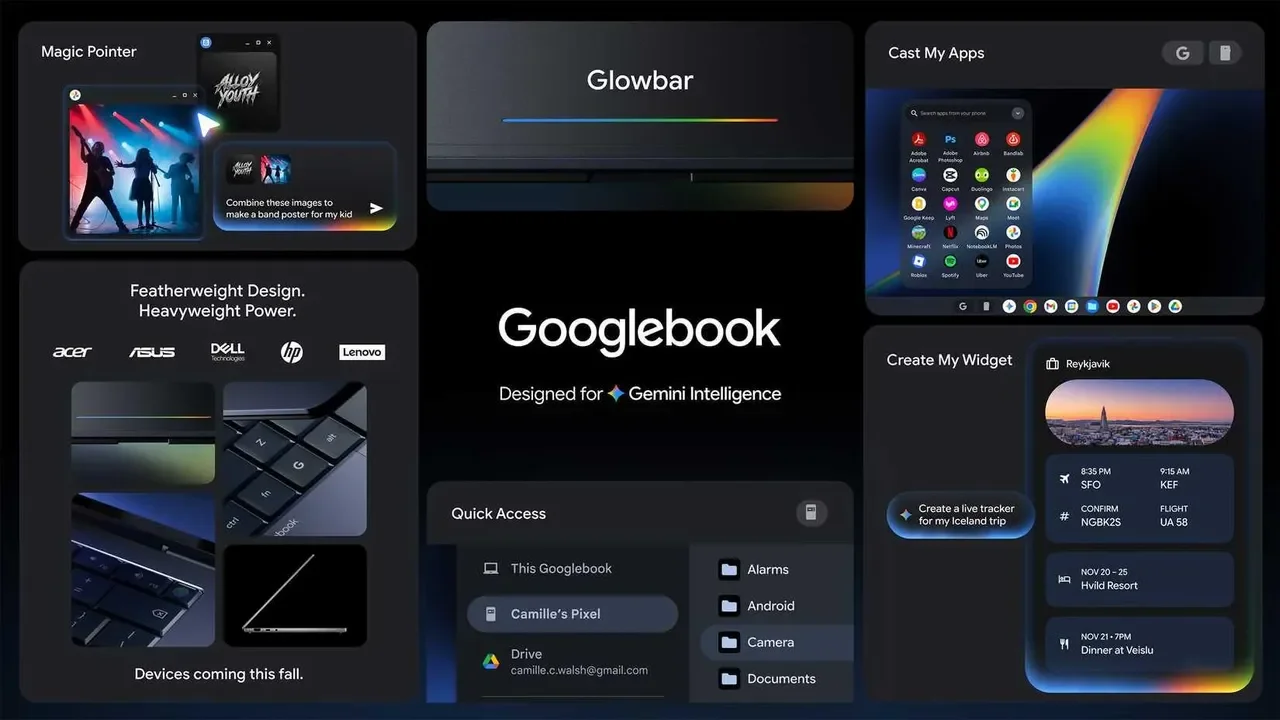
- Google has officially launched the 'Googlebook', a revolutionary laptop category that merges Android and ChromeOS under a unified Gemini-led AI intelligence layer.
Strategic Deep-Dive
On May 12, 2026, Google shattered the traditional boundaries of mobile computing with the official unveiling of the ‘Googlebook’. This is not merely a new hardware product; it represents the culmination of a long-rumored internal project to unify Google’s fragmented software ecosystems into a cohesive, AI-driven architecture. The Googlebook is the first device of its kind to be described as ‘AI-native,’ meaning that the Gemini AI model is not an add-on application but a fundamental component of the operating system’s kernel.
By merging the Android app ecosystem with the robust browser-centric power of ChromeOS, Google has created a hybrid environment that leverages the strengths of both platforms while removing the friction that has historically plagued cross-platform development within the Google ecosystem.
From a technical data architect’s perspective, the Googlebook introduces an ‘Intelligence Layer’ that sits between the hardware abstraction layer (HAL) and the user interface. This layer functions as a persistent neural processing entity that monitors system-wide telemetry to optimize power distribution, memory management, and application performance in real-time. Unlike traditional laptops where AI features are triggered by specific user commands, the Googlebook’s architecture allows Gemini to act as a proactive agent.
For instance, the system can autonomously synthesize data from Android-based communication apps and Chrome-based research tools to prepare a user’s work environment before they even open their first document. This deep integration is a direct strategic challenge to Apple’s MacBook Pro, which relies on its Neural Engine for specific tasks but has yet to fully cede OS-level control to a generative AI model.
Investigative analysis of Google’s May 12 reveal suggests that the Googlebook is also a vehicle for Google’s custom silicon ambitions. To support the intensive on-device processing required by a system-wide Gemini layer, the hardware likely features specialized Tensor processing units (TPUs) designed for low-latency inference. This shift away from a general-purpose computing model toward a domain-specific, AI-centric architecture marks the beginning of the ‘Post-PC’ era in earnest.
The Googlebook aims to capture the enterprise and creative markets by offering a level of automated productivity that traditional operating systems cannot match. By centralizing Gemini as the arbiter of the user experience, Google is betting that the future of computing lies in ‘predictive orchestration’ rather than manual input. As the market digests this launch, the success of the Googlebook will serve as the ultimate litmus test for whether consumers are ready to embrace hardware that is inextricably linked to the continuous evolution of large language models.
This move fundamentally shifts the competitive landscape, forcing rivals to reconsider their software-hardware integration strategies in an increasingly AI-dominated world.