🔍 Executive Summary
- Fiberhome Telecommunication Technologies has unveiled a record-breaking optical fiber preform, a critical move to dominate the physical layer of AI infrastructure by optimizing throughput density and manufacturing scale.
Strategic Deep-Dive
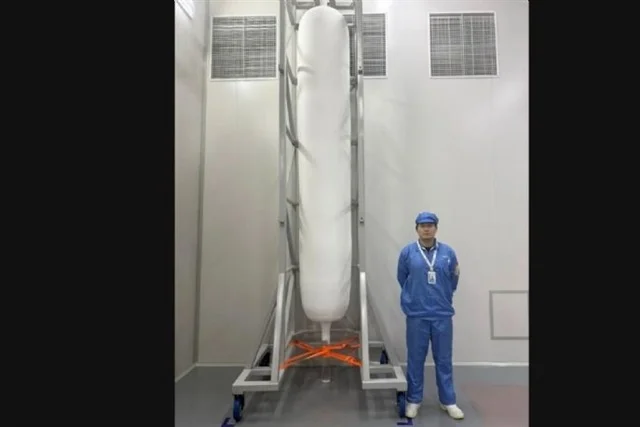
In an era where Artificial Intelligence (AI) compute power is often limited by interconnect bottlenecks, Fiberhome Telecommunication Technologies has introduced a strategic solution that targets the very bedrock of networking: the optical fiber preform. By unveiling what is currently categorized as the world’s largest optical fiber preform, the Chinese telecommunications giant is addressing the massive demand for high-capacity Data Center Interconnect (DCI) and long-haul backbones that sustain the global AI boom. From the perspective of a Lead Data Architect, this is not merely a manufacturing milestone; it is a fundamental shift in the scalability of the physical layer.
The optical fiber preform is the high-purity glass cylinder from which fiber strands are drawn. The scale of this preform directly correlates with manufacturing throughput and the structural integrity of the resulting fiber. In AI clusters, where synchronization latency between thousands of H100 or B200 GPUs is measured in nanoseconds, any reduction in signal attenuation is a victory.
Larger preforms allow for the drawing of longer, continuous fiber strands with fewer fusion splices. Every splice in a fiber network introduces a point of potential signal loss and reflection. By minimizing these points, Fiberhome’s technology facilitates a cleaner signal path, essential for supporting 800Gbps and the upcoming 1.6Tbps networking standards that define the next generation of AI infrastructure.
Technically, the production of such a massive preform requires mastery over complex Chemical Vapor Deposition (CVD) processes, specifically focusing on Vapor Axial Deposition (VAD) or Outside Vapor Deposition (OVD). Managing the thermal envelope during the soot deposition and subsequent sintering phase is an architectural challenge; a preform of this size must be cooled and handled with extreme precision to avoid micro-cracks that would lead to devastating transmission failures at high frequencies. Fiberhome has integrated advanced sensors and AI-driven process controls to maintain a uniform refractive index profile across the entire volume of the glass.
Strategically, this move secures China’s foothold in the AI supply chain at a time when upstream semiconductor access is constrained. While logic chips face geopolitical hurdles, the physical transport layer—fiber optics—remains an area where China can exert significant market influence through sheer scale and cost efficiency. The integration of these high-capacity fibers into global data centers will likely lower the Total Cost of Ownership (TCO) for hyper-scalers while simultaneously reinforcing the dominance of Chinese optical hardware.
As we move toward larger LLMs (Large Language Models) that require terabits-per-second of inter-rack connectivity, the ability to produce superior optical precursors at scale becomes a significant competitive advantage. Fiberhome is positioning itself not just as a vendor, but as the architect of the high-speed conduits that will carry the world’s most critical AI workloads, ensuring that the physical limitations of light transmission do not become the ceiling for machine intelligence.