🔍 Executive Summary
- Leaked documents reveal Google’s plans for 'Googlebook,' an Android-based platform designed to succeed Chromebook, featuring deep Gemini AI integration and a dynamic 'Glowbar' interface for a unified hardware-software experience.
Strategic Deep-Dive
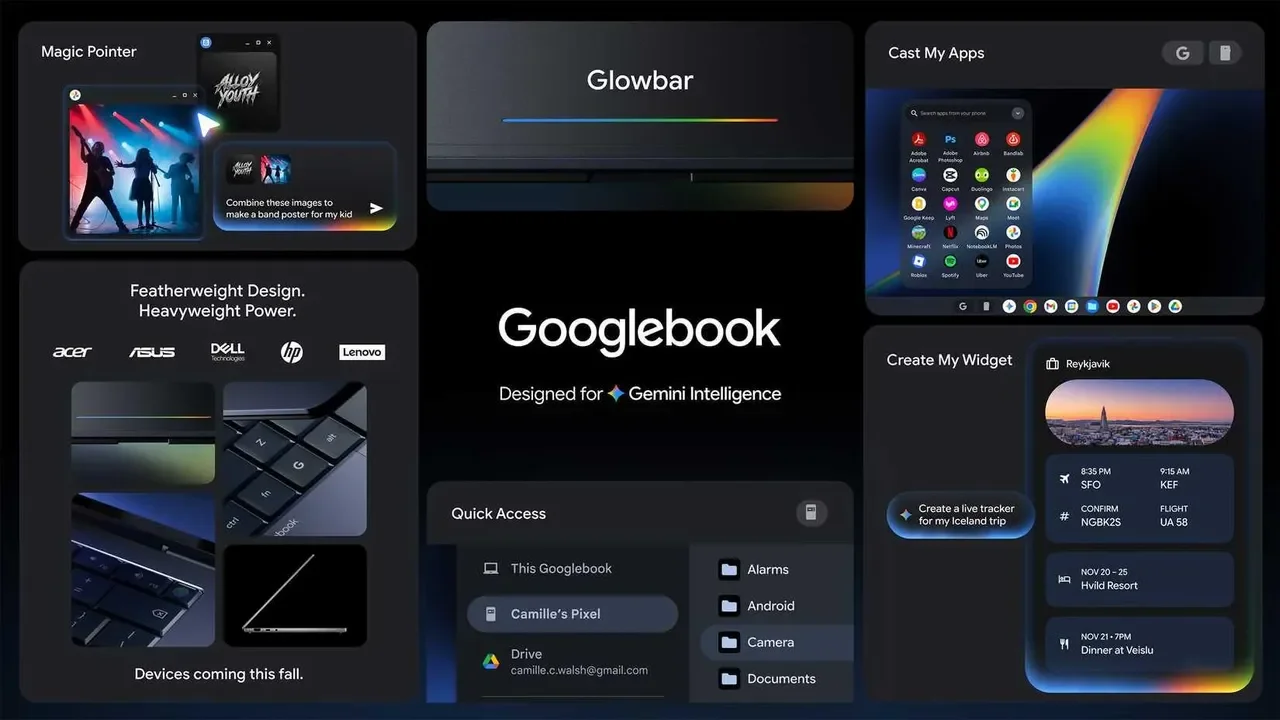
Google is reportedly poised to disrupt its own mobile computing legacy with the introduction of ‘Googlebook,’ a new laptop platform designed to succeed the long-standing Chromebook brand. According to leaks surfacing ahead of a major reveal event, the Googlebook marks a definitive transition from the cloud-centric ChromeOS to a robust, Android-powered architecture. This strategic pivot is not merely a change in operating systems; it represents a fundamental reimagining of the laptop as an extension of the Android ecosystem.
By leveraging the vast application library and developer support of Android, Google aims to eliminate the limitations that have historically hindered Chromebooks in high-performance and creative workflows. This move aligns with a broader industry trend where mobile and desktop architectures are merging into a single, seamless user experience.
At the core of the Googlebook experience is ‘Gemini Intelligence,’ a deep integration of Google’s flagship generative AI. Unlike previous iterations where AI felt like an add-on, Gemini is baked into the kernel of the Googlebook’s OS, facilitating seamless task automation, intelligent search, and contextual assistance across all applications. A physical manifestation of this integration is the ‘Glowbar,’ a dynamic hardware feature that provides visual feedback based on the system’s activities and Gemini’s processing state.
This hardware-software synergy suggests a level of polish and intent that aims to challenge the dominance of macOS and Windows in the premium segment. The Glowbar, in particular, signals a move toward ’emotional hardware’ that communicates with the user in ways more intuitive than traditional UI elements.
One of the most compelling aspects of the Googlebook platform is its native integration with the broader Android device landscape. Google is prioritizing ‘mobile-to-PC continuity,’ allowing users to transition workflows between their smartphones and laptops with zero friction. Looking at the long-term industry forecast, the Googlebook launch is expected to significantly impact the x86 vs.
ARM laptop market share. As Google optimizes Android for its own ARM-based silicon, Microsoft and Intel will face renewed pressure to improve the efficiency of Windows on ARM. If Google can successfully attract developers to build high-performance ‘Android for Desktop’ apps, the Googlebook could become the primary choice for a generation that grew up on mobile interfaces but requires the power of a laptop.
The success of this platform will likely redefine the standards for modern personal computing, forcing competitors to accelerate their own AI and ecosystem integration efforts.