🔍 Executive Summary
- In a milestone for the AI economy, CME Group and Silicon Data have established a compute futures market, allowing enterprises to hedge against the volatile pricing of GPU and cloud resources.
Strategic Deep-Dive
The Financialization of Compute: AI as the New Commodity
CME Group, the world’s preeminent derivatives marketplace, has announced a groundbreaking partnership with Silicon Data to establish the first formal AI compute futures market. This development marks the definitive transition of computing power—specifically High-Performance Computing (HPC) and GPU cycles—from a specialized service into a standardized global commodity. As AI model scaling continues to demand unprecedented levels of silicon, the volatility in rental rates for Nvidia H100s, B200s, and their successors has become a significant systemic risk for the technology sector.
By launching this market, CME Group is providing a sophisticated financial infrastructure to stabilize the ‘digital oil’ that powers the 21st-century economy.
Benchmarking the Cloud: The Role of Silicon Data
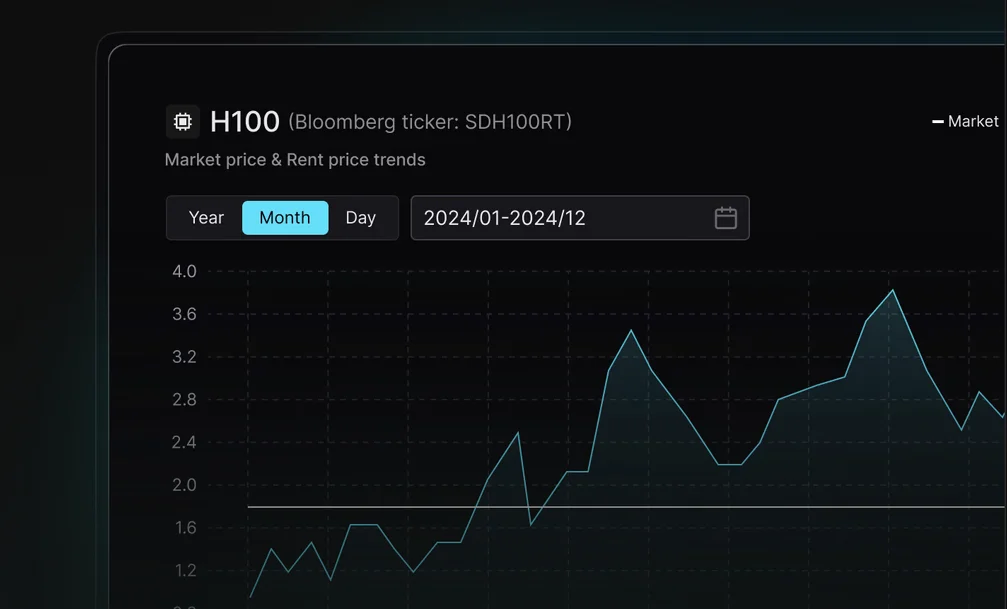
The integrity of a futures market depends entirely on its underlying index. Silicon Data has emerged as the critical oracle for this ecosystem, providing high-fidelity price indexes that aggregate real-time rental data from public clouds (AWS, GCP, Azure), private GPU clusters, and emerging decentralized compute networks. This index accounts for factors such as regional power costs, data center vacancy rates, and the secondary market pricing of AI accelerators.
For a data systems architect, this transparency is revolutionary. It allows for the objective valuation of compute resources based on supply-and-demand fundamentals rather than opaque, negotiated pricing between enterprises and hyperscalers. The Silicon Data index will serve as the trusted benchmark for all contracts traded on the CME, fostering a level of price discovery previously unseen in the semiconductor and cloud infrastructure sectors.
Strategic Risk Mitigation: The CTO and CFO Perspective
The launch of compute futures has profound implications for the ‘CapEx vs. OpEx’ debate within corporate leadership. Currently, Chief Technology Officers (CTOs) must navigate a landscape where a sudden spike in demand for inference can decimate a company’s quarterly budget if they are reliant on spot-market cloud pricing.
Meanwhile, Chief Financial Officers (CFOs) have struggled to model long-term AI profitability due to the lack of predictable infrastructure costs. Through CME’s new futures contracts, organizations can now implement rigorous hedging strategies. An enterprise planning a massive model refresh in 18 months can go long on compute futures today, effectively locking in their infrastructure costs and ensuring project viability regardless of future supply chain shocks or geopolitical shifts in the semiconductor industry.
Furthermore, this financialization creates a secondary market for compute liquidity, allowing providers to sell forward their capacity to fund the construction of next-generation data centers. This symbiotic relationship between finance and AI infrastructure represents a major step toward a more resilient and predictable global AI ecosystem.