🔍 Executive Summary
- In a landmark collaboration, Foxconn's research division and French startup Quobly have released an open-source QPE numerical toolbox, aiming to standardize and accelerate fault-tolerant quantum computing for materials science and chemistry.
Strategic Deep-Dive
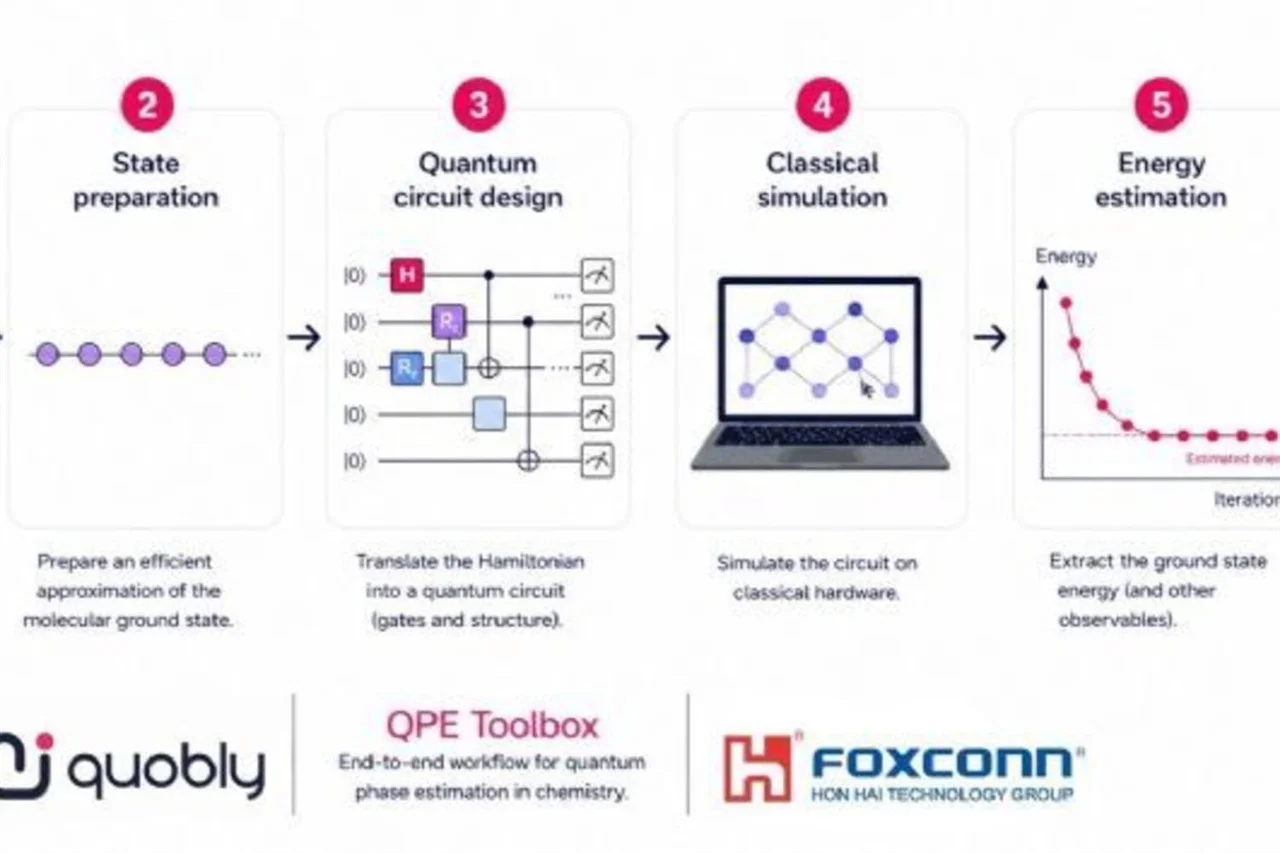
The collaboration between the Hon Hai Research Institute (HHRI)—the R&D powerhouse of Foxconn—and French quantum startup Quobly represents a significant milestone in the journey toward practical, fault-tolerant quantum computing. On Tuesday, the partners announced the release of an open-source numerical toolbox dedicated to Quantum Phase Estimation (QPE). This release is strategically designed to provide researchers and industrial developers with the high-fidelity tools necessary to simulate and validate quantum algorithms before they are deployed on actual hardware.
As the quantum industry shifts its focus from ’noisy intermediate-scale’ devices to robust, error-corrected systems, such numerical toolboxes are essential for bridging the gap between theory and application.
Quantum Phase Estimation is widely considered one of the ‘crown jewels’ of quantum algorithms. It serves as a foundational subroutine for many other advanced protocols, most notably in the domain of quantum simulation. By determining the eigenvalues of a unitary operator with high precision, QPE allows for the accurate modeling of molecular Hamiltonians.
This has direct, transformative implications for quantum chemistry and materials science. For instance, the ability to simulate the nitrogen fixation process or the electronic structure of new battery electrolytes could lead to industrial breakthroughs that are currently impossible using classical supercomputing clusters. The Foxconn-Quobly toolbox democratizes access to these complex calculations, allowing the global scientific community to contribute to the refinement of fault-tolerant methodologies.
For Foxconn, this move is a clear signal of its ambition to transcend its legacy as a contract manufacturer. By investing in fundamental quantum research through HHRI, Foxconn is positioning itself as a key architect of the next era of computing. The partnership with Quobly is particularly noteworthy because Quobly focuses on silicon spin qubits.
This technology leverages standard CMOS manufacturing processes, suggesting a future where quantum processors could be produced at scale within existing semiconductor foundries. By open-sourcing the software layer today, Foxconn is effectively building the developer ecosystem that will eventually run on its future quantum hardware.
Technically, the toolbox provides a framework for analyzing the effects of noise and gate errors on QPE performance, which is a critical requirement for designing effective error-correction codes. It also facilitates ‘Trotterization’—a method for approximating complex quantum evolutions—enabling more efficient simulations of physical systems. In an era where technological sovereignty is increasingly tied to computational supremacy, the Foxconn-Quobly alliance is not just releasing a piece of software; it is laying the groundwork for a scalable, silicon-based quantum future.
This open-source strategy ensures that the standards for fault-tolerant quantum computing are influenced by Taiwanese and European industrial interests, providing a strategic counterweight to the closed ecosystems being developed elsewhere.