🔍 Executive Summary
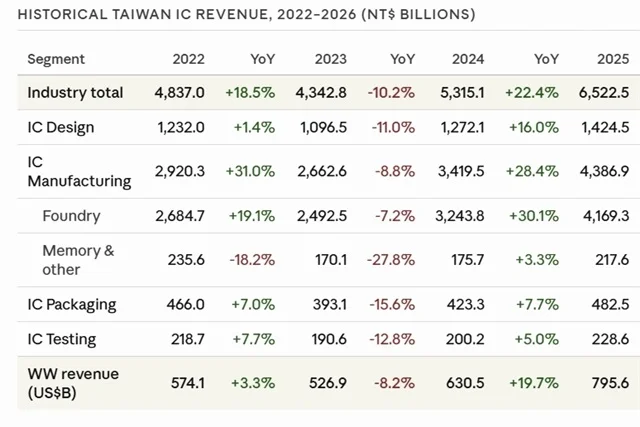
- Bolstered by an insatiable appetite for AI silicon and a structural recovery in the memory market, Taiwan’s integrated circuit industry reported a 29% YoY revenue surge in 1Q26, with annual projections now reaching a historic US$ 270 billion.
Strategic Deep-Dive
Silicon Dominance: Taiwan’s IC Industry Hits New Highs in 1Q26
The first quarter of 2026 will be remembered as a watershed moment for Taiwan’s integrated circuit (IC) industry. According to the latest sector data, the industry generated a staggering NT$ 1.93 trillion (approximately US$ 61.9 billion) in revenue. The 29% year-over-year increase is a testament to the structural shifts in the global computing landscape, where Taiwan serves as the indispensable foundry and memory hub for the AI era.
Deciphering the 29% Revenue Surge
The growth observed in the first quarter was not distributed evenly, but rather concentrated in the sectors most critical to AI infrastructure development:
- Foundry Excellence: The world’s leading foundries based in Taiwan have seen a massive influx of orders for 3nm and 5nm wafers. As hyperscalers race to build proprietary AI silicon and specialized accelerators, the demand for advanced logic nodes has effectively reached a permanent state of high utilization. This has protected margins and driven revenue to unprecedented levels.
- The Memory Renaissance: Perhaps the most dramatic turnaround has occurred in the memory segment. Following a period of cyclical downturn in 2024-2025, the segment is now experiencing a ‘booming rebound.’ This is driven specifically by the integration of High Bandwidth Memory (HBM3E/HBM4) with AI GPUs and the broader transition to DDR5 in server environments. The premium pricing of these advanced memory products has significantly bolstered the sector’s total revenue contribution.
Toward a US$ 270 Billion Milestone
The sheer scale of the 1Q26 performance has forced analysts to revise their full-year projections upward. Current estimates now place Taiwan’s annual IC revenue at over US$ 270 billion for 2026. This projection assumes a sustained demand for AI servers and a gradual recovery in the consumer electronics space, specifically AI-enabled PCs and smartphones.
From a data systems architecture perspective, this revenue surge highlights the massive capital expenditure (CapEx) being funneled into the global computing backbone. Taiwan is effectively the primary beneficiary of the ‘AI Gold Rush,’ providing the ‘picks and shovels’ (chips and memory) that make the software revolution possible. However, the concentration of revenue in high-end nodes and specialized memory also points to a deepening divide between leading-edge manufacturers and those still operating on legacy processes.
As the industry moves into the second half of 2026, the focus will shift from simple capacity to yield optimization and the next generation of 2nm production readiness to sustain this growth trajectory.