🔍 Executive Summary
- 메타렌즈 기술이 스마트 글래스와 머신 비전 분야의 상용화를 위해 개념 증명을 넘어 양산 단계로 진입하고 있습니다. DUV, DLW, NIL 공정이 정밀도와 대량 생산성 사이에서 치열하게 경쟁하는 가운데, 풀컬러 구현의 핵심인 빛의 산란 제어가 상용화의 최종 관문으로 부상했습니다.
Strategic Deep-Dive
The Strategic Pivot from Concept to Consumer AR
Metalens technology is currently traversing a pivotal turning point, transitioning from laboratory proof-of-concept stages to targeted integration in high-performance hardware. The primary drivers for this adoption are smart glasses and machine vision systems, where the demand for extreme miniaturization makes traditional, bulky refractive lens stacks increasingly obsolete. However, a significant technical hurdle remains: “Physical Dispersion.” Because metalenses rely on sub-wavelength nanostructures to manipulate light, maintaining focus across the entire visible spectrum (full-color imaging) is inherently difficult.
This “Chromatic Aberration” issue means that while metalenses are ready for monochromatic sensor applications, their arrival in consumer-grade AR wearables depends on overcoming these dispersive limitations.
Manufacturing Scalability: DUV vs. NIL Precision
The commercial success of metalenses hinges on selecting a manufacturing process that balances nanometer-scale precision with industrial-scale throughput. Deep Ultraviolet (DUV) lithography offers the most immediate path to mass-market adoption by leveraging established semiconductor fabrication ecosystems. In contrast, Nanoimprint Lithography (NIL) is emerging as a disruptive contender, capable of replicating complex 3D nanostructures with high fidelity at a fraction of the cost of advanced photolithography.
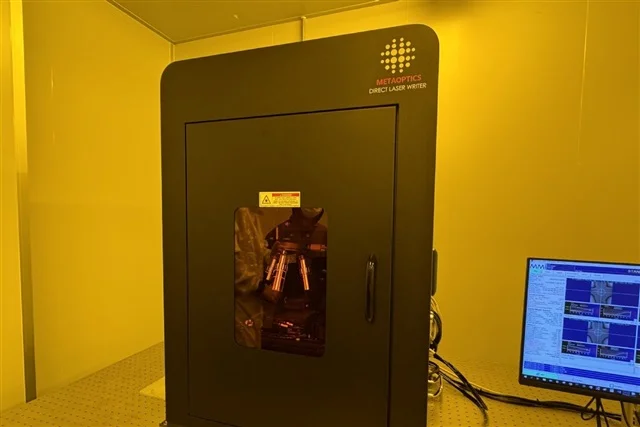
Laser Direct Writing (DLW) remains essential for rapid prototyping and bespoke optical designs. The competition between these three pathways will determine the cost-efficiency of next-generation optical stacks, directly impacting the deployment speed of augmented reality devices in the post-smartphone era.