🔍 Executive Summary
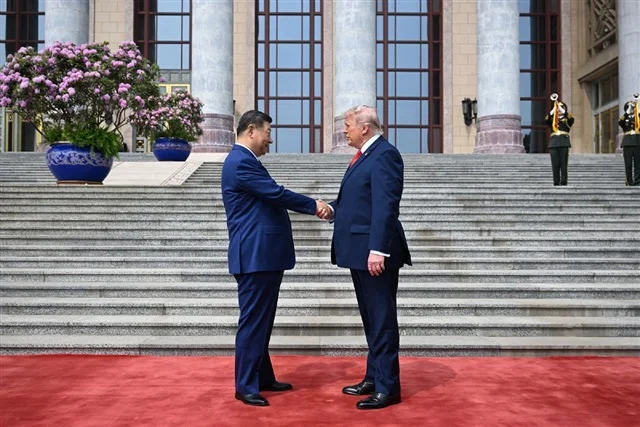
- The recent two-day summit between US and Chinese leaders concluded without a definitive breakthrough regarding AI chip export controls or sensitive technology restrictions. While high-stakes issues like the export of Nvidia H200 GPUs remain unresolved, the two nations successfully negotiated trade-stabilizing measures, including tariff reductions and agricultural commitments, reflecting a calculated move toward managed economic competition.
Strategic Deep-Dive
The latest high-level summit between the US and China underscores the persistent friction in the global technology sector. Despite two days of intensive dialogue, the deadlock over high-performance AI semiconductors remains the defining feature of the bilateral relationship. The US administration continues to prioritize national security by maintaining stringent export controls on advanced nodes and specialized AI hardware, specifically targeting the potential military applications of such technology.
The discussion surrounding the Nvidia H200—the benchmark for modern AI workloads—served as a focal point, yet no concessions were made to ease its distribution within the Chinese market.
However, the summit was not entirely devoid of progress. In a tactical move to prevent a full-scale economic decoupling, both sides agreed on specific ‘cooling’ measures. These include significant Chinese commitments to purchase US agricultural products and a reciprocal agreement to reduce tariffs on select non-strategic goods.
The establishment of a new bilateral framework for ongoing economic communication suggests that both superpowers are seeking a way to compartmentalize technology competition from broader trade relations. This ‘managed competition’ approach allows for the continuation of the AI tech war while stabilizing global markets against sudden trade shocks. For the semiconductor industry, this outcome implies that the status quo of a bifurcated market—one centered around Western-aligned technology and another focusing on Chinese domestic alternatives—will persist for the foreseeable future, requiring multinational firms to maintain complex, dual-track compliance strategies.