🔍 Executive Summary
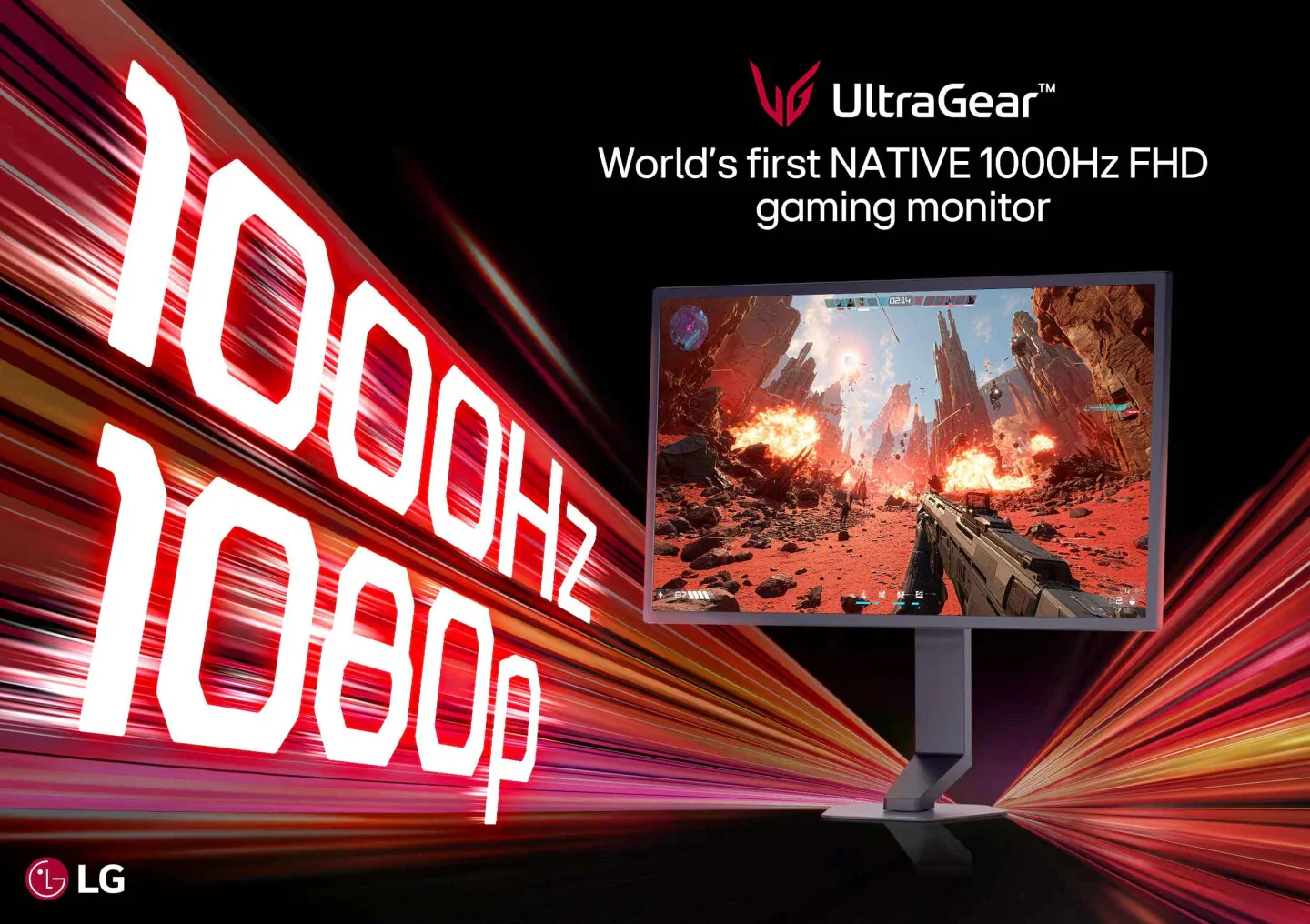
- LG Electronics sets a new technical milestone with the UltraGear 25G590B, delivering a native 1000 Hz refresh rate for unparalleled visual fluidity in professional-grade gaming.
Strategic Deep-Dive
The global gaming display market has witnessed a relentless pursuit of higher refresh rates, evolving rapidly from the 144 Hz standard to the 360 Hz and 540 Hz tiers used by elite esports professionals. LG Electronics has now effectively leapfrogged the competition by introducing the world’s first native 1000 Hz gaming monitor, the LG UltraGear 25G590B. This monumental achievement represents a fundamental shift in display engineering, moving toward a 1-millisecond frame delivery time that virtually eliminates the biological perception of motion blur.
While 540 Hz panels were previously thought to be the apex of human perception, the jump to 1000 Hz provides a distinct advantage in ‘motion persistence’—the clarity of an object as it moves across the screen.
From a technical standpoint, driving a display at 1000 Hz natively involves overcoming massive bandwidth and synchronization hurdles. To achieve this frequency at Full HD (1920 x 1080) resolution, the display controller must process an immense amount of data every second. Even with modern interfaces like DisplayPort 2.1 or HDMI 2.1 utilizing Display Stream Compression (DSC), the raw throughput required is staggering.
LG’s decision to stick with 1080p for the 25G590B is a calculated engineering trade-off. By limiting the pixel count, the monitor ensures that the internal timing controllers (TCON) and the host GPU can maintain the necessary cadence without introducing micro-stutter or frame drops, which are lethal in competitive environments. Furthermore, only at 1080p can current-generation high-end GPUs like the RTX 4090 or the upcoming 50-series hope to reach frame rates approaching the 1000 fps mark in optimized titles like Counter-Strike 2 or Valorant.
The impact on motion clarity cannot be overstated. Standard high-refresh displays still suffer from ‘strobe crosstalk’ or minor ghosting when the pixels cannot transition fast enough to keep up with the frame rate. By utilizing an advanced E-TN (Esports Twisted Nematic) panel, LG has minimized the gray-to-gray (GtG) response times to a level that complements the 1000 Hz cycle.
For a professional player, this means that a target moving rapidly across the peripheral vision remains sharp and trackable, rather than becoming a blurred streak. This level of fidelity provides a measurable reduction in input latency, as the time between a physical mouse movement and the visual representation of that movement is compressed to the absolute physical limit of current hardware. The LG UltraGear 25G590B is not just a peripheral; it is a statement of intent from LG, signaling that they are willing to push the boundaries of physics to provide the ultimate tool for the competitive elite.
As the industry watches, this 1000 Hz milestone will likely spark a new era of ultra-refresh displays, forcing other manufacturers to rethink their panel roadmaps for 2026 and beyond.