🔍 Executive Summary
- The PS5-Linux-loader project reaches a critical milestone by expanding support to firmware 6.02, significantly increasing the number of consoles capable of running custom Linux kernels.
Strategic Deep-Dive
The journey to transform the PlayStation 5 from a locked-down gaming console into a versatile Linux workstation has reached a pivotal juncture. Historically, the ability to run custom kernels on modern consoles has been restricted to a very small set of ‘golden’ machines—consoles that were intentionally kept on original, launch-day firmware to preserve known vulnerabilities. However, the open-source community, organized around the PS5-Linux-loader project on GitHub, has announced a major expansion in support.
The loader now officially supports PlayStation 5 consoles running firmware up to version 6.02. This move significantly increases the total addressable market of mod-capable consoles, as firmware 6.02 was a standard version for a substantial period, encompassing many more units than the early 4.xx firmwares.
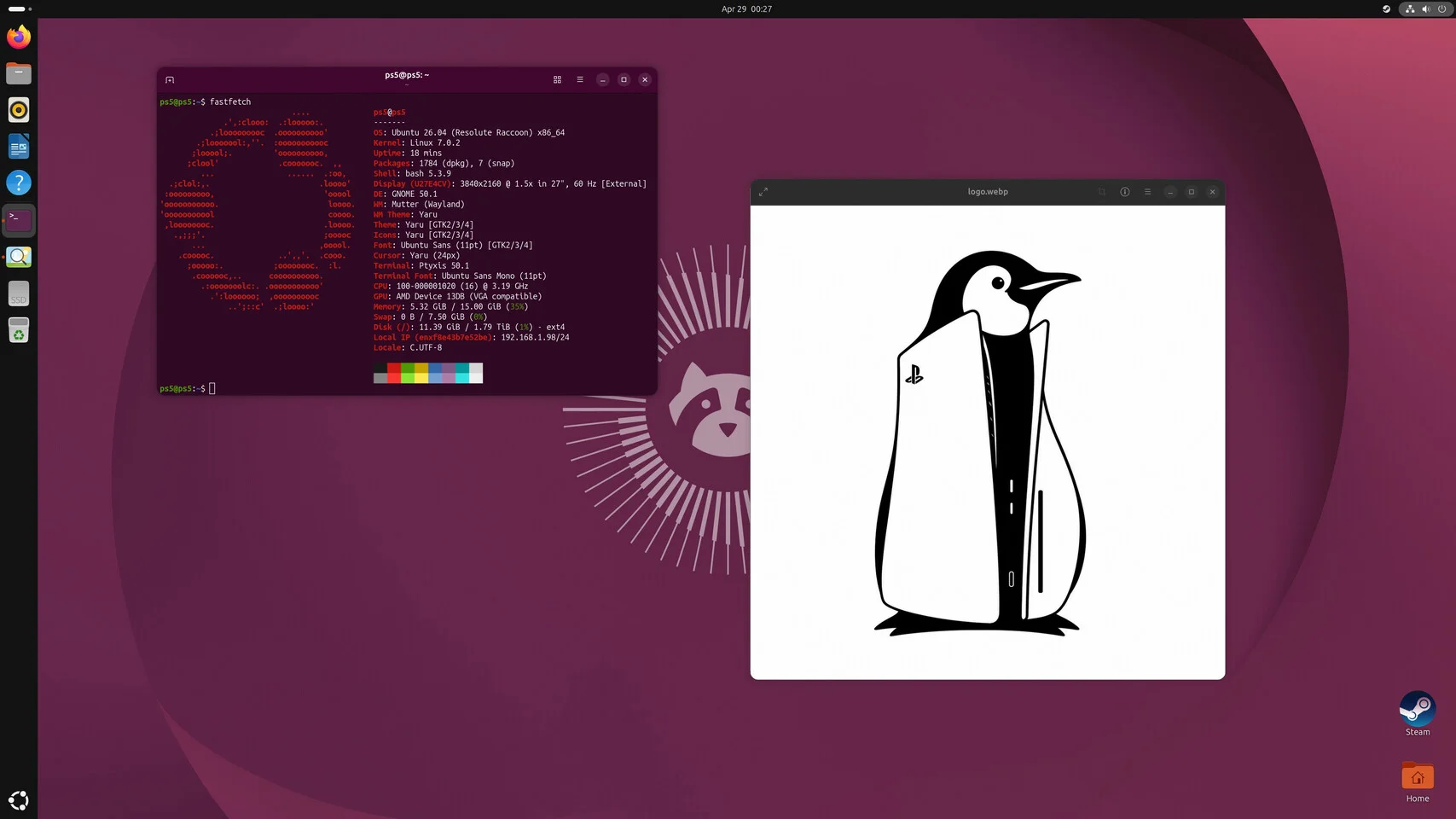
Technically, the PS5-Linux-loader utilizes a sophisticated chain of exploits to bypass Sony’s multi-layered security architecture. Since the PS5 is fundamentally an x86-64 machine powered by a custom AMD ‘Oberon’ SoC (featuring Zen 2 and RDNA 2 architectures), it is theoretically highly compatible with Linux. The challenge lies in the secure boot process and the hypervisor that Sony uses to isolate the game OS.
By leveraging user-land WebKit vulnerabilities and subsequent kernel-level exploits found in firmware 6.02, developers have successfully created a path to inject a Linux bootloader into the system memory. This allows the console to initialize a Linux kernel, giving users direct access to the raw processing power of the 8-core CPU and, to a limited extent, the integrated GPU. This process is a ‘soft mod,’ meaning it requires no hardware disassembly or soldering, making it accessible to a wider range of technical enthusiasts.
The implications of reaching the 6.02 threshold are profound for the homebrew ecosystem. It allows researchers to investigate the PS5’s proprietary hardware components more deeply, potentially leading to better hardware-accelerated drivers for the Linux environment. In the past, similar efforts for the PS4 led to the creation of robust emulation layers and specialized media applications that extended the life of the hardware long after its primary commercial cycle ended.
By breaking the 6.02 barrier, the community has proved that Sony’s security patches, while formidable, are not impenetrable. This cat-and-mouse game between console security engineers and independent researchers continues to drive innovation in the field of cybersecurity and reverse engineering. For the enthusiast owner, a PS5 on firmware 6.02 is no longer just a portal to Sony’s digital storefront; it is now an experimental platform for open-source development and high-performance computing exploration.