🔍 Executive Summary
- The introduction of Ultra-Wideband (UWB) technology was heralded as the definitive solution to the inherent inaccuracies of Bluetooth-based tracking. While Bluetooth Low Energy (BLE) has served as the backbone for proximity services for over a decade, its reliance on Received Signal Strength Indicator (RSSI) makes it notoriously unreliable in complex indoor environments where signal multipath interference is common. In contrast, UWB utilizes Time of Flight (ToF) and Angle of Arrival (AoA) measurements across a wide 500MHz spectrum, enabling spatial awareness with centimeter-level precision. Ho...
Strategic Deep-Dive
The introduction of Ultra-Wideband (UWB) technology was heralded as the definitive solution to the inherent inaccuracies of Bluetooth-based tracking. While Bluetooth Low Energy (BLE) has served as the backbone for proximity services for over a decade, its reliance on Received Signal Strength Indicator (RSSI) makes it notoriously unreliable in complex indoor environments where signal multipath interference is common. In contrast, UWB utilizes Time of Flight (ToF) and Angle of Arrival (AoA) measurements across a wide 500MHz spectrum, enabling spatial awareness with centimeter-level precision.
However, despite these technical superiorities, the Android ecosystem has reached a strategic impasse, effectively ignoring UWB for its ‘Find My Device’ (FMD) network in favor of legacy-compatible but lower-fidelity solutions.
From a senior analyst’s perspective, this ‘on purpose’ neglect is driven by a convergence of hardware economics and emerging alternative standards. Integrating high-quality UWB silicon, such as the NXP SR150 or Qorvo’s DW3000 series, adds significant Bill of Materials (BOM) costs and requires complex antenna designs that compete for space in increasingly crowded smartphone internal architectures. Furthermore, the Bluetooth Special Interest Group (SIG) has recently introduced Bluetooth 5.4 Channel Sounding, a feature that mimics UWB’s distance measurement capabilities using phased-based ranging.
For many Android OEMs, BLE 5.4 represents a ‘good enough’ compromise that avoids the fiscal and physical overhead of dedicated UWB hardware, even if it lacks the sophisticated spatial security and sub-decimeter accuracy of UWB.
Google’s role in this stagnation is equally pivotal. While Apple has achieved a seamless vertical integration with its U1 and U2 chips—creating a massive, unified network of UWB-enabled devices—Google must manage a fragmented sea of hardware from dozens of manufacturers. The current Android FMD API is designed for the lowest common denominator, which is Bluetooth.
This creates a chicken-and-egg dilemma: third-party tracker manufacturers like Tile or Pebblebee are hesitant to invest in UWB hardware when only a tiny fraction of flagship Android devices (mostly from Samsung or Google) can actually utilize the signal for precision finding.
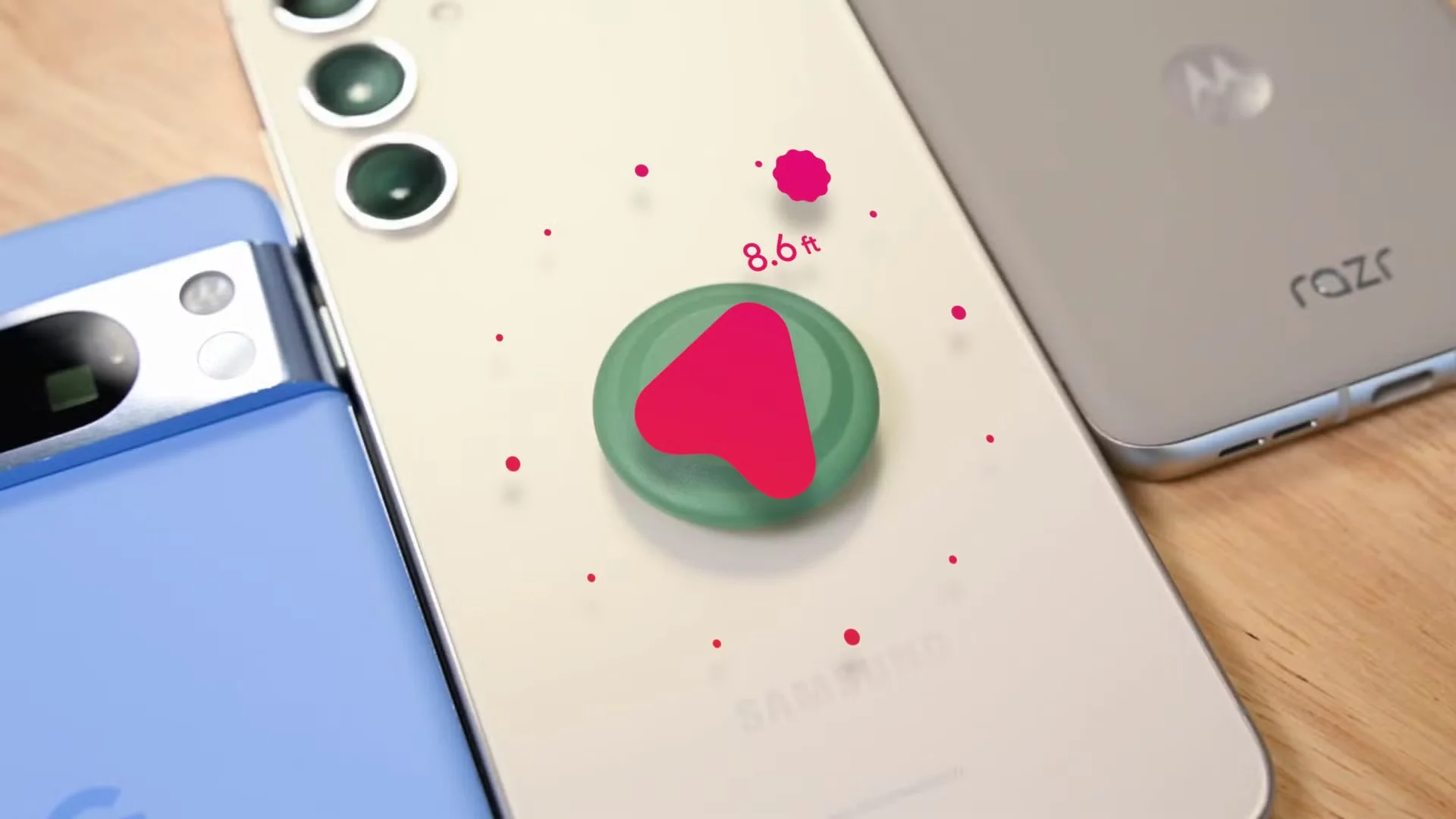
Ultimately, the technical implications of this decision are profound. By failing to mandate or incentivize UWB integration, the Android ecosystem is sacrificing a transformative user experience—the ‘directional arrow’ navigation—for the sake of broad market reach. This strategic choice reinforces the perception that Android is a platform defined by hardware fragmentation rather than unified innovation.
As long as Google prioritizes backward compatibility over high-fidelity spatial computing standards, Apple’s AirTags will remain the benchmark for the category, leaving Android users with a tracking experience that is functionally adequate but technologically outdated. The neglect of UWB is a calculated move that highlights the friction between cutting-edge hardware potential and the harsh realities of mass-market Android distribution.